Analyzing a 2026 Salary Cap Fantasy Football Mock Draft (July)

 Make us preferred on Google
Across the broad spectrum of fantasy formats available in the modern day, few are harder to strategize and practice for than salary cap drafts. Every salary cap draft is different; their flow and outcome are heavily dictated by the managers in your league, and one or two moves can completely change the landscape of your roster in ways that they simply would not in typical snake drafts.
As such, when analyzing a single salary cap mock draft — like we're going to do below — it’s rarely useful to identify specific takeaways or strategic angles with the goal of applying them carte blanche to your real draft this summer.
Instead, salary cap mocks are best used for a few specific purposes.
1. Practice. While it may not “make perfect” in fantasy football, practice will “make better.”
2. Comfort. The greatest danger in salary cap drafts is overreacting, panicking, or generally losing your cool. It’s a slippery slope that will lead to more mistakes. So being comfortable and familiar with the ups and downs of the format is crucial.
3. Exposure. Salary cap drafts can go so many different directions (so quickly) that learning all the possible avenues means you’re less likely to get backed into a corner on draft day.
With all this context in mind, we’re going to dive into a 12-team salary cap draft, undertaken in mid-July, to help provide you with some “film” to study the inner workings of the format.
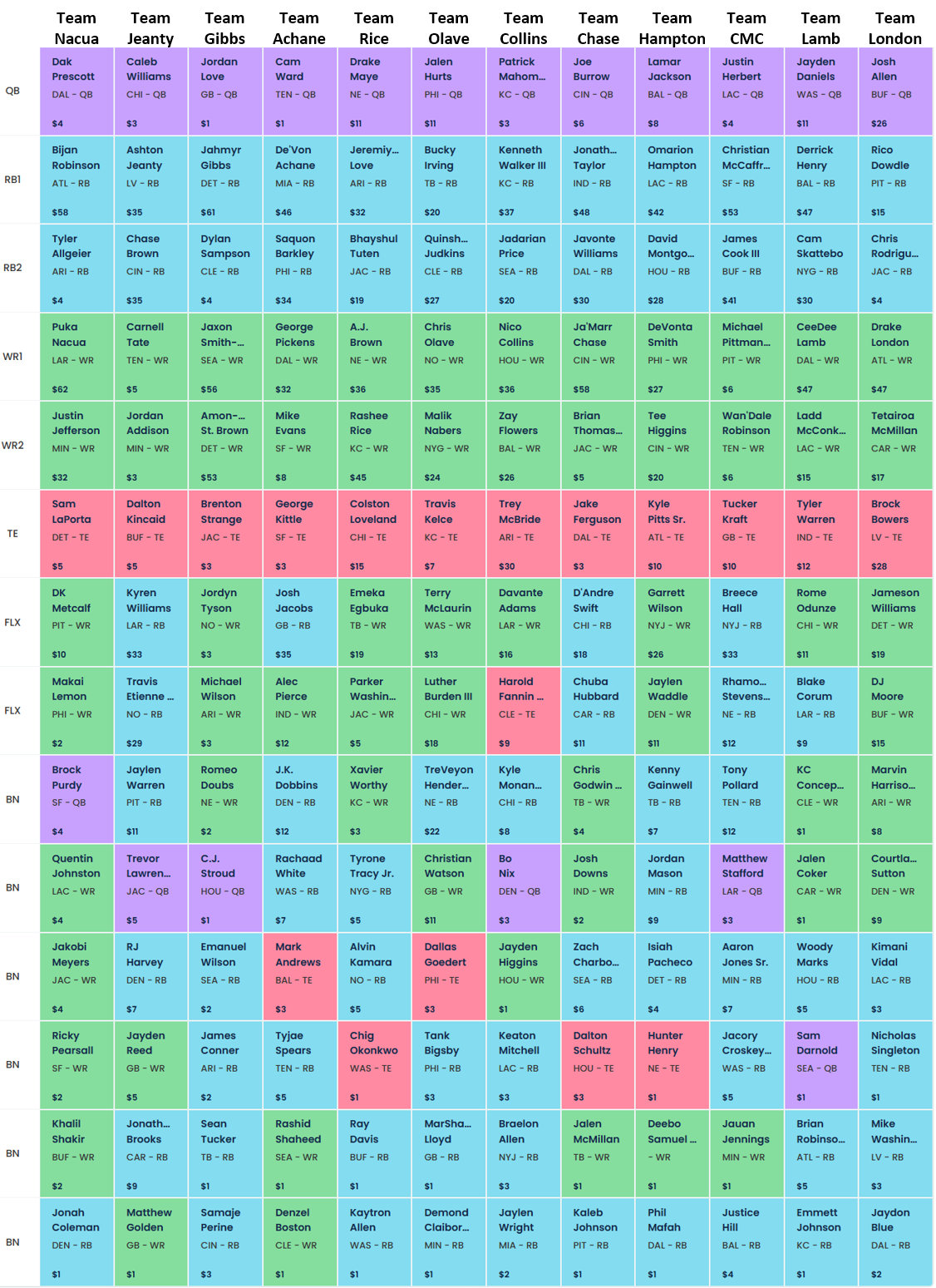
For settings, we went with a pretty typical roster setup — QB, RB, RB, WR, WR, TE, two FLEX spots, and six bench spots — half-PPR scoring, and a $200 salary cap. You can scan the full draft results at the end of the article, and get the “film analysis” in between. Also, to make things a little easier to follow this year, I've named each team by their "star" player, rather than a generic number!
Let's get into it.
Roster Construction
Studs & Scrubs
Two teams in the draft truly executed the "Studs & Scrubs" approach in this mock, sinking at least three-quarters of their budget into their top three players. Team Gibbs might have pulled off the most extreme version of this strategy I've ever seen, spending $170 of their $200 cap on those top three players.
| Team Nacua | Team Gibbs |
|---|---|
| WR Puka Nacua ($62) | RB Jahmyr Gibbs ($61) |
| RB Bijan Robinson ($58) | WR Jaxon Smith-Njigba ($56) |
| WR Justin Jefferson ($32) | WR Amon-Ra St. Brown ($53) |
The Studs & Scrubs salary cap strategy is perhaps one of the most exhilarating in all of fantasy football, as you can land an absolutely absurd nucleus of superstars that would be impossible in a snake draft. According to 4for4's Multi-Site ADP, Team Nacua drafted three Round 1 picks, and Team Gibbs somehow managed to draft three top-seven picks. That's obviously bonkers, and unimaginable to the snake-draft enthusiasts who've never dabbled in the salary cap streets.
Of course, there is a tradeoff for this type of "all-in" approach. After landing their monster trio, Team Gibbs had just $30 left for the remaining 14 spots on their roster. Essentially $2 per player. To put this into even starker perspective, a more "balanced" squad like Team Olave — who spent just $86 on their top three players — had $114 remaining for the rest of the roster, nearly four times the post-studs budget of Team Gibbs. Four of Team Nacua's projected starters and five of Team Gibbs' projected starters went for $5 or fewer. Team Olave doesn't have a single starter valued below $7.
As a result, the depth on these Studs & Scrubs rosters is...questionable at best. Team Nacua is rocking with Tyler Allgeier as their RB2, and their next-best back is Denver rookie Jonah Coleman. Yikes. Team Gibbs has Dylan Sampson at RB2, Brenton Strange at tight end, and both Jordyn Tyson and Michael Wilson projected to start in the FLEX spots. Are their studs enough to carry their balance of scrubs? Maybe. In last year's version of this column, one of the Studs & Scrubs teams picked up incredible values in Chris Olave for $4, Tetairoa McMillan for $5, and Dak Prescott for $3 to pair with their Bijan Robinson-Saquon Barkley-Derrick Henry super-trio at running back. Unofficially, that team probably won the league.
Regardless, these sorts of strategies are what make salary cap drafts so intriguing. And this is a perfect example of what mock drafts can offer: a glimpse of the glory you can achieve up top ... and the grime it leaves you with down below.
Balance, Balance, Balance
In this mock, two teams picked up at least six players for between $10 and $30 to form what I consider the "Balanced" roster strategy (excluding Team London, for reasons you'll read about below). Team Olave — mentioned above — was the clear standout, as their biggest spend was Olave at $35, while their "cheapest" starter was Travis Kelce at $7, and they landed three running backs and five wideouts at more than $10 apiece. Team Hampton also took a balanced approach, with every player besides Hampton ($42) costing fewer than $30 and Lamar Jackson constituting their cheapest starter at $8 (not cheap for a QB).
| Team Olave | Team Hampton |
|---|---|
| RB Quinshon Judkins ($27) | RB David Montgomery ($28) |
| WR Malik Nabers ($24) | WR DeVonta Smith ($27) |
| RB Bucky Irving ($20) | WR Garrett Wilson ($26) |
| RB TreVeyon Henderson ($22) | WR Tee Higgins ($20) |
| WR Luther Burden III ($18) | WR Jaylen Waddle ($11) |
| WR Terry McLaurin ($13) | TE Kyle Pitts Sr. ($10) |
| WR Christian Watson ($11) | |
| QB Jalen Hurts ($11) |
For further perspective, by saving money at the top, Team Olave ended up with multiple bench players — TreVeyon Henderson and Christian Watson — who are currently being drafted in the fifth or sixth round by ADP. Similarly, Team Hampton landed seven starters who are currently being drafted in the first four rounds, with the only exception being tight end Kyle Pitts (7.08 ADP), who I like as a top-four tight end a couple rounds ahead of his current ADP. For additional context, Team Hampton spent $4 on their third-most expensive bench asset, Isiah Pacheco ... the same cost as Team Nacua and Team Gibbs's starting RB2s, Allgeier and Sampson, who are also going in the same range as Pacheco in snake drafts.
And of course, just because these players didn't cost an arm and a leg doesn't mean they can't be superstars-at-a-discount. The "Balanced" team in last year's column got Jaxon Smith-Njigba for just $26 and also landed eventual RB23 Zach Charbonnet for just $5. On the two teams above, I could easily see a half-dozen players finishing top-12 at their positions, with names like Nabers, Judkins, and Pitts carrying elite upside.
Position Pirates
A couple of teams indexed very heavily into a single position, putting together some formidable RB or WR rooms, while poaching those players from other teams in need. Another wrinkle of salary cap drafts is that you can pull this off more aggressively, since you don’t have to rely on the “right guys” being on the board when the snake returns to you, but can pay what you want, for who you want, whenever you want.
At running back, Team Jeanty, Team Achane, and Team CMC stand out, as each spent more than two-thirds of their budget on the position. Notably, Team Jeanty landed four backs worth at least $29, while Team CMC spent 83.5% of their total cap on RBs. From an ADP perspective, Team Jeanty picked up four of the top 17 running backs, all of whom are going inside the first three rounds.
| Team Jeanty | Team Achane | Team CMC |
|---|---|---|
| Ashton Jeanty ($35) | De'Von Achane ($46) | Christian McCaffrey ($53) |
| Chase Brown ($35) | Josh Jacobs ($35) | James Cook ($41) |
| Kyren Williams ($33) | Saquon Barkley ($34) | Breece Hall ($33) |
| Travis Etienne ($29) | J.K. Dobbins ($12) | Rhamondre Stevenson ($12) |
| Jaylen Warren ($11) | Rachaad White ($7) | Tony Pollard ($12) |
| Jonathon Brooks ($9) | Tyjae Spears ($5) | Aaron Jones Sr. ($7) |
| RJ Harvey ($7) | Jacory Croskey-Merritt ($5) | |
| Justice Hill ($4) | ||
| Total: $159 | Total: $139 | Total: $167 |
Unsurprisingly, all three teams are rather thin elsewhere. There's only one receiver between all three teams who cost more than $12 — George Pickens at $32 for Team Achane — and Teams Jeanty and CMC each spent less on all their wideouts combined than they did on just their RB3. Team CMC spent $10 on Tucker Kraft, but all three squads spent fewer than $5 on their quarterback. Jordan Addison, Mike Evans, and Wan'Dale Robinson are the three WR2s on these three rosters.
Meanwhile, Team Nacua was the only team to go truly bananas at the wide receiver position, landing eight wideouts across 14 draft rounds and spending $118 on the position in total. Team London did spend $115 on six receivers, which put them close to cracking this section, but no other manager drafted more than five WRs. This is a pretty notable departure from last season's iteration of this piece, where two teams spent $136 and $149 on wide receivers ... possibly a sign of shifting sentiment at the position.
| Puka Nacua ($62) |
|---|
| Justin Jefferson ($32) |
| DK Metcalf ($10) |
| Quentin Johnston ($4) |
| Jakobi Meyers ($4) |
| Makai Lemon ($2) |
| Ricky Pearsall ($2) |
| Khalil Shakir ($2) |
| Total: $118 |
As we mentioned early, this approach left Team Nacua with Tyler Allgeier at RB2 and Jonah Coleman at RB3. Risky, to say the least.
Team London also deserves a special shoutout here, which is why I left them out of the Balanced section above. They spent $26 on Josh Allen and $28 on Brock Bowers. It's not a single position, but Team London dedicated a significant portion of their budget to "the onesies," quarterback and tight end, giving them a unique positional advantage as long as those two players live up to expectations. For reference, while Team London spent $54 on QB and TE, no other team spent more than $33 combined, and only two other teams dropped double-digit dollars on each of QB and TE — Team Rice, with $11 on Drake Maye and $15 on Colston Loveland, and Team Lamb, with $11 on Jayden Daniels and $12 on Tyler Warren.

The “Classic” Build
If you’re wondering what happened with Teams Rice, Collins, Chase, and Lamb, they each went for some variation of what I'd consider the “Classic" build:
- Top two RBs: Roughly even split of 30% of budget
- Top two WRs: Roughly even split of 30% of budget
- QB: Decent spend for an upper-tier option
- TE: Decent spend on an elite option
- Top two FLEX: Roughly 10-15% of budget
- Bench: Roughly 7-10% of budget
There are some departures within this loose criteria, of course. Team Rice indexed more heavily into wide receiver. Team Collins went cheaper with Patrick Mahomes at QB (for $3), while spending a position-high $30 on Trey McBride. Team Chase took a budget tight end in Jake Ferguson and only spent $5 on their WR2 (Brian Thomas Jr.). Team Lamb was probably the most "cookie-cutter" version of this strategy, so eyeball that roster for your "run-of-the-mill" salary cap approach.
Valuation Evaluation
If all of the above was a review of where managers spent their salary cap, what about the values they assigned when they spent those dollars? Did the manager who dropped $26 on Josh Allen — more than double the next most expensive quarterback — strike gold or sink their own ship? Is Michael Pittman Jr. really worth just a tenth of Puka Nacua or Ja'Marr Chase?
The first thing to note is that valuations can vary wildly from draft to draft, typically far more than in snake drafts (unless we’re talking about your family league in Kansas City, where Travis Kelce goes in the first round to your diehard-Swiftie cousin). While players will sometimes go a little earlier than ADP in run-of-the-mill snake drafts, that’s typically because one manager makes a move, leaving the rest of the league with no recourse or response. In salary cap drafts, if two managers really want the same guy, the resulting bidding war can break banks in the blink of an eye. And conversely, if you nominate a mid-round sleeper while the sharps in your league are distracted, you might snag a player for $1 that should have cost five or 10 times that.
All that being said, we can identify some interesting “highlights” in this “film analysis” of a mock draft, that should help expose you to the types of values you’re likely to see.
Running Back Inflation and Wide Receiver Savings
As we've seen in previous versions of this column, the shallow and top-heavy nature of the running back position tends to result in more overpays at RB and more discounts at WR. Here are a few examples of backs and wideouts going right next to each other in snake draft ADP, who saw significant gaps in salary cost in this mock.
- Justin Jefferson (1.11 / $32) versus De'Von Achane (2.01 / $46)
- A.J. Brown (2.08 / $36) versus Derrick Henry (2.09 / $47)
- DeVonta Smith (3.03 / $27) versus Kyren Williams (3.07 / $33)
- Malik Nabers (3.09 / $24) versus Josh Jacobs (3.12 / $35)
- Jaylen Waddle (4.08 / $11) versus Cam Skattebo (4.07 / $30)
You'll notice that all the running backs mentioned above currently sit between RB7-RB19 in ADP ... after the mega-elites like Gibbs, Robinson, McCaffrey, and Taylor, and ever closer to the "cliff" at which "NFL RB1" quickly gives way to committees. As that cliff approaches, managers are going to be much more likely to overspend as they try to snag one of the last available "workhorses."
For perspective, consider Team Lamb and the $77 they spent on Henry and Skattebo, leaving them with Ladd McConkey at WR2, and Rome Odunze and Blake Corum in their FLEX spots. Had they instead gone with a more "discounted" duo like Bucky Irving ($20) and D'Andre Swift ($18) at the salaries they demanded, they could have used that savings to get Justin Jefferson at WR2 ($32) and Jaylen Waddle at WR3 ($11). Here’s a look at the actual squad and the hypothetical squad, with current ADPs included.
| Actual Roster (ADP / Cost) | Hypothetical Roster (Cost / ADP) |
|---|---|
| RB1 Derrick Henry (2.09 / $47) | RB1 Bucky Irving ($20 / 5.07) |
| RB2 Cam Skattebo (4.07 / $30) | RB2 D'Andre Swift ($18 / 5.01) |
| WR2 Ladd McConkey (4.06 / $15) | WR2 A.J. Brown ($36 / 2.08) |
| FLEX Rome Odunze (6.02 / $11) | FLEX DeVonta Smith ($27 / 3.03) |
| FLEX Blake Corum (9.03 / $9) | FLEX Jaylen Waddle ($11 / 4.08) |
| $112 total / 5.05 Average ADP | $112 total / 4.03 Average ADP |
Are the starting RBs worse on paper? Of course. But on average, each pick on the hypothetical roster ends up being worth a little more than a round of ADP ahead of the actual roster. Obviously, Team Lamb couldn't have known every possible discount that would be available in this mock, but still ... it's hard not to prefer the hypothetical WR-focused version in this scenario.
Quarterback Discounts
Note: All of the following applies to one-QB leagues. In Superflex or two-QB formats, this all goes out the window.
We mentioned it earlier when highlighting the $26 Josh Allen pick ... every single QB besides Allen went for $11 or fewer. That's right, Drake Maye, Jayden Daniels, and Jalen Hurts for $11, with Lamar Jackson clocking in at just $8, Joe Burrow at just $6, and Caleb Williams at just $3. On the one hand, I do believe Allen is a cheat code in fantasy, and he is going nearly two rounds ahead of Jackson, and more than two rounds ahead of everyone else in snake draft ADP. So I respect the spend from Team London.
On the other hand, as with the "late-round QB" strategy you can apply in snake drafts, there is pretty significant value to be potentially gained by going cheaper on the NFL's most important position. Team Nacua got Dak Prescott ($4) for the same price as Jakobi Meyers, who's going two rounds later in snake draft ADP. Team Chase got Joe Burrow ($6) for the same price as Zach Charbonnet, who's going nearly 80 picks later. And Team Jeanty got Caleb Williams ($3) for a dollar fewer than they got Dylan Sampson ($4) ... who's going more than 100 picks later.
Weighing the Costs
At the intro to this section, I asked whether Michael Pittman Jr. should really be worth just a tenth of Puka Nacua or Ja'Marr Chase? As an exercise, let's look at some of the highest-priced players against a package of lesser players that cost about the same in total. You be the judge of whether you would make these "trades" in a league.
- Puka Nacua ($62) versus ... Ashton Jeanty ($35) and Zay Flowers ($26)
- Bijan Robinson ($58) versus ... Jeremiyah Love ($32), Tee Higgins ($20), and Joe Burrow ($6)
- Drake London ($47) versus ... Emeka Egbuka ($19), Tetairoa McMillan ($17), and Jaylen Waddle ($11)
- James Cook III ($41) versus ... D'Andre Swift ($18), Luther Burden III ($18), and Carnell Tate ($5)
- Trey McBride ($30) versus ... DeVonta Smith ($27) and George Kittle ($3)
How do you feel about these comparisons, and others like them that you can put together using the full draft table below? Do you prefer the elite star or the package? Your instinct might tell you which type of strategy you want to take when approaching a salary cap draft.
The Bottom Line
- No one strategy or roster construction necessarily reigns supreme. One of the highlights of salary cap drafts is that you can build the team you want to build (within reason), and we saw the full range of approaches in this mock.
- With the scarcity and tier drops at running back, we may see some price inflation at the position in 2026. That said, it’s more important to monitor the trends in your actual draft than to apply the runout of this mock across the board.
- It pays big to identify where premiums are being posted and to avoid those traps. If there’s a flurry of overpays on a position in your draft, don’t feel compelled to follow the crowd out of fear. Instead, pivot to the resulting values elsewhere.