2026 Fantasy Football Rankings - PPR
| Rank | Player | Team | BYE | Position-Rank | FF Pts | VOR | ADP ( Average ) | ADP Dif ( Average ) | ADP (BB10s) | ADP Dif (BB10s) | ADP (CBS) | ADP Dif (CBS) | ADP (Drafters) | ADP Dif (Drafters) | ADP (ESPN) | ADP Dif (ESPN) | ADP (Fantrax) | ADP Dif (Fantrax) | ADP (FFPC) | ADP Dif (FFPC) | ADP (NFFC) | ADP Dif (NFFC) | ADP (NFL) | ADP Dif (NFL) | ADP (Sleeper) | ADP Dif (Sleeper) | ADP (Underdog) | ADP Dif (Underdog) | ADP (Y!) | ADP Dif (Y!) | ADP (Superflex) | ADP Dif (Superflex) | ADP (FFPC SF) | ADP Dif (FFPC SF) | ADP (Sleeper SF) | ADP Dif (Sleeper SF) | GC | GC Dif |
|---|---|---|---|---|---|---|---|---|---|---|---|---|---|---|---|---|---|---|---|---|---|---|---|---|---|---|---|---|---|---|---|---|---|---|---|---|---|---|
| 1 | Jahmyr Gibbs
Draft Note
Gibbs has finished as the RB3 and RB4 in back-to-back seasons, putting together one of the most consistent two-year runs at the position. His production is built around pre-contact efficiency–his YBC/Att ranks at the 95th percentile, stemming from Detroit's zone-running scheme and his ability to hit gaps quickly. He's less effective once contact arrives (20th-percentile YAC/Att), so the offense needs to keep creating clean looks for him, and it likely will. His receiving ability is elite–his route grade (97th percentile) and target share (96th percentile) rank among the best at the position, and his 1.67 YPRR underscores how efficiently he converts catches into yardage. The opportunity picture looks improved entering 2026. Detroit has 161 vacated RB carries–5th-most in the NFL–including 16 vacated carries inside the five. With David Montgomery out and Isiah Pacheco stepping in as the handcuff, Gibbs could absorb more of that red-zone and overall touch volume.
| DET | 6 | RB-1 | 318.6 | 181 | 1 | 0 | 0 | -1 | 1 | 0 | 1 | 0 | 1 | 0 | 1 | 0 | 1 | 0 | 1 | 0 | 0 | -1 | 1 | 0 | 1 | 0 | 3 | 2 | 1 | 0 | 1 | 0 | 1 | 0 | 1 | 0 |
| 2 | Bijan Robinson
Draft Note
Robinson has quietly been one of the more consistent backs in the league, finishing RB4 and RB3 in back-to-back seasons. What sets him apart is the receiving profile–he led all running backs in YPRR (99th percentile) and ranked 2nd in targets (97th percentile), posting 79 catches for 820 yards and four scores. As a rusher he's well-rounded–97th-percentile elusive rating, 85th-percentile YBC/Att–without a glaring weak spot. Atlanta enters 2026 with 143 vacated RB carries, 6th-most in the NFL–via Tyler Allgeier’s departure, though Brian Robinson will replace him–so there's a chance Bijan’s touch volume grows. A high-floor, high-ceiling RB1.
| ATL | 11 | RB-2 | 312.9 | 175 | 2 | 0 | 0 | -2 | 2 | 0 | 2 | 0 | 2 | 0 | 2 | 0 | 2 | 0 | 2 | 0 | 0 | -2 | 2 | 0 | 2 | 0 | 16 | 14 | 2 | 0 | 3 | 1 | 2 | 0 | 2 | 0 |
| 3 | Jonathan Taylor
Draft Note
Taylor finished as the RB2 in half-PPR formats in 2025, trailing only Christian McCaffrey. After an injury-shortened 2024 that dropped him to RB14 in 13 games, he returned with a full workload and validated his standing as a top-tier bell cow. The efficiency leans heavily on what he does after contact–his YAC/Att ranked at the 88th percentile among qualified backs. His 82nd-percentile PFF run grade confirms he's operating at an above-average level as a runner even when the blocking isn't generating much pre-contact space (57th-percentile YBC/Att). The receiving role is solid but not spectacular–54 targets, 46 catches, 378 yards–enough to support his half-PPR ceiling without driving it. A locked-in workhorse with elite after-contact traits. Draft him as a high-floor RB1.
| IND | 13 | RB-3 | 290.4 | 152 | 5 | 2 | 0 | -3 | 5 | 2 | 8 | 5 | 6 | 3 | 7 | 4 | 8 | 5 | 8 | 5 | 0 | -3 | 5 | 2 | 8 | 5 | 24 | 21 | 9 | 6 | 11 | 8 | 8 | 5 | 8 | 5 |
| 4 | Jaxon Smith-Njigba
Draft Note
Every meaningful receiver metric points in the same direction with JSN. He led all wide receivers in ESPN OPEN score (100th percentile) and ranked 98th in OVERALL, and his PFF route grade (99th percentile) and YPRR (3.62, 99th percentile) were both at the top of the sample. The production matched: 119 receptions, 1,793 yards, and 10 touchdowns in 2025–a WR2 overall finish at 18.1 points per game. He also added an 82nd-percentile contested catch rate, which tells you he's not just a soft-route slot receiver who needs clean looks to function. Sam Darnold is a minor concern at quarterback–93rd percentile CPOE sounds great until you see the 14 interceptions–but Darnold got the job done last year and JSN is the rare receiver whose separation ability is good enough to overcome questionable quarterback play. He's going as the WR3 overall, and the metrics justify it.
| SEA | 11 | WR-1 | 308.8 | 145 | 4 | 0 | 0 | -4 | 6 | 2 | 5 | 1 | 5 | 1 | 6 | 2 | 6 | 2 | 5 | 1 | 0 | -4 | 8 | 4 | 5 | 1 | 28 | 24 | 6 | 2 | 8 | 4 | 6 | 2 | 5 | 1 |
| 5 | Amon-Ra St. Brown
Draft Note
Consistency is St. Brown's defining trait. He's finished WR3 overall in back-to-back seasons–15.4 and 15.5 points per game–without a single significant injury. He does it with a 99th-percentile ESPN OPEN score and a 98th-percentile PFF route grade, getting open against coverage as cleanly as anyone in football. The 95th-percentile YPRR backs up the separation, and 11 touchdowns last season in an offense that doesn't lack for weapons (Jahmyr Gibbs, Sam LaPorta, Jameson Williams) shows just how embedded he is in Detroit's red zone plan. Going as the WR4 with a late-first/early-second ADP, he's priced fairly for a player who should be drafted with confidence that he’ll deliver WR1 production.
| DET | 6 | WR-2 | 287.2 | 123 | 3 | -2 | 0 | -5 | 8 | 3 | 6 | 1 | 8 | 3 | 8 | 3 | 7 | 2 | 6 | 1 | 0 | -5 | 7 | 2 | 7 | 2 | 2 | -3 | 10 | 5 | 10 | 5 | 10 | 5 | 6 | 1 |
| 6 | Christian McCaffrey
Draft Note
McCaffrey finished as the RB1 in half-PPR formats in 2025, but the caveat is significant–he appeared in just four games in 2024. When healthy, his production is driven almost entirely by the passing game. He led all running backs in targets (121) and route grade (99th percentile among qualified RBs), while ranking 3rd in YPRR (96th percentile)–a profile that sets him apart from traditional workhorses. The rushing efficiency tells a different story: his run grade (14th percentile) and YAC/Att (9th percentile) are well below average, suggesting he's no longer the same threat between the tackles. However, given his receiving, the upside is the weekly RB1 ceiling when healthy.
| SF | 8 | RB-4 | 291.7 | 154 | 11 | 5 | 0 | -6 | 7 | 1 | 7 | 1 | 7 | 1 | 5 | -1 | 5 | -1 | 7 | 1 | 0 | -6 | 4 | -2 | 6 | 0 | 103 | 97 | 7 | 1 | 7 | 1 | 7 | 1 | 7 | 1 |
| 7 | James Cook
Draft Note
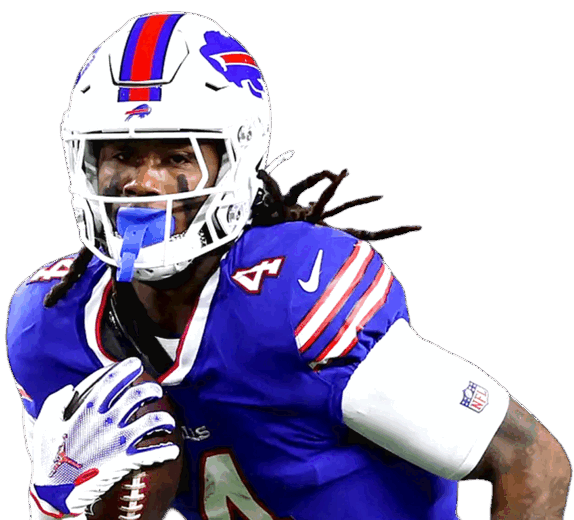
Cook has finished RB8 and RB6 the last two seasons, and the profile is consistent: a workhorse who benefits enormously from Buffalo's offensive line. His 92nd-percentile YBC/Att reflects as much scheme and blocking as it does Cook himself, though his 85th-percentile PFF run grade confirms he's holding up his end. He's not a huge factor in the passing game (39 targets, 33 catches), but no one can argue with his workload.
| BUF | 7 | RB-5 | 243.3 | 105 | 6 | -1 | 0 | -7 | 9 | 2 | 9 | 2 | 10 | 3 | 9 | 2 | 9 | 2 | 9 | 2 | 0 | -7 | 9 | 2 | 10 | 3 | 14 | 7 | 12 | 5 | 13 | 6 | 11 | 4 | 9 | 2 |
| 8 | Puka Nacua
Draft Note
Nacua led all receivers in ESPN OVERALL score (100th percentile) and was 99th in OPEN, and his PFF route grade (100th percentile) and YPRR (3.71, 100th percentile) were both the best in the entire sample. He backed it up: 129 receptions, 1,715 yards, 10 touchdowns, and a WR1 overall finish at 19.3 points per game in 2025. He also had a 91st-percentile contested catch rate and 86th-percentile YAC per reception, making him effective at every phase of the route. Two flags on his profile is the durability history–he played 11 games in 2024 before returning for a full 2025–and Matthew Stafford's age. Both are real risks, but Stafford was elite last season (91st-percentile EPA) and Nacua's separation ability means he doesn't require elite quarterback play to produce. The other outstanding issue is a potential suspension, though it sounds as it it may be a short one if it comes at all, per Adam Schefter. He's going as the overall WR2, and the metrics make it very difficult to argue with, despite the red flags.
| LAR | 11 | WR-3 | 300.6 | 137 | 10 | 2 | 0 | -8 | 4 | -4 | 4 | -4 | 4 | -4 | 4 | -4 | 4 | -4 | 4 | -4 | 0 | -8 | 6 | -2 | 4 | -4 | 116 | 108 | 5 | -3 | 6 | -2 | 5 | -3 | 4 | -4 |
| 9 | Kenneth Walker
Draft Note
Walker produced a 97th-percentile run grade in 2025, second-best among qualified backs, so the talent is real. The problem in Seattle was opportunity–221 carries, five touchdowns, while sharing the backfield with Zach Charbonnet. Kansas City represents a significant change in scenery: the Chiefs enter 2026 with 288 vacated RB carries, the most of any team in the NFL, clearing the runway for a genuine workhorse role. The concern is the blocking environment. KC's run-block win rate fell from 7th to 25th last season, and the team was a net loser in offensive line spending this offseason with no early-round picks. Creed Humphrey remains an elite center, but run blocking was a weakness last year and it really didn't get addressed. Walker's elite elusiveness (89th-percentile elusive rating, 88th-percentile broken-tackle rate) gives him a chance to generate on his own, which is probably why the Chiefs went after him. He’s a high-upside RB2 with some environment risk.
| KC | 5 | RB-6 | 225.3 | 87 | 8 | -1 | 0 | -9 | 16 | 7 | 14 | 5 | 22 | 13 | 16 | 7 | 14 | 5 | 16 | 7 | 0 | -9 | 18 | 9 | 13 | 4 | 8 | -1 | 25 | 16 | 25 | 16 | 22 | 13 | 20 | 11 |
| 10 | Justin Jefferson
Draft Note
Jefferson proved last year that he's not entirely quarterback-proof. After a WR2 finish at 16.2 points per game in 2024, he crashed to WR28 overall and WR38 per game with J.J. McCarthy at quarterback–grinding out 1,048 yards but scoring just two touchdowns in 17 games. The underlying metrics weren't the problem: his 85th-percentile route grade, 80th-percentile YPRR, and 84th-percentile YAC per reception all suggest the talent is intact, and his 69th-percentile ESPN OPEN score reflects a legitimate separator. The issue was a Minnesota offense that couldn't consistently put him in the end zone. Two touchdowns on 140 targets is brutal luck, bad scheme, or bad quarterback–probably a combination of all three. Kyler Murray is a meaningful step up. He's not elite–his 2025 EPA and CPOE were both in the middle of the pack–but he brings improvisation, mobility, and a demonstrated ability to find receivers on broken plays that McCarthy never could. Murray also arrives with a full cast: Jordan Addison and Jauan Jennings as complementary weapons, T.J. Hockenson at tight end, Aaron Jones in the backfield. Jefferson is going as the WR6, and the bet is that moving from one of the worst quarterbacks in the league to a serviceable one is enough to restore the red zone production that turned 2025 into a disaster. With Jefferson's tools and Murray's resourcefulness, a top-ten finish is a reasonable base case and a top-5 finish is within reach.
| MIN | 6 | WR-4 | 241.7 | 78 | 7 | -3 | 0 | -10 | 15 | 5 | 10 | 0 | 9 | -1 | 12 | 2 | 12 | 2 | 12 | 2 | 0 | -10 | 12 | 2 | 11 | 1 | 17 | 7 | 18 | 8 | 23 | 13 | 15 | 5 | 11 | 1 |
Spend more time winning, less time guessing. Stay ahead with accurate rankings, advanced tools, and data-driven content.
Our dynamic rankings utilize algorithms and site projections that can be customized for various scoring systems and roster needs. This produces a Value Over Replacement (VOR) calculation, the basis for our overall rankings. Overall rankings exclude defense and kickers.
Users can also choose to blend the rankings between VOR and Average Draft Position, to better prepare to draft without reaching too far for key players. We recommend starting with a VOR% value of 50% and adjusting from there to alter the weight between VOR and ADP.
Flex positions can be divvied up among the positions. For example, if a league has two starting running backs, three starting receivers, and a RB/WR flex, users can enter "2.5" for RB Starters and "3.5" for WR starters to place more emphasis on those positions.
VOR = Value Over Replacement, the calculation to rank players across positions based on their projected fantasy points and factoring the lineup requirements for your league
ADP = Average Draft Position rank from our multi-site ADP tool
ADP Dif = Difference between 4for4.com and ADP
GC = General Consensus ranking averaged from a large pool of fantasy analysts
GC Dif = Difference between 4for4.com and General Consensus