Expert Fantasy Football Mock Draft Recap: 12-Team Half-PPR (August 2026)

 Make us preferred on Google
Fantasy Draft Weekend is nearly here, and with preseason games, injuries, depth chart movement, and increasingly unhinged camp hype influencing ADP every day, it was time to get another 4for4 mock draft on the books.
I rounded up 11 other fantasy football sickos for another 12-team half-PPR redraft exercise, this time with one important change from our July mock: kickers and defenses are back. Most home leagues are drafting complete starting lineups at this point of the summer, so rather than squeezing 13 rounds of skill-position takes onto the board, we wanted this iteration to more closely resemble the drafts managers will actually be participating in over the next few weeks.
The goal remains the same: see where drafters are willing to push running backs, how long we can wait at quarterback and tight end, which rookies continue to rise, and what kind of skill-position talent remains once K and D/ST begin eating into the final few rounds.
All ADP references come from 4for4’s Multi-Site ADP tool, with rankings from 4for4.
2026 Fantasy Football Mock Draft
Roster Settings: 1QB, 2RB, 2WR, 1TE, 2 FLEX (RB/WR/TE), 1 K, 1 D/ST, 5 Bench Spots
Scoring of Note: Half-PPR
Draft Participants in Order:
- Ryan Kirksey - @CableBoxScore
- Jon Hammerman - @Jon_Hammerman
- Nate Vetter - @NateVetter
- Neil Dutton - @ndutton13
- Billy Riccette - @Billy_Riccette
- Addison Hayes - @AddisonHayes_
- Jennifer Eakins - @JenEakinsNFL
- Justin Edwards - @Justin_Redwards
- Jordan Heck - @JordanHeckFF
- Mike MacGregor - @DraftBuddy
- Caleb Niemi - @CalebNiemi_
- Kevin Zatloukal - @kczat
Rounds 1-3

Takeaways
If July showed us that running backs were gaining ground on wide receivers, August didn't do much to reverse the trend.
The first round opened with Jahmyr Gibbs and Bijan Robinson before Ja'Marr Chase and Puka Nacua, while six running backs came off the board in the first 12 selections. By the end of Round 3, the position remained heavily represented, though the room was still willing to scoop up wide receivers whenever one slipped beyond ADP.
The biggest change from our July mock came at quarterback. Josh Allen was selected at 3.08, significantly earlier than the QB run we saw last month, while Trey McBride and Brock Bowers both came off the board before the fourth round. Still, nothing approached panic at either onesie position. Only one quarterback was drafted through three rounds, while Bowers and McBride were the only tight ends selected.
For as much movement as we've seen throughout August, the very top of the board remains remarkably orderly.
Biggest Reaches
Rashee Rice (3.01), Javonte Williams (3.05)
By pure ADP definition, Rice was the most aggressive selection of the opening three rounds. He's currently the No. 35 overall player in Multi-Site ADP, putting him around the end of the third round in a 12-team league, yet he kicked off Round 3 here at No. 25 overall.
That doesn't necessarily make it a bad pick. Kansas City still offers an above-average passing-game environment, and Rice gives Patrick Mahomes the underneath and intermediate target winner this offense has leaned on when he's available. But we're paying nearly a full-round premium over the market while players such as DeVonta Smith, Malik Nabers, and Chris Olave remained available.
Williams is an easier fade for me at this cost. He was selected 29th overall despite a current ADP of 36, and we're now paying for another high-end season before knowing whether his 2025 workload is repeatable. His RB12 finish last season was fantastic, but only 7.8% of Dallas' targets went his way, and we might finally have legit competition for touches from his backfield mates. Williams can absolutely remain useful as the lead runner in a good offense; 3.05 simply leaves much less room for anything to go wrong.
Best Values
Breece Hall (3.11), DeVonta Smith (3.07)
Hall's current ADP sits at No. 27 overall, yet he fell all the way to No. 35 here. There are fair reasons for the market to have cooled on him relative to his old first-round prices, including his apparent injury hiccup earlier this month, but he’s been cleared as “weeks, not months”, and should still hold a massive lead in the carry department ahead of Braelon Allen/Isaiah Davis.
DeVonta Smith continues to be one of the easier wide receiver values to identify. He typically comes off the board around No. 25 overall but lasted until pick 31 in this room.
With A.J. Brown now in New England, we've already seen what Smith's target ceiling can look like. Across four games without Brown over the previous two seasons, Smith earned a 27.5% target share, averaged more than 100 air yards per game, and produced 11.6 half-PPR points. That was enough to make him one of our favorite values in July, and apparently fantasy drafters still aren't completely buying it.
Rounds 4-7

Takeaways
This is where the onesie positions started flying.
Lamar Jackson closed Round 4, Drake Maye went in Round 5, and Joe Burrow, Jayden Daniels, and Jalen Hurts all went in Round 6. At tight end, Colston Loveland, Tyler Warren, Tucker Kraft, Sam LaPorta, Kyle Pitts, and Harold Fannin joined Bowers and McBride by the end of Round 7.
That leaves eight teams with a tight end, and six with a quarterback before Round 8 begins.
The interesting part is that the room didn't necessarily follow ADP while doing it. Loveland and Warren both slipped from market price, while several running backs and wide receivers were pushed well ahead of consensus. We're no longer choosing between positions at this stage; we're deciding which tier breaks we believe in enough to jump ahead of the room.
Biggest Reaches
Makai Lemon (7.11), Rico Dowdle (7.04)
Maki Lemon was one of the strongest stands taken anywhere in this portion of the draft. His current Multi-Site ADP is No. 106 overall, but he went 83rd here, nearly two full rounds ahead of consensus.
There's plenty to like about the rookie's opportunity in Philadelphia. A.J. Brown is gone, and there should be available work alongside DeVonta Smith, Dallas Goedert, and Dontayvion Wicks. But a seventh-round price asks Lemon to establish himself as a weekly fantasy starter relatively quickly, rather than letting us draft him as a bench stash with upside.
Dowdle was also pushed pretty aggressively, going at 7.04 despite a current No. 90 overall ADP. His two monster rushing performances last year are difficult to forget, but I'm still of the opinion that Jaylen Warren is the more appealing fantasy back in Pittsburgh. If Dowdle settles into more of a breather/early-down complement role, we're asking a lot from a seventh-round selection without a particularly safe receiving floor.
Best Values
Colston Loveland (5.04), Zay Flowers (4.05)
If you've read basically anything I've written about Loveland over the last week, you're probably not surprised by this one.
Loveland is currently the TE3 at No. 39 overall, yet he lasted until pick 52. That's more than a full round of savings on a player who averaged 11.9 half-PPR points and 2.26 yards per route run from Week 9 onward as a rookie, and Chicago has since traded D.J. Moore away.
You can argue that a fourth-round ADP is aggressive for a tight end who hasn't technically produced an elite full season yet. At 5.04, a lot of that objection disappears.
Flowers is apparently destined to live in this section every month. He went 41st overall despite a current ADP of 30, another near-round discount. Baltimore added young receiving talent this offseason, but neither Elijah Sarratt nor Ja'Kobi Lane should immediately threaten Flowers' standing as the No. 1 receiver. He slipped behind players with shakier weekly target floors, and I'd happily take the discount.
Honorable mention: Terry McLaurin (5.07)

Rounds 8-10

Takeaways
This section is where patience at quarterback really started paying off.
Caleb Williams went at 8.02, Dak Prescott at 8.03, Justin Herbert at 8.08, Trevor Lawrence at 9.03, and Patrick Mahomes didn't come off the board until the very end of Round 9.
That's a pretty dramatic reminder that managers don't need to panic if they miss Josh Allen, Lamar Jackson, or the Round 6 group. Enough viable quarterbacks mean an aggressive room-wide fade can keep useful starters pushing several rounds beyond ADP.
Running back also becomes particularly fun here. RJ Harvey, Blake Corum, Kenneth Gainwell, Tony Pollard, Kyle Monangai, and several other backs with paths to meaningful workloads were available, but we also saw managers aggressively attack contingency upside rather than simply waiting for current ADP.
Biggest Reaches
Jonah Coleman (10.02), RJ Harvey (8.05)
Apparently everyone has an opinion on the Denver backfield.
Coleman was the most aggressive bet of the bunch. His current ADP is No. 153 overall—roughly the late 13th round in a 12-team format—yet he went at 10.02 here. That's more than three rounds ahead of the broader market.
I like Coleman quite a bit as a late-round breakout candidate. J.K. Dobbins has a lengthy injury history, RJ Harvey profiles as the better receiving option, and that leaves a realistic path for Coleman to earn traditional rushing work if things break correctly. The issue is that most of that appeal came from being cheap.
And, yes, Harvey was my pick at 8.05, so I get to criticize myself here. He currently has a No. 102 overall ADP, meaning I paid roughly a round over market price.
I'm willing to make that bet because his receiving profile gives him an avenue to standalone production even with Dobbins healthy, and we've already seen Sean Payton lean heavily on that type of back. Still, a reach is a reach. This room was clearly much more bullish on Denver than the average fantasy drafter.
Best Values
Caleb Williams (8.02), Michael Pittman Jr. (10.04)
Williams' current ADP sits at No. 73 overall, but he slipped to pick 86. That's particularly appealing after he rode a huge sophomore season to a QB5 finish, topped 20 fantasy points seven times, and now enters Year 2 under Ben Johnson.
The Bears finished 2025 sixth in raw yardage and 10th in touchdowns per drive, and the supporting cast remains plenty strong even after moving D.J. Moore. When quarterbacks such as Williams and Herbert are available this late, it's difficult to justify forcing the position early unless you're getting one of the true difference-makers.
Pittman might be an even more straightforward value. His current ADP sits at No. 98 overall, but he lasted until pick 117 in this room, nearly 20 selections later than the market.
Pittman's 2025 wasn't some massive efficiency breakout, but he still finished as the WR21 overall while scoring seven touchdowns. The appeal in Pittsburgh comes from opportunity: the Steelers enter 2026 with 102 vacated wide receiver targets, including 16 vacated looks from inside the opponent's 10-yard line. That's 44.3% of last year's WR target volume and nearly half of the team's high-value red-zone opportunities suddenly available.
Honorable mention: Trevor Lawrence (9.03)
Rounds 11-15

Takeaways
Here's where this mock becomes fundamentally different from July. Last month, we deliberately skipped kicker and defense to squeeze in as many late-round player discussions as possible. This time around, 24 of the final 60 picks went toward K or D/ST, meaning two full rounds' worth of selections disappeared from the skill-position pool.
Brandon Aubrey started the kicker run at 11.11, while the Rams became the first defense selected at 12.02. From there, both positions trickled off the board until every manager had filled both slots by the end of Round 15.
That also means raw round-to-round comparisons with July need some context. A skill player going in Round 14 this time around isn't necessarily experiencing a huge market collapse from a Round 12 July selection; kickers and defenses are literally occupying picks that didn't exist in the previous mock.
What did stand out was how little interest there was in drafting backup quarterbacks. Several managers were still waiting on their QB1 deep into the draft, with Tyler Shough lasting until 12.09, while Jaxson Dart and Brock Purdy somehow made it all the way into Round 15.
Best Values
Dalton Kincaid (11.06), Brock Purdy (15.09)
Kincaid is one of my favorite late tight end bets this season, so getting him nearly two rounds past current ADP is an easy win. He usually comes off the board around No. 108 overall but lasted until pick 126 here. And unlike some late-round tight ends where we're simply hoping for opportunity, Kincaid has already demonstrated elite per-route production.
In our 69-player 2025 tight end sample, he ranked first in targets per route run, yards per route run, and first downs per route while ranking just 39th in route participation. The addition of D.J. Moore complicates Buffalo's target hierarchy, but if Kincaid simply runs more routes, there's plenty of room for a fantasy jump.
And then there's Purdy.
His current ADP is No. 94 overall, yet this room allowed him to slide all the way to 15.09, pick 177.
That's not a typo.
This is less about discovering some Brock Purdy sleeper case and more about roster construction. By this point, almost everyone already had a quarterback, which crushed demand at the position and allowed a perfectly usable QB1 to fall more than six rounds beyond market price.
Rookie Costs
The rookie market is a little more scattered than it was in July, with several players continuing to climb while others have moved backward as preseason roles become clearer.
- Quarterbacks: None
- Running Backs: Jeremiyah Love (2.11), Jadarian Price (5.12), Jonah Coleman (10.02), Emmett Johnson (14.07)
- Wide Receivers: Carnell Tate (6.03), Makai Lemon (7.11), KC Concepcion (9.02), Jordyn Tyson (9.06), Denzel Boston (11.09), Ja'Kobi Lane (12.06), Caleb Douglas (13.03)
- Tight Ends: None
The most interesting month-over-month movement belongs to Coleman and Tyson. Coleman went from 12.05 in July all the way to 10.02 here, while Tyson fell from 7.03 to 9.06 due to his hamstring injury. Love also slid from 2.04 to 2.11, while KC Concepcion climbed from 10.06 to 9.02.
Again, anything in the final few rounds needs the K/DST caveat, but the bigger early- and middle-round changes are meaningful.
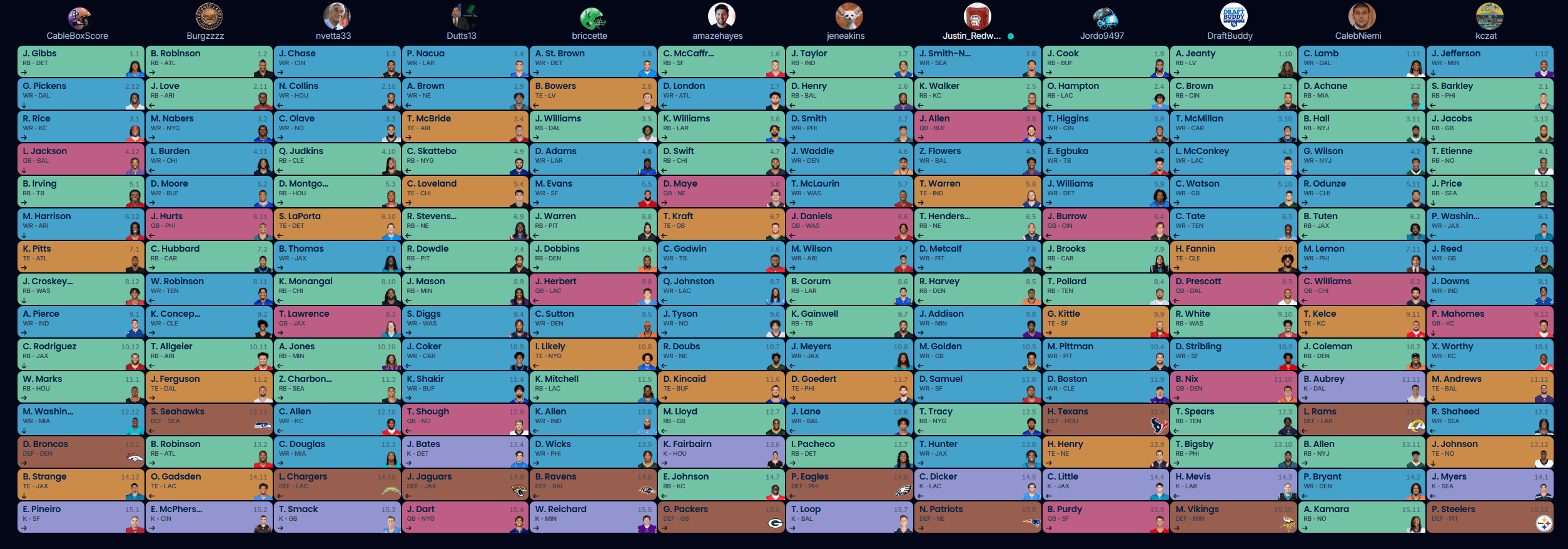
Final Draft Board
Bottom Line
- There were 57 total RBs drafted and 65 WRs.
- Only 15 quarterbacks were selected, with just three teams drafting a backup. That's a huge shift from July, when 17 quarterbacks came off the board, and eight teams decided they needed two.
- There were 19 tight ends, with seven teams selecting more than one. July featured 21 total tight ends, so the addition of K/DST also ate into some of the late-round TE2 dart throws.
- Exactly 12 kickers and 12 defenses were selected, accounting for 24 picks and showing why some familiar late-round skill players appear a round or two later than they did in July.
- The longest any manager waited to draft a running back was 4.09, while the furthest anyone waited for their first wide receiver was 3.10.
- Quarterback remained the easiest position to wait on. One manager didn't select a QB until 12.09, and usable options such as Brock Purdy remained available into the final round.
- Rookie prices aren't moving in one direction anymore. Jonah Coleman and KC Concepcion have climbed aggressively, while Jordyn Tyson and Jeremiyah Love were cheaper here than they were one month ago.
- The biggest practical lesson as we enter the heaviest draft weekends is that K and D/ST don't eliminate late-round skill-position value — they compress it. Once managers start filling those required positions, players who would have been 12th- or 13th-round darts in an offseason mock can suddenly survive until Round 14 or 15.
- And despite all the movement we've seen through camp and the preseason, there is still enough depth at quarterback, tight end, and the FLEX positions that drafters don't need to force a rigid positional build. Let the room create the values, take the falling tiers when they appear, and worry about filling kicker and defense when everyone else finally remembers they're supposed to.