Expert Fantasy Football Mock Draft Recap: 12-Team Half-PPR (July 2026)

 Make us preferred on Google
Training Camps are about to kick off, and before that torrent of news comes down the pipe to heavily influence current ADP positions, you know we had to knock out another 4for4 mock draft. I rounded up 11 other fantasy football sickos for a 12-team half-PPR redraft exercise to get our last look at boards before the impending movement. The goal wasn’t just to build “perfect” teams, but to see where drafters were willing to push running backs, how long they waited at quarterback and tight end, and which rookies are already being priced like immediate contributors.
All ADP references come from 4for4’s Multi-Site ADP tool, with rankings from 4for4. The full draft board is posted at the bottom of the article, but you can jump to it here.
2026 Fantasy Football Mock Draft
- Roster Settings: 1QB, 2RB, 2WR, 1TE, 2 FLEX (RB/WR/TE), 5 Bench Spots
- Scoring of Note: Half-PPR
Draft Participants in Order:
1. Matt Okada - @MattOkada
2. Justin Taylor - @jtorange
3. Wyatt Bertolone - @WyattB_FF
4. Justin Edwards - @Justin_Redwards
5. Chris Allen - @ChrisAllenFFWX
6. Addison Hayes - @AddisonHayes_
7. Jon Hammerman - @Jon_Hammerman
8. Mike MacGregor - @DraftBuddy
9. Nate Vetter - @NateVetter
10. Ryan Kirksey - @CableBoxScore
11. Neil Dutton - @ndutton13
12. Jennifer Eakins - @JenEakinsNFL
Rounds 1-3

Takeaways
The early RB vs. WR debate seems to be swinging back toward the ground game early in the 2026 draft cycle. There were 17 RBs drafted in the first three rounds, while 16 WRs came off the board. Seven teams left these rounds with at least two rushers, while only two didn’t select an RB at all to start this draft.
The scarcity at the TE position did not cause any panic for this crowd, as only two were selected, with a large gap until we saw the TE3 come off the board. Similarly, only one quarterback was taken in this range (with a big gap between QB2 and QB3). With passing volume down and rushing production up league-wide, it makes sense that early running backs are gaining ground while single-QB drafters feel less pressure to push the position.
Biggest Reaches
Jeremiyah Love (2.04), Josh Jacobs (3.04)
This was a very by-the-books opening three rounds, so you’ve really gotta pick some nits if you’re looking for reaches with this group. Both “reaches” are still within tiers of players we can easily project for workhorse roles.
By pure definition, Love went about nine ADP slots early, with clear concerns about an Arizona Cardinals team that has the second-lowest projected win total and the second-lowest implied team total. There’s also the Ashton Jeanty hangover that many fantasy managers are feeling after his disappointing rookie season in a similarly shaky environment a few short months ago. Though there may be some early friction in the form of short-yardage and goal-line work siphoned off by Tyler Allgeier, Love’s ability in all areas of the field will at least make him a high-floor option, even if the Cardinals might not offer a ton of ceiling opportunities.
In a far better environment, we have Jacobs, who also happens to be in a much different arc of his career than the rookie. Jacobs has handled the sixth-most regular-season rushing attempts in the league over the last two seasons (535), and his 1,840 carries since entering the league in 2019 rank behind only Derrick Henry (2,161), while we saw his year-to-year success rate drop from 15th (52.2%) down to 28th (49.1%) from 2024 to 2025. With that said, he is near the end of the tier where we can etch in a no-doubt workhorse role if health agrees with him.
Best Values
Omarion Hampton (2.09), DeVonta Smith (3.09)
Considering the general ineptitude of a Chargers offensive line forced to play with mostly backups for a large portion of the season, Hampton’s injury-shortened rookie campaign was actually quite positive. He averaged 13.3 half-PPR points and nearly four targets per game in a far worse situation than we’re expecting here in 2026. The o-line looks to be back at full strength, the team added more playmakers, and, most importantly, they added Mike McDaniel as offensive coordinator. Sure, some of those panic dump-offs might dwindle with a functional trench game, but the only thing standing in his way of a huge workload in a sped-up offense is Kimani Vidal and everyone’s favorite sleeper, Keaton Mitchell. I’ll take my chances.
With A.J. Brown heading over to New England, we’ll now get to see one of the best WR2s in the league move up the food chain with only Dontayvion Wicks and rookie Makai Lemon standing in the way of a massive target share. Per 4for4’s Market Share Splits App, Smith has played four games without AJB in the lineup over the last two seasons, earning a 27.5% target share, north of 100 air yards per game, and 11.6 half-PPR points. Stretched over a whole season, we could see those numbers bump up against WR1 output, which makes this late-third selection look pretty, pretty good.
Rounds 4-7

Takeaways
We see the “onesie” positions get some love here, as half of the league grabs their quarterback and/or tight end. There were back-to-back onesie selections throughout this region of the draft as managers tried to avoid missing out on an entire tier of selections by the time it snaked back to them.
Biggest Reaches
Brian Thomas Jr. (5.02), Alec Pierce (6.07)
The Jaguars’ target tree is honestly anyone’s guess right now, so I’m certainly not faulting someone for grabbing Thomas as a potential bounce-back case, but this selection was also roughly 15 picks and 8 position slots before ADP. Last year, in the fresh new Liam Coen offense, Thomas morphed into more of a sacrificial X receiver, with his targets per route run dropping from 26% as a rookie down to 20%, behind teammates Parker Washington (24%), Jakobi Meyers (21%), and even Brenton Strange (21%). There’s a chance that with fewer nagging injuries (ankle, wrist, shoulder), he can regain some of that Year 1 magic, but I’d rather bet on that a round later. For a deeper dive into the Jaguars receiver room, check out Wyatt Bertolone’s write-up on the subject here.
Pierce’s breakout in 2025 was a joy to watch. He was allotted far more intermediate work while maintaining his league-leading 19.4 aDOT and clocked in with the 12th-highest yards per route run (2.25) among qualifying wide receivers. We got more “easy” looks for him in 2025, and though that’s a reason to be bullish on him, there are still better options on the team for those easy-button looks (Josh Downs, Tyler Warren), which still makes him a shaky consistency bet. Particularly if he’s not fully cleared by Week 1. I like him as a boom-bust option, but he could have potentially been available the next time this manager was on the clock, considering this is roughly a full round before his ADP. You can read my full thoughts on Pierce’s 2026 outlook here.
Honorable mention: Ricky Pearsall (7.11)
Best Values
Zay Flowers (4.08), Terry McLaurin (5.08)
In this area of the draft, we’re not often seeing full-round drops from ADP, but that’s what we’ve got here with Flowers and McLaurin. Flowers also went seven positional slots (WR21) later than he’s typically drafted, behind far shakier floor plays like Luther Burden and Malik Nabers. It’s utterly disrespectful. Sure, the team drafted both Elijah Sarratt and Ja’Kobi Lane, but those were both firmly in the middle rounds, and it’s not as if Mark Andrews or Rashod Bateman are going to be target vacuums able to eat into their WR1’s fantasy floor.
McLaurin is potentially in a similar spot among fantasy drafters; he’s not exactly the freshest name on the market, and the Commanders are coming off a season in which they rode the ground game to a disappointing 5-12 finish. The bad news here is that head coach Dan Quinn reportedly wants a more run-controlled offense moving forward, but new offensive coordinator David Blough also said he wanted to target McLaurin 10 times a game, so I’d say those two coach-speak nuggets even out. A fully healthy Jayden Daniels should go a long way toward the veteran receiver having a nice bounce-back season.
Honorable mention: Jalen Hurts (7.06)

Rounds 8-10

Takeaways
This is where a majority of the ambiguous situations rear their collective heads, forcing drafters to take a stand on guys when we can’t be certain how much they’ll mean to respective teams. We see the Vikings running backs, along with Packers, Chargers, and Chiefs pass-catchers, leading the way in unknown usages.
Biggest Reaches
Michael Wilson (8.01), Oronde Gadsden (9.10)
Maybe the only wide receiver room that can cause more headaches than what is happening in Jacksonville is the very confusing Wilson/Marvin Harrison Jr. tandem in Arizona. As we mentioned earlier, the Cardinals have the second-lowest projected win total and the second-lowest implied team total. But Wilson looked really, really good last year. Was it because he made a third-year jump, or simply because the Cardinals dropped back to pass at such an egregious clip when Jacoby Brissett took over? His Reception Perception profile hints that Wilson definitely showed on film that he can handle his own as a legitimate fantasy contributor in 2026 and beyond.
Fantasy drafters as a whole seem to be placing far too much emphasis on the Chargers’ mid-May signing of veteran David Njoku. Gadsden’s ADP has dropped multiple rounds since his new teammate was hired; down 40+ spots since the NFL Draft, and it’s still dropping. He now sits as the TE18 over on 4for4’s Multi-Site ADP, and while I think that has jumped the shark a little bit, the other side of the coin is taking him here at the end of the 9th as the TE11. It should certainly be somewhere in the middle.
Best Values
Caleb Williams (8.05), Rico Dowdle (9.06)
With so many drafters pushing quarterbacks further down the board, Williams went right about where he goes in positional ADP, but roughly a round and a half past where he’s typically taken. Williams rode his late-game heroics to a QB5 finish in his breakout sophomore season, adding a few rushing touchdowns and even a receiving score to break 20+ fantasy points in seven games (eight if you count his 19.9 Week 6). The new-look Ben Johnson offense scored the 10th-most touchdowns per drive and racked up the sixth-most raw yardage. It’s all but guaranteed that if Williams stays healthy all season, the Bears will finally see their very first 4,000-yard quarterback.
Dowdle is very much a value here considering his current 8.02 ADP, but I personally passed on him at both the 8.09 and 9.04, knowing full well that he was dropping further than usual. I’m of the (potentially off-base) position that Jaylen Warren will take control of this backfield, and that Dowdle will serve more of a “breather” role. Dowdle’s two (admittedly incredible) big rushing performances last year are doing a lot of heavy lifting when looking at his 2025 numbers, and let us not forget that Chuba Hubbard eventually pushed him back out of the way down the final stretch of the season.
Rounds 11-13

Takeaways
As we get closer to Fantasy Draft Weekend, there will surely be mocks with both kickers and defenses, but for now, you’ll notice that we’ve skipped the positions in this mock to squeeze in as many player takes and ADP talk as possible. While some of the players you see here will likely be waiver wire fodder in a full draft with D/ST and Ks, it’s still helpful to see who the fantasy community values at the ends of drafts.
Best Values
Dallas Goedert (11.08), Tyjae Spears (13.10)
Even if the Eagles get back to their explosive rushing ways, there should still be plenty of meat left on the bone for Goedert to return a top-12 finish at the tight end position, with the chance to push up a little further. Rookie Makai Lemon could gobble up some of those middle-of-the-field looks, but he and Dontayvion Wicks won’t prove to be as much of a formidable target-share foe as A.J. Brown has been over the years. Goedert’s explosive 11-touchdown performance last year has nowhere to go but down, yet he could easily push past his 82 targets, which should help even things out.
Spears has a two-way battle in the works between Tony Pollard and rookie Nicholas Singleton, but his work in the passing game comes with a built-in floor, particularly if you’re looking at him in a full PPR league. Singleton, luckily, profiles as someone who will shine in the short-yardage and goal-line areas, somewhere that Spears doesn’t really operate in to begin with. Any jump in efficiency for the Tennessee offense would be a boon to both Pollard and Spears, as the latter averaged 4.2 targets per game in 12 healthy appearances last year.
Rookie Costs
Quarterbacks: (none)
Running Backs: Jeremiyah Love (RB10, 2.04), Jadarian Price (RB26, 6.03), Jonah Coleman (RB47, 12.05), Emmett Johnson (RB54, 13.12)
Wide Receivers: Carnell Tate (WR30, 6.02), Jordyn Tyson (WR35, 7.03), Makai Lemon (WR40, 8.03), KC Concepcion (WR52, 10.06), Denzel Boston (WR54, 11.06), Omar Cooper Jr. (WR58, 12.04)
Tight Ends: Kenyon Sadiq (TE21, 13.09)
Final Draft Board
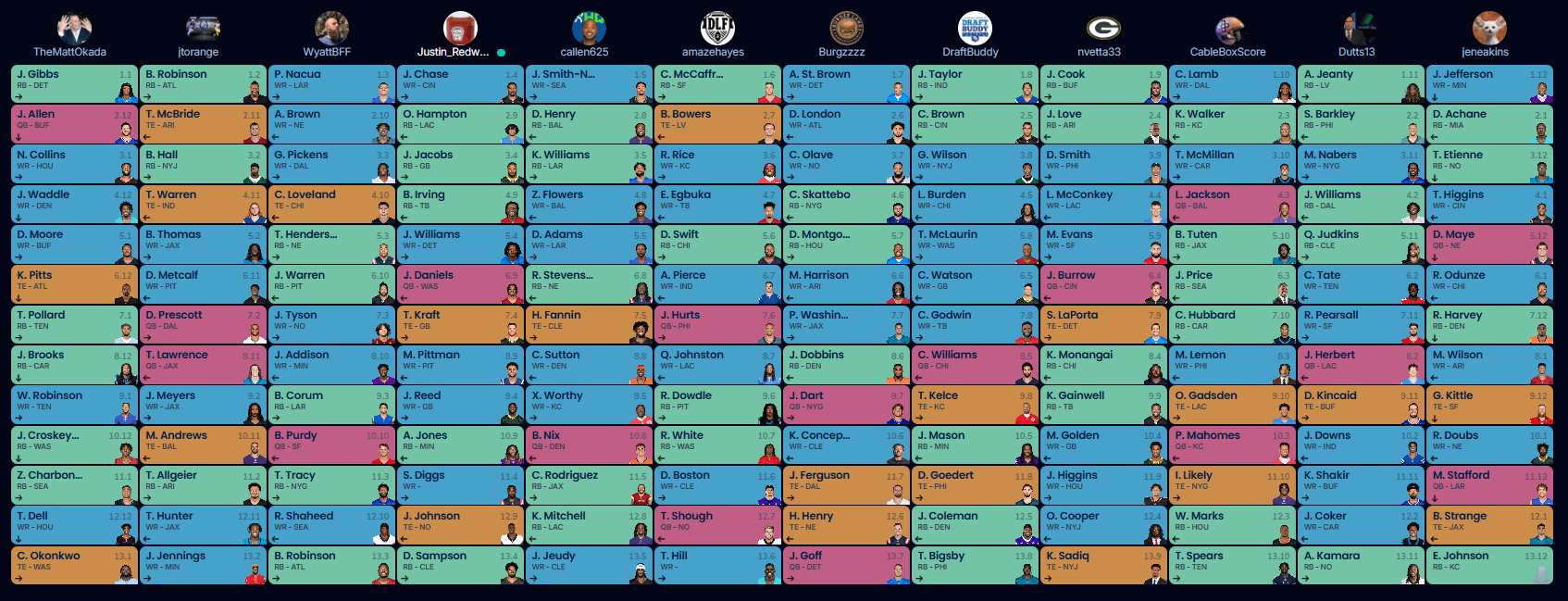
Bottom Line
- There were 55 total RBs drafted and 64 WRs.
- Seventeen QBs were selected in this mock, with eight (!!) teams (questionably) opting to draft a backup.
- Seven of the 12 teams decided to draft more than one tight end, leaving 21 selected in total.
- The longest any team waited to draft an RB was 5.03, while the furthest any manager waited to select a WR was 5.02.
- Rookies across the board have bumped up a little bit month-over-month.
- QB selection appears to be trending slightly later than in recent years, so there is still plenty of value at the position later in drafts in a single-QB format.
- At this point in the Summer, there is plenty of value on draft boards at every position while the hype machine is still churning with no on-field action.