NFL Offensive Line Rankings Week 10: Matchups to Exploit

 Make us preferred on Google
Evaluating offensive line play through a fantasy football lens can reveal matchup advantages that traditional rankings or defensive fantasy points allowed don’t always show.
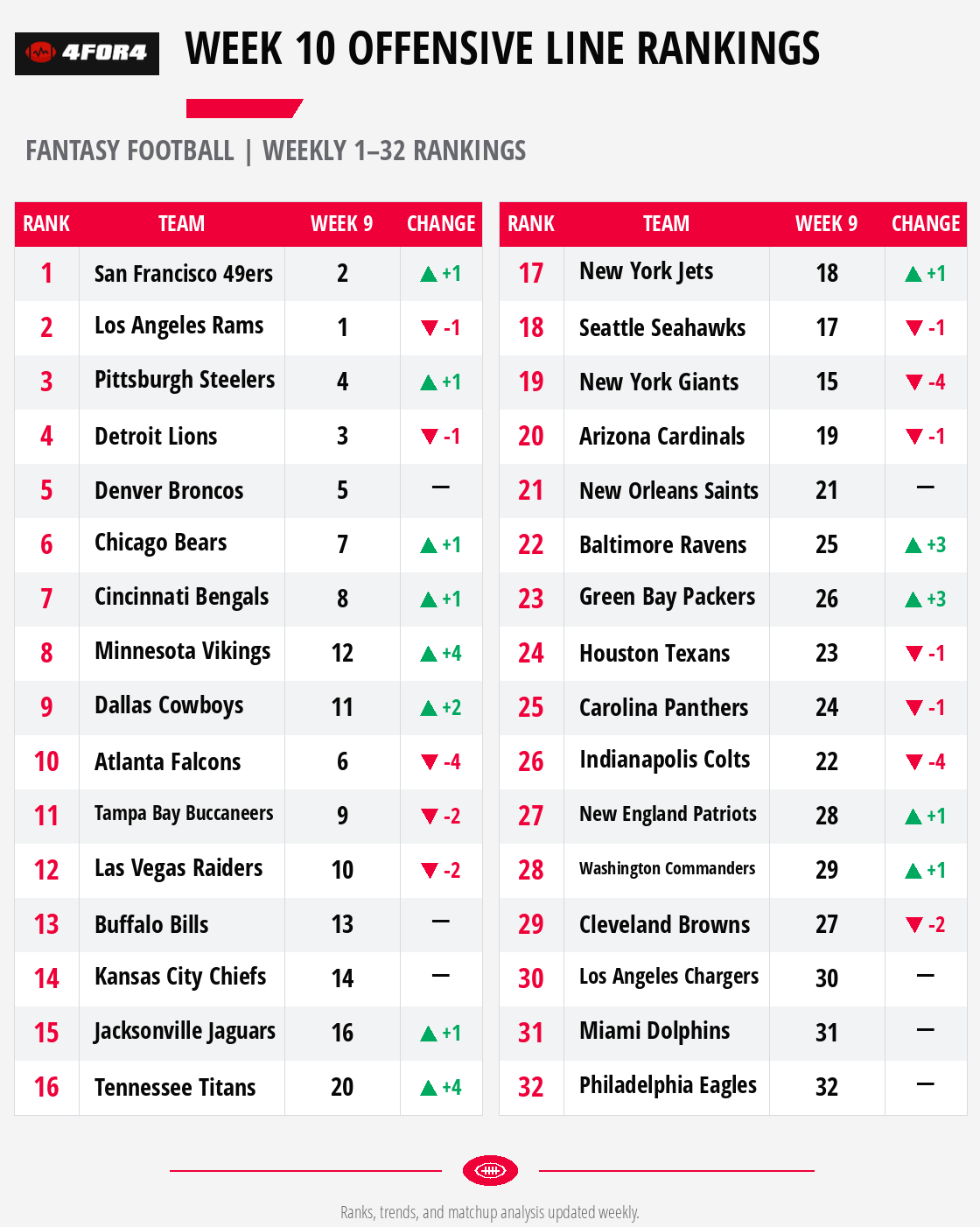
Each week, we rank all 32 offensive lines, track the biggest movers, and compare those units against the opposing defense’s adjusted fantasy points allowed (aFPA) to find the quarterback, running back, and D/ST matchups most affected by trench play.
Week 10 puts Matthew Stafford and Trevor Lawrence in favorable passing environments, gives Seattle and New Orleans room to lean on their backfields, and brings Baltimore and Indianapolis into the D/ST streaming conversation against two of the league’s most vulnerable offenses.
Editor’s Note: Check out the complete set of Week 10 fantasy football rankings here.
Biggest Offensive Line Risers and Fallers
Risers
Tennessee Titans (+4)
Tennessee’s offense has made it easy to lump the line in with everything else going wrong, but the protection has quietly separated itself from the rest of the unit. The Titans rank 12th in pressure rate allowed (33.1%), 11th in Pressure Rate Over Expectation (+1.26%), and third in adjusted sack rate (4.6%), with the league’s seventh-lowest blown-block rate adding another encouraging signal.
The running game remains the limiting factor, as Tennessee sits 19th in adjusted line yards and 23rd in running back yards before contact, but the overall profile is considerably sturdier than its previous No. 20 ranking suggested.
Minnesota Vikings (+4)
Like the Jets, the Vikings’ sack numbers look worse than their protection deserves because the quarterback carousel has driven much of the problem, with Kyler Murray (23.4%) and Carson Wentz (29.2%) both ranking near the bottom of the league in pressure-to-sack rate.
Minnesota has allowed pressure on only 33.5% of its dropbacks while ranking sixth in running back yards before contact (1.76) and ninth in blown-block rate (2.34%). Kirk Cousins took a sack on only 14.1% of his pressured dropbacks with Las Vegas, giving those underlying results a better chance to show up in the box score.
Fallers
Indianapolis Colts (-4)
Indianapolis is asking an average line to absorb two major personnel changes at once after trading Quenton Nelson to Seattle and losing right tackle Jalen Travis for multiple weeks with a knee injury.
Even before those losses, the Colts ranked 22nd in both pressure rate allowed (37.0%) and Pressure Rate Over Expectation (+5.2%), while their adjusted line yards sat 17th. Career reserve Luke Tenuta is now positioned to take over at right tackle as the Colts reconfigure both sides of the center.
New York Giants (-4)
The Giants’ Week 9 performance looked just as bad on film as it did in the box score, with eight tackles for loss wiping out approximately one-quarter of their designed runs before the ball carrier had a chance to get started.
Andrew Thomas struggled to hold his ground while Jon Runyan and Francis Mauigoa repeatedly allowed penetration inside, extending problems that have left New York 23rd in both adjusted line yards (3.88) and Pressure Rate Over Expectation (+6.75%) even after accounting for the quarterbacks’ contributions to the sack total.
Week 10 Fantasy Impact Players Helped by Their Offensive Line Matchup
The featured matchups below aren’t the only places where the trenches can swing a fantasy decision. Three more situations worth circling:
- Brock Purdy and the 49ers’ passing game: Dallas has created pressure at a top-10 rate, so its 30th-ranked QB aFPA doesn’t tell the whole story. San Francisco’s top-ranked line is built to handle that resistance, keeping Purdy and George Kittle in comfortable QB1 and TE1 territory while Deebo Samuel, Mike Evans, and newly acquired Keenan Allen sort out the targets behind them.
- Jaylen Warren and Rico Dowdle, Steelers: Cincinnati’s RB aFPA lands closer to the middle of the league, but the Bengals have allowed the second-highest explosive-run rate and fifth-highest rushing success rate. Warren carries a heavier workload and a stronger RB2 outlook, while Dowdle remains a touchdown-dependent FLEX behind our third-ranked line.
- James Cook, Bills: The Jets have done a good job preventing explosive runs, but they rank 29th in rushing success rate and 30th in stuff rate. Cook’s workload already makes him an easy start, and Buffalo should be able to stay patient on the ground even if the long run never arrives.
Best Quarterback and Passing Game Matchups
Rams at Cardinals
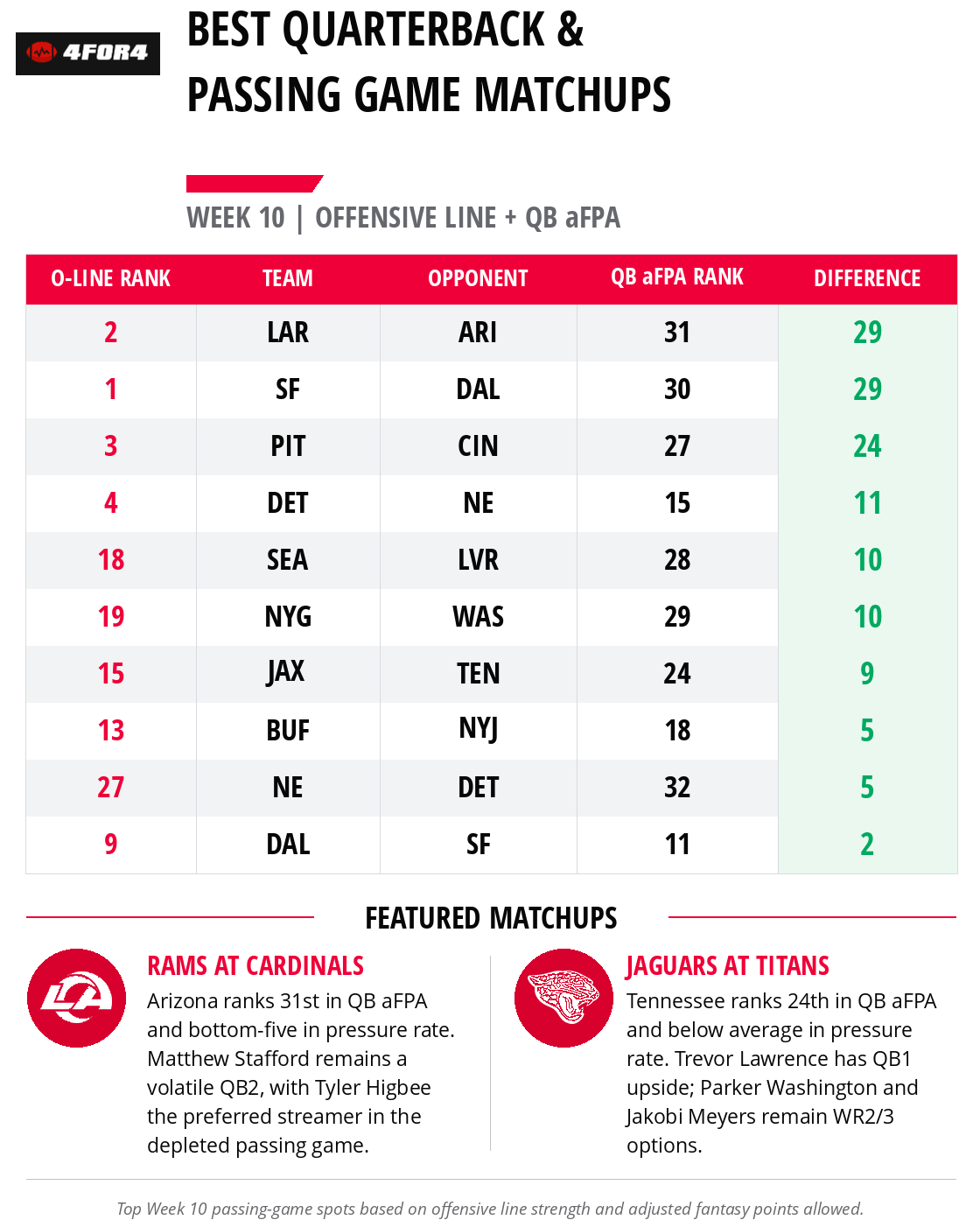
The Rams are asking Matthew Stafford to work with an unfamiliar collection of targets, but at least they aren’t asking him to do it behind shaky protection. Los Angeles has allowed pressure on only 26.4% of its dropbacks with a -5.1% Pressure Rate Over Expectation, while Stafford has turned just 13.8% of those pressures into sacks.
Arizona has generated pressure at the fifth-lowest rate in the league and ranks 31st in QB aFPA, giving Stafford a clean matchup even if Puka Nacua and Davante Adams' absences keep him in the more volatile QB2 range.
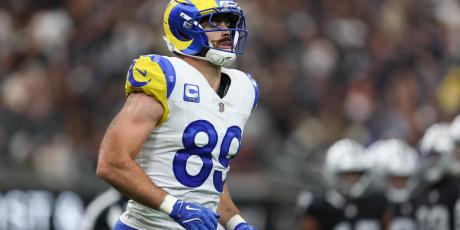
The missing receivers could push Sean McVay even further toward the three-tight-end formations that Los Angeles already uses more than any other offense. Tyler Higbee ran a route on 68.9% of Stafford’s dropbacks last week and received all five of his targets as the first read, while Colby Parkinson added four targets of his own. Higbee is the preferred streamer, with Konata Mumpfield carrying deeper appeal as the lone receiver in some heavier formations.
Jaguars at Titans
Jacksonville’s passing game has been uneven, but the protection has quietly held up well, allowing a 30.9% pressure rate while Trevor Lawrence has converted only 16.9% of his pressures into sacks.
Tennessee ranks 24th in QB aFPA and carries a negative defensive Pressure Rate Over Expectation, so Lawrence should have enough time to push for another QB1 finish. Parker Washington and a healthy Jakobi Meyers both fit into the WR2/3 range now that Meyers is off the injury report.
Best D/ST Matchups
Ravens vs. Chargers
Baltimore doesn’t need its pass rush to jump a tier in effectiveness because the Chargers have been manufacturing fantasy points for opposing defenses all season, allowing double-digit D/ST production in seven of eight games.
Los Angeles ranks 30th in our offensive line rankings with a +10.8% Pressure Rate Over Expectation, and Justin Herbert has compounded those problems by taking a sack on 27.0% of his pressured dropbacks. His 6.0% turnover-worthy play rate creates another path to points against an offense carrying a 16.5-point implied total, making the Ravens a viable streamer in the 61% of Yahoo leagues where they remain available.
Colts vs. Dolphins
Indianapolis hasn’t generated enough pressure to become a regular streaming target, but Miami provides an opponent that can make an ordinary defense useful for a week. The Dolphins rank 31st up front, allowing a 41.6% pressure rate with a +11.4% Pressure Rate Over Expectation, and will now hand the offense to Kyle McCord after placing Malik Willis on injured reserve. McCord has never taken a regular-season snap and completed 55.6% of his preseason passes over the last two years with a 5.1-yard average per attempt.
With Miami carrying a 19.0-point implied total into McCord’s first start, the Colts offer a widely available swing at sacks and turnovers from the waiver wire.
Best Running Back Matchups
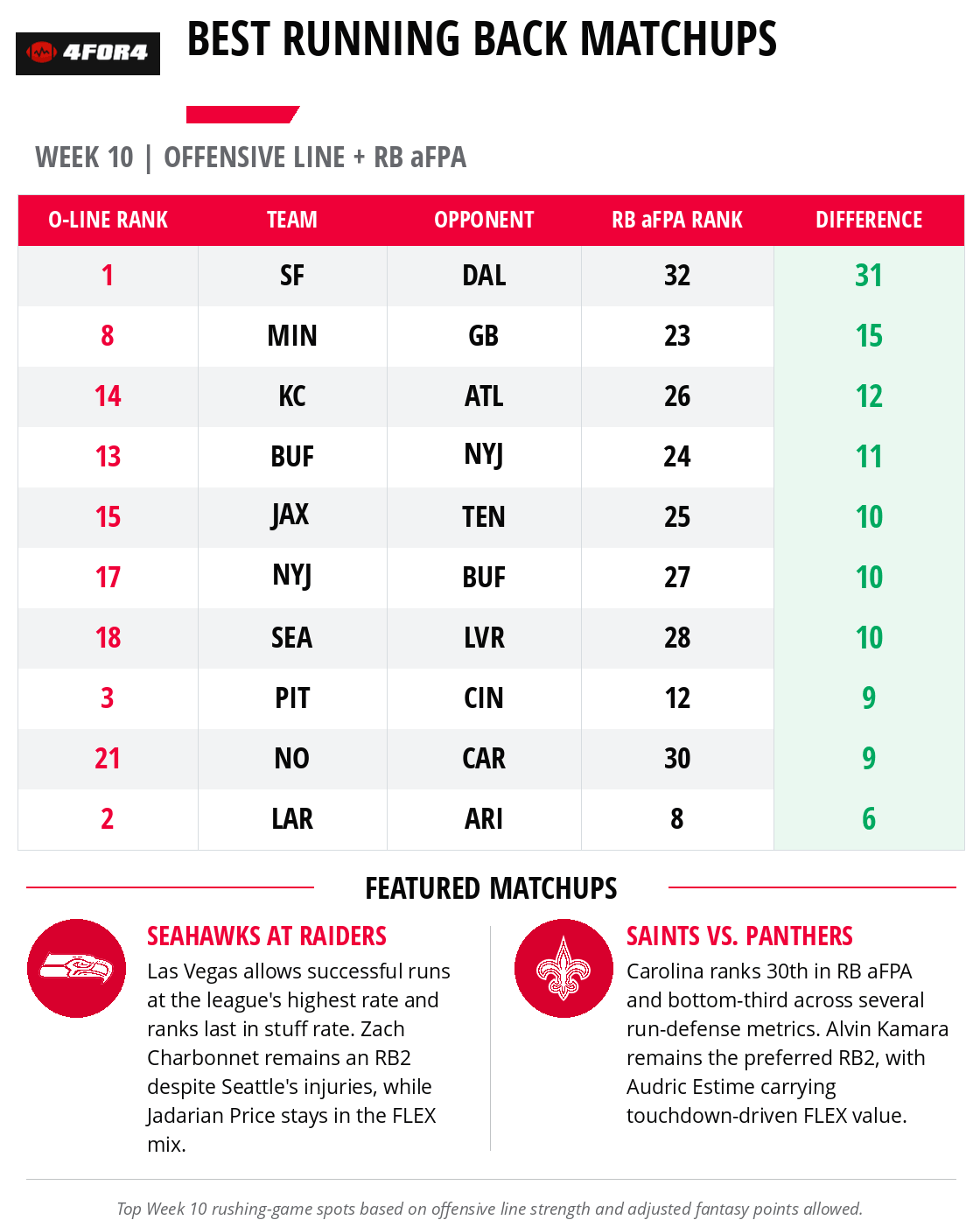
Seahawks at Raiders
Seattle has little reason to put the game in an injured Drew Lock’s hands when Las Vegas has allowed successful runs at the league’s highest rate while stuffing fewer attempts than any other defense. The Raiders have also surrendered an explosive run on 6.6% of carries, giving the Seahawks several ways to keep the offense on the ground if the score cooperates.
That matchup bodes well for a Seattle line whose expected midseason improvement has been delayed by Quenton Nelson’s knee surgery and Charles Cross’ high-ankle sprain. The instability has been clearest in the running game, where the Seahawks rank last in running back yards before contact, but Zach Charbonnet still belongs in the RB2 range, and Jadarian Price has enough projected work to remain in the FLEX mix.
Saints vs. Panthers
Audric Estime immediately complicated the New Orleans backfield upon his return, turning 15 carries into 72 yards and a touchdown while splitting snaps evenly with Alvin Kamara. Kamara retained the larger receiving role, creating a workable division of labor as long as Travis Etienne remains unavailable.
Carolina gives both backs room to survive the split after ranking 30th in RB aFPA and landing in the bottom third of the league in rushing success rate, stuff rate, and missed tackles forced per attempt. New Orleans has been closer to average on the ground than its No. 21 overall line ranking suggests, although Erik McCoy’s biceps injury keeps this from becoming a completely clean matchup.
Kamara remains the preferred RB2, with Estime offering touchdown-driven FLEX appeal after walking directly into meaningful early-down work.
Fantasy Players to Downgrade in Week 10
These aren’t automatic sits, but each carries more downside than usual because of the matchup up front.
- Jordan Love and the Packers’ passing game: Minnesota leads the league in pressure rate and defensive Pressure Rate Over Expectation while ranking first in QB aFPA. Love’s ability to avoid sacks should keep the offense functional, although the matchup pushes him toward the QB1/2 border and adds volatility for Christian Watson and Matthew Golden.
- Justin Herbert, Chargers: Los Angeles has allowed a 39.1% pressure rate with a +10.8% Pressure Rate Over Expectation, and Herbert has converted 27.0% of those pressures into sacks. Baltimore’s pass rush has been closer to average than dominant, but the Chargers have created difficult passing environments without requiring much help from the opponent.
- Ashton Jeanty, Raiders: Las Vegas has protected its quarterbacks well but ranks near the bottom of the league in both adjusted line yards and running back yards before contact. Seattle has allowed the sixth-lowest rushing success rate while ranking second in stuff rate and missed tackles forced per attempt, leaving Jeanty dependent on volume and receiving work to overcome another inefficient rushing matchup.
- Tony Pollard, Titans: Jacksonville has allowed successful runs at the league’s second-lowest rate while stuffing more than half of opposing attempts. Pollard’s workload keeps him in the RB2 conversation, but there isn’t much room for error against a defense that has consistently eliminated rushing lanes before they develop.

How These Offensive Line Rankings Work
These are fantasy football rankings, not a pure evaluation of offensive line talent, so the effect each unit has on quarterback and running back production matters more than how its five starters might be graded in isolation.
The weekly order combines injuries, projected starters, recent film, and results across pressure rate, blown-block rate, adjusted sack rate, adjusted line yards, and running back yards before contact. Pressure rate and blown-block rate receive particular weight because they identify how often the protection or rushing assignment breaks down before quarterback play can influence the result.
Sacks still matter for fantasy purposes, but quarterbacks have considerable control over whether pressure becomes a negative play. Pressure-to-sack rate helps separate that influence from the blocking, while Pressure Rate Over Expectation compares actual pressure with the rate expected based on the quarterback’s time to throw. Penalties receive very little weight unless they become an extreme or recurring problem.
The final rankings are compared with 4for4’s adjusted fantasy points allowed to quarterbacks and running backs, which accounts for opponent quality and updates throughout the season.