NFL Offensive Line Rankings Week 12: Matchups to Exploit

 Make us preferred on Google
Evaluating offensive line play through a fantasy football lens can reveal matchup advantages that traditional rankings or defensive fantasy points allowed don’t always show.
Each week, we rank all 32 offensive lines, track the biggest movers, and compare those units against the opposing defense’s adjusted fantasy points allowed (aFPA) to find the quarterback, running back, and D/ST matchups most affected by trench play.
Week 12 gives Trevor Lawrence and Dak Prescott favorable passing environments, while Chase Brown and the Rams’ backfield draw defenses that have struggled to control the running game. The Jets and Patriots also enter the D/ST streaming conversation with both available in more than 70% of Yahoo leagues.
Editor’s Note: Check out the complete set of Week 12 fantasy football rankings here.
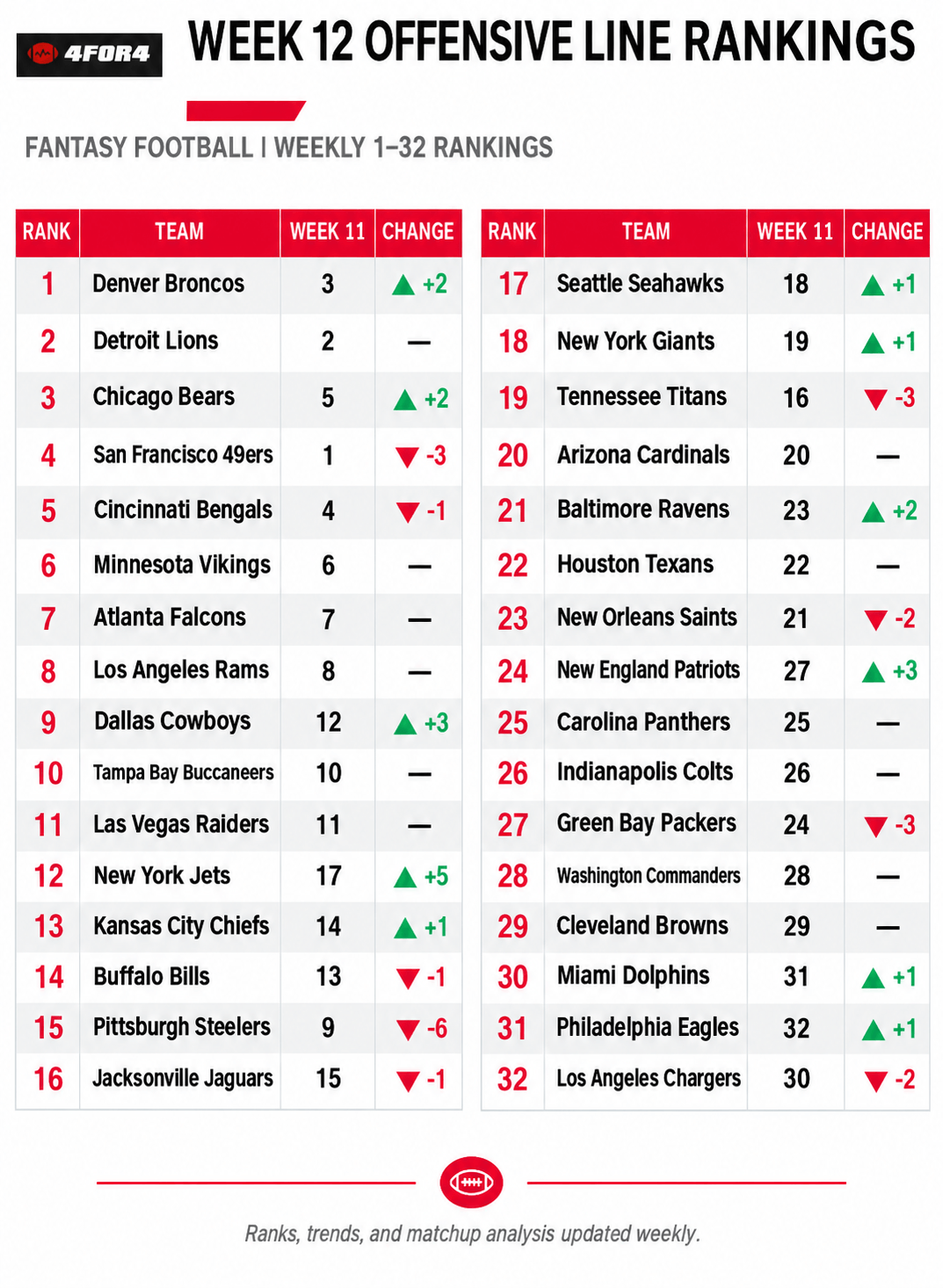
Biggest Offensive Line Risers and Fallers
Risers
New York Jets (+5)
New York’s 9.1% adjusted sack rate continues to exaggerate the problems up front, with Geno Smith converting 24.2% of his pressures into sacks. The Jets have allowed pressure on 35.6% of their dropbacks while ranking inside the top 12 in both adjusted line yards and running back yards before contact.
The young tackle pairing provided an especially encouraging result in Week 11, when New York allowed pressure on only 4.9% of its dropbacks and rushed for 165 yards. Olu Fashanu and Armand Membou have given the line a foundation that was missing early in the season.
Dallas Cowboys (+3)
Dallas has developed one of the league’s cleaner all-around profiles; allowing pressure on 34.7% of its dropbacks while producing 4.64 adjusted line yards and 1.66 running back yards before contact.
The Cowboys have also needed only six starters through 11 weeks. Tyler Booker’s ankle injury creates something to monitor, but Cooper Beebe and T.J. Bass held up well against Pittsburgh, with Beebe finishing the game without allowing a pressure.
Fallers
Pittsburgh Steelers (-6)
Mason McCormick’s leg injury removed arguably the Steelers' best lineman, while Spencer Anderson struggled during his first extended opportunity at left guard. The Steelers as a whole are coming off a game in which the Eagles stifled their running game and generated five sacks.
The season-long results remain respectable, including a 29.8% pressure rate and 4.45 adjusted line yards, but the current lineup no longer carries the same stability.
San Francisco 49ers (-3)
Colton McKivitz’s season-ending ankle injury forces another change for a line that had used only five starters through Week 11. Vederian Lowe is expected to take over at right tackle, placing a new blocker next to Dominick Puni as San Francisco prepares for a difficult matchup with Seattle.
The 49ers have allowed pressure on only 31.6% of their dropbacks and remain one of the league’s best rushing units. Losing McKivitz removes some of the certainty that helped them hold the top spot.
Week 12 Fantasy Impact Players Helped by Their Offensive Line Matchup
The featured matchups below aren’t the only places where the trenches can swing a fantasy decision. Three more situations worth circling:
- Jayden Daniels and the Commanders’ passing game: Washington’s 28th-ranked line has struggled to keep the pocket clean, but Arizona has generated pressure on only 27.9% of opposing dropbacks with a -2.4% defensive Pressure Rate Over Expectation. Daniels carries high-end QB1 upside against a defense ranked 29th in QB aFPA, while Stefon Diggs and Antonio Williams gain FLEX appeal. Chigoziem Okonkwo also draws an Arizona defense ranked 30th against tight ends.
- Bucky Irving, Buccaneers: Tampa Bay’s 10th-ranked line faces a Carolina defense sitting 25th in RB aFPA. The Panthers have allowed successful runs on half of their opponents’ attempts with a 5.8% explosive-run rate, giving Irving a strong path to RB1 production. Kenneth Gainwell remains more dependent on receiving work and touchdowns.
- Quinshon Judkins, Browns: Cleveland’s offensive line remains a concern, but Las Vegas ranks 30th in RB aFPA while allowing a 54.8% rushing success rate and 6.2% explosive-run rate. The Raiders have also stuffed only 35.9% of opposing runs. Judkins moves into the RB2/FLEX range in a matchup that can cover some of the problems around him.
Best Quarterback and Passing Game Matchups
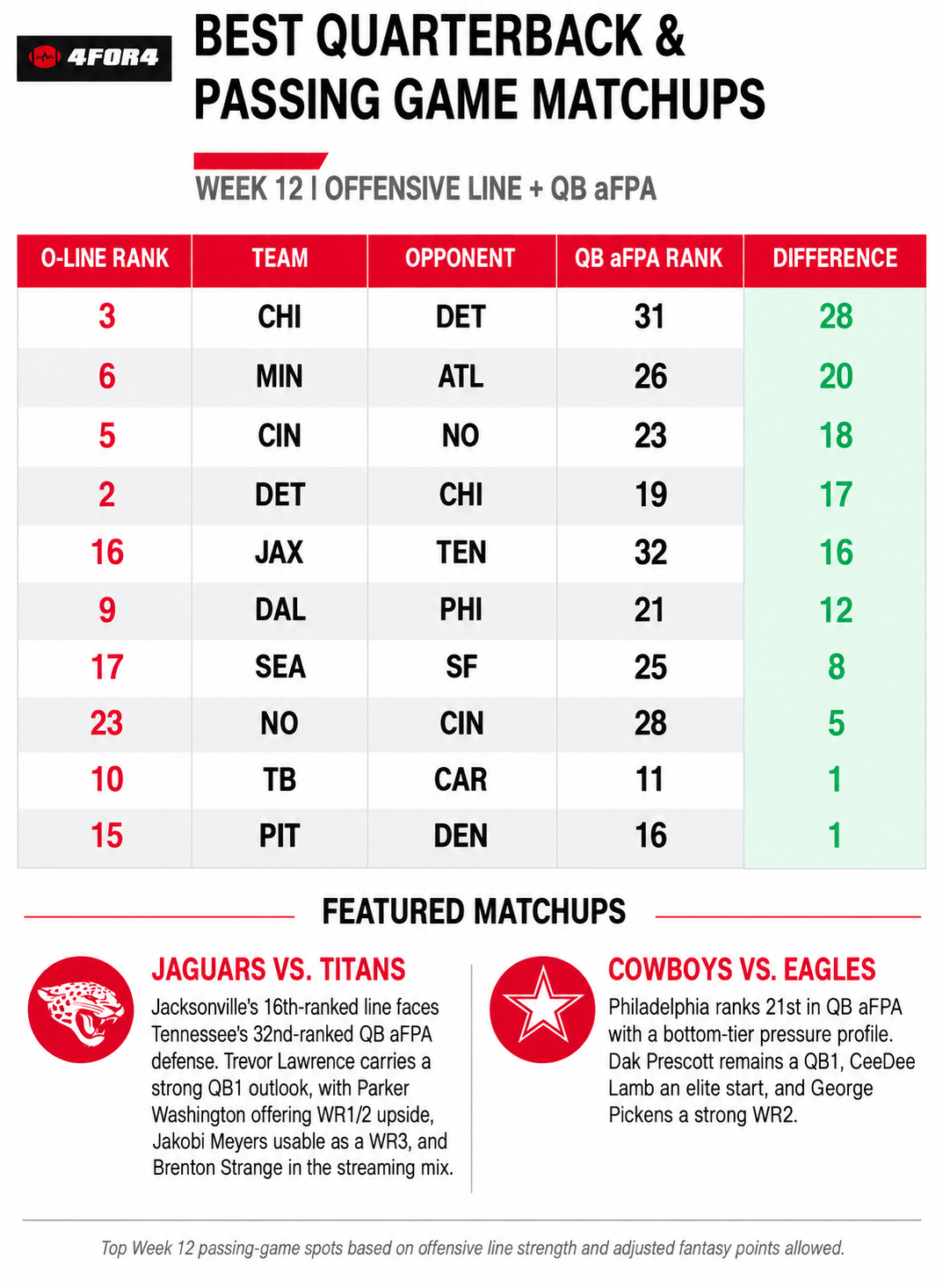
Jaguars vs. Titans
Jacksonville’s 16th-ranked line has performed much better in pass protection than its overall placement suggests. The Jaguars have allowed pressure on only 30.0% of their dropbacks with a -3.8% Pressure Rate Over Expectation, keeping Trevor Lawrence out of the league’s more difficult passing environments despite uneven results elsewhere.
Tennessee offers little reason to expect that to change. The Titans rank last in QB aFPA and have generated pressure on only 29.3% of opposing dropbacks with the league’s lowest defensive Pressure Rate Over Expectation.
Lawrence can be started as a strong QB1 after throwing for 301 yards against the Giants. Parker Washington commanded 17 targets in that game, turning them into eight catches for 103 yards, while Jakobi Meyers drew ten targets and finished with 85 yards. Washington carries WR1/2 upside, Meyers belongs in the WR3 conversation, and Brenton Strange remains a viable tight end streamer.
The statuses of Robert Hainsey and Walker Little should be monitored after both entered the week questionable, but Lawrence and his primary receiving options are ready to play.
Cowboys vs. Eagles
Philadelphia ranks only 21st in QB aFPA, but its underlying pass-rush results create a much friendlier matchup than that placement suggests. The Eagles have generated pressure on 28.2% of opposing dropbacks with a -2.7% Pressure Rate Over Expectation, leaving them near the bottom of the league in both categories.
Dallas has allowed pressure on 34.7% of its dropbacks with a 4.7% adjusted sack rate, both of which are in the top half of the league. Dak Prescott should be able to support multiple fantasy options, which gives us a boost to the ancillary pieces behind CeeDee Lamb and George Pickens.
Jake Ferguson has yet to practice this week because of knee and ankle injuries. If he misses another game, Ryan Flournoy should remain involved behind Lamb and Pickens, while Brevyn Spann-Ford would handle most of the tight end work. Neither needs to be forced into standard lineups, but both gain relevance in deeper formats.
Best D/ST Matchups
Jets at Dolphins
Miami’s protection problems meet a Jets defense capable of turning them into fantasy production. The Dolphins enter Week 12 with our 30th-ranked offensive line after allowing pressure on 40.8% of their dropbacks with a +9.4% Pressure Rate Over Expectation.
New York ranks inside the top 10 in both defensive pressure rate and defensive Pressure Rate Over Expectation. That combination gives the Jets a clear path to sacks against an offense that has struggled to sustain drives.
Kyle McCord followed his debut with 12 completions on 33 attempts for 102 yards and an interception against Buffalo. Miami finished with nine points, all on field goals, and now carries an 18.5-point implied team total.
The Jets are available in 73% of Yahoo leagues.
Patriots at Chargers
New England hasn’t produced an overwhelming pass rush, but the Chargers have made opposing defenses playable without one. Los Angeles ranks last in our offensive line rankings after allowing pressure on 41.6% of its dropbacks with a league-high +13.2% Pressure Rate Over Expectation.
The Chargers have also produced an 11.8% adjusted sack rate and allowed six sacks against the Jets last week. Justin Herbert has converted 26.5% of his pressures into sacks, giving New England a usable floor even if he clears the concussion protocol.
DJ Uiagalelei would start if Herbert is unavailable. He has attempted only seven NFL passes, completing two, so his presence would strengthen the Patriots’ streaming case without being necessary to make it work.
New England is available in 71% of Yahoo leagues.
Best Running Back Matchups
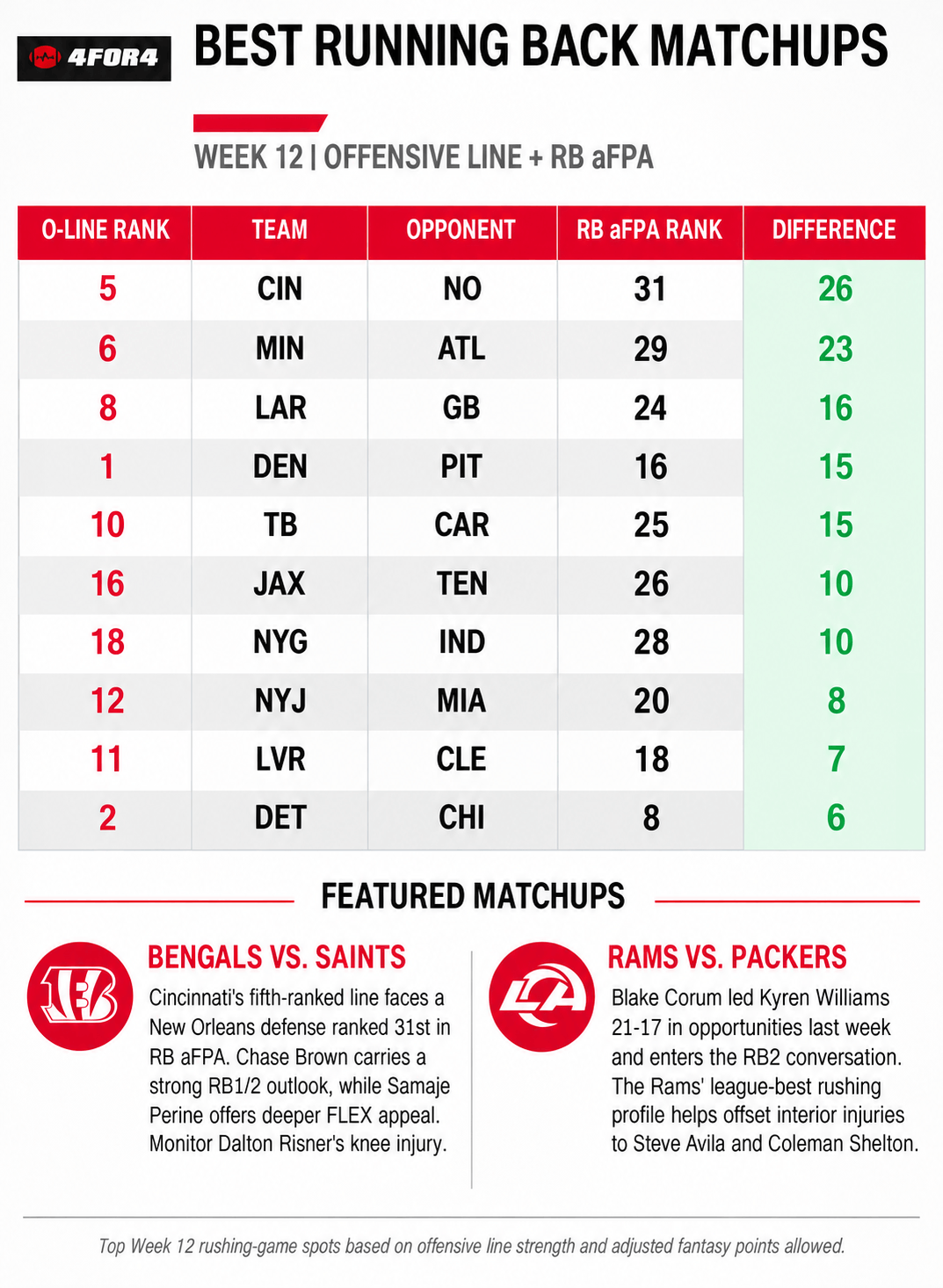
Bengals vs. Saints
Cincinnati’s fifth-ranked line draws one of the week’s softest rushing matchups against a New Orleans defense ranked 31st in RB aFPA.
The Saints have allowed successful runs on 51.3% of opposing attempts with a 5.3% explosive-run rate, while their 41.5% stuff rate has made it difficult to create negative plays before the backfield can get started. Injuries to Erik McCoy, Taliese Fuaga, and Asim Richards also leave the New Orleans offense vulnerable to game scripts that could give Cincinnati additional rushing volume.
Chase Brown’s Week 11 workload was again quite lacking, as he once again ceded work in both the pass and run game to Samaje Perine. However, Brown’s receiving involvement kept him useful, and this matchup gives him a better chance to produce on the ground. He belongs in the RB1/2 range, while Perine carries deeper FLEX appeal.
Dalton Risner’s knee injury needs to be monitored, but the Bengals have used only five starting linemen this season and continue to offer one of the league’s most stable blocking environments.
Rams vs. Packers
The Rams have lost Steve Avila and Coleman Shelton from the interior, but their season-long rushing production provides enough room to absorb some regression. Los Angeles leads the league with 5.32 adjusted line yards and ranks first with 2.25 running back yards before contact.
Green Bay has limited explosive runs, but opponents have stayed on schedule against the Packers, allowing successful runs on 52.7% of attempts while stuffing only 41.4%, which contributed to their No. 24 ranking in RB aFPA.
Blake Corum has started to claim a larger share of the backfield. Before Ronnie Rivers handled the final drive of last week’s blowout, Corum led Kyren Williams 21-17 in opportunities, finishing with 100 rushing yards, 19 receiving yards, and a touchdown. Williams added five targets but managed only 23 yards on 12 carries.
Corum is the preferred RB2, while Williams remains in the RB2/FLEX mix through his receiving work and scoring opportunities. The injuries prevent this from being a completely clean line advantage, but both backs should have chances to produce.
Fantasy Players to Downgrade in Week 12
These aren’t automatic sits, but each carries more downside than usual because of the matchup up front.
- Brock Purdy and the 49ers’ passing game: Seattle ranks second in QB aFPA while producing a 37.8% pressure rate and +6.7% defensive Pressure Rate Over Expectation. San Francisco’s fourth-ranked line keeps Purdy in the low-end QB1 range, but McKivitz’s absence creates another concern against one of the league’s more disruptive fronts. George Kittle remains the safest receiver, while Mike Evans, Deebo Samuel, and Keenan Allen carry more volatility.
- Michael Penix Jr. and the Falcons’ passing game: Minnesota leads the league in pressure rate and defensive Pressure Rate Over Expectation while ranking first in QB aFPA. Atlanta’s seventh-ranked line gives Penix a chance to survive the matchup, but he belongs in the QB2 range. Drake London’s volume keeps him in lineups, although his ceiling is lower than usual, while Kyle Pitts remains closer to the back end of the TE1 group.
- Jordan Love and the Packers’ offense: Green Bay has used 11 starting linemen while ranking last in adjusted line yards and near the bottom in running back yards before contact. The Rams rank fourth in QB aFPA and third against running backs, creating problems in both phases. Love remains viable near the QB1/2 border, but the matchup adds volatility to Matthew Golden, Christian Watson, and Tucker Kraft. Josh Jacobs’ finger injury further complicates the backfield.
- Chuba Hubbard and the Panthers’ offense: Tampa Bay ranks first in RB aFPA and has allowed successful runs on only 46.1% of opposing attempts while producing one of the league’s highest stuff rates. Carolina’s 25th-ranked line has allowed pressure on 39.0% of its dropbacks with a +7.7% Pressure Rate Over Expectation, giving the Panthers few obvious ways to attack this matchup. Hubbard’s workload keeps him in the RB2 range, but his efficiency ceiling is considerably lower.

How These Offensive Line Rankings Work
These are fantasy football rankings, not a pure evaluation of offensive line talent, so the effect each unit has on quarterback and running back production matters more than how its five starters might be graded in isolation.
The weekly order combines injuries, projected starters, lineup continuity, recent film, and results across pressure rate, blown-block rate, adjusted sack rate, adjusted line yards, and running back yards before contact. Pressure rate and blown-block rate receive particular weight because they identify how often protection or rushing assignments break down before quarterback play can influence the result.
The number of starters a team has used provides additional context, especially when injuries force repeated changes at multiple positions, but continuity alone doesn’t guarantee effective blocking. A stable line can still perform poorly, while a well-coached unit can survive one or two replacements without collapsing.
Sacks still matter for fantasy purposes, but quarterbacks have considerable control over whether pressure becomes a negative play. Pressure-to-sack rate helps separate that influence from the blocking, while Pressure Rate Over Expectation compares actual pressure with the rate expected based on the quarterback’s time to throw. Penalties receive very little weight unless they become an extreme or recurring problem.
The final rankings are compared with 4for4’s adjusted fantasy points allowed to quarterbacks and running backs, which accounts for opponent quality and updates throughout the season.