2026 NFL Draft: Live Fantasy Tracker (Round 1)

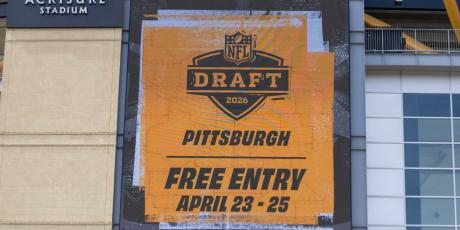
The 2026 NFL Draft begins at 8 p.m. ET on Thursday, April 23rd, with the first round. The second and third rounds will be held on Friday (beginning at 7:00 p.m. ET), while the remainder of the draft will finish up on Saturday (12 p.m. ET).
Throughout the first round, I'll be updating this page with player evaluations from the Rookie Draft Profiles produced by our partners over at Dynasty League Football. I'll also add receiver evaluation from Matt Harmon (Reception Perception). Finally, I'll add my own fantasy spin based on the player's opportunity, draft capital, and landing spot.
I'll be back on Friday to cover the second and third rounds as well.
Reminder: Get 25% off any 2026 season subscription using the code JOHN25.
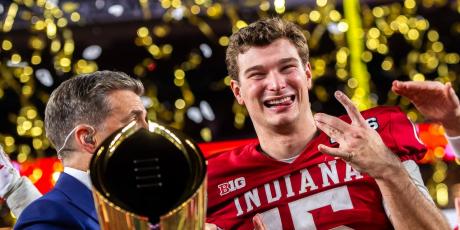
1.01 - Raiders - QB Fernando Mendoza, Indiana
DLF Dynasty Profile: Mendoza isn't a "can't miss" prospect like Peyton Manning or Andrew Luck, but what he did last season at Indiana really can't be denied. After all, he threw for 3,535 yards and 41 touchdowns while throwing just six interceptions en route to leading perennial doormat Indiana to the National Championship. Mendoza is going to be the top overall pick of the Las Vegas Raiders unless something really unusual happens. While his rushing ability (or inability) is a concern in terms of his dynasty ceiling, Mendoza looks like an accurate passer who has a pretty high floor. Clearly the QB1 this year, he'll be a high pick in 2QB leagues and a fringe first-rounder in conventional formats this Spring.
Opportunity: B+
Paulsen’s Fantasy Analysis: Mendoza is the clear QB1 in this class after leading Indiana to a national title and a Heisman. The advanced profile is rare: a 98th-percentile PFF Pass Grade (90.7), 94th-percentile Adjusted Completion % (79.0), and 98th-percentile yards per attempt (9.3). He wasn't manufacturing that efficiency underneath either. His aDOT sat at 9.8 yards. Forty-one touchdowns against six picks across 16 games.
The landing spot has pieces. Brock Bowers is a top-three fantasy tight end, Ashton Jeanty should take a leap in Year 2 under Gary Kubiak's run-heavy scheme, and the Tyler Linderbaum signing shores up the interior line. The receiver room is the problem—Tre Tucker, Jack Bech, Jailen Nailor, and Dont'e Thornton are underwhelming, and Kubiak's play-action-heavy system could cap passing volume. Kirk Cousins adds a short-term murky timeline, though most first-overall QBs are starting within weeks. My rookie QB model projects 15.6 rushing yards per game. Mendoza looks like a back-end QB2 in redraft with a ceiling tied to the weapons around him, and the Raiders may add a receiver or two in the Draft.
1.03 - Cardinals - RB Jeremiyah Love, Notre Dame
DLF Dynasty Profile: In the mold of "can't miss" running back prospects like Saquon Barkley and Bijan Robinson, Love enters the 2026 NFL Draft as the most coveted prospect on the board, regardless of position or format. It's hard to argue as the former Notre Dame Fighting Irish star averaged nearly seven yards per carry not just last season, but the last two years combined. He needs to show a little more in the passing game (63 career catches), but the key number dynasty managers are focusing on is "40" as he scored 40 touchdowns the past two years and ran the 40-yard dash in a sizzling 4.36 at the NFL Draft Combine. Love looks like a player who will be taken with the 1.01 and immediately become a top-10 dynasty asset upon his arrival to the NFL.
Opportunity: A
Paulsen’s Fantasy Analysis: Love is the best pure running back prospect since Saquon Barkley, and the PFF data backs it up. He posted a 98th-percentile PFF Run Grade (93.7), a 93rd-percentile yards after contact per attempt (4.5), a 92nd-percentile PFF Elusive Rating (127.5), and a 95th-percentile yards per route run (1.83)—a four-stat profile that screams three-down workhorse. The receiving chops matter here; Notre Dame's Marcus Freeman has said he thinks Love could play wide receiver at the next level. (I heard Christian McCaffrey comparisons before the pick was made.)
Arizona is a fascinating landing spot. The Cardinals moved on from Kyler Murray and are rolling with Jacoby Brissett/Gardner Minshew for now, which caps the passing game upside but should mean heavy volume for Love from Day 1. Mike LaFleur's scheme values tempo and playmaking ability out of the backfield, and the Cardinals' backfield was a complete wasteland last year—no back even hit 100 carries. Love walks into an immediate bell-cow role with minimal competition. The quarterback situation limits his ceiling in PPR formats, but the volume floor should be rock solid. I view him as a low-end RB1/high-end RB2 in early fantasy drafts.
1.04 - Titans - WR Carnell Tate, Ohio State
DLF Dynasty Profile: Tate's 51/875/9 season won't knock anyone's socks off, but we've all seen what Ohio State receivers do in the NFL - they perform. Tate isn't the fastest receiver in the class (he ran a 4.53 40-yard dash at the NFL Draft Combine), but he has plenty of juice, nonetheless. The best thing Tate has going for him is an elite skill set when it comes to tracking and catching the football. While lost in the shadow of Jeremiah Smith for much of the season, Tate has a chance to be a WR1 in the NFL, and his landing spot could put him in the mix to be the first receiver taken in rookie drafts this spring.
Harmon: A player like this can be an early starter and will, at worst, grow into being a strong No. 2 receiver. However, there are plenty of scenarios where a refined technician who is an explosive option downfield can become a featured weapon. Tate will be similarly ranked to where I placed Tetarioa McMillan in last year’s class, if that helps you frame where I’m at with the latest Ohio State star. Neither were flawless prospects, but their strengths shone bright. McMillan was taken in the top-10, an instant starter as the X-receiver in Carolina, and has a good rookie season with room to improve down the road. All of that should be available for Tate, as well.
Opportunity: A-
Paulsen’s Fantasy Analysis: Tate is the alpha receiver in this class, and the profile is about as clean as it gets for fantasy purposes. He posted a 98th-percentile PFF Receiving Grade (89.0), a 97th-percentile yards per route run (3.02), and a 97th-percentile contested catch rate (85.7)—all while running an 84th-percentile aDOT (14.6). He had zero drops on the season. He's a big-bodied X receiver who wins downfield and in traffic, lined up almost exclusively on the outside (89% wide rate, just a 21st-percentile slot rate). That profile translates immediately.
The landing spot is a significant upgrade for Cam Ward, who had very little to work with on the outside last year. Pairing Tate with Wan'Dale Robinson in the slot gives Tennessee a legitimate 1-2 punch, with Tate commanding targets downfield while Robinson works underneath. Ward's aggressiveness as a passer should feed Tate's contested-catch ability, and the Titans should be playing from behind often enough to keep the volume flowing. The YAC upside is limited (40th-percentile yards after catch per reception), so Tate's fantasy value will be tied to touchdowns and air yards rather than chunk plays after the catch. He looks like a solid WR3 range in redraft with upside from there.
1.08 - Saints - WR Jordyn Tyson, Arizona State
DLF Dynasty Profile: Tyson is in the mix to be the top receiver off the board in rookie drafts based not on his numbers, but on his athletic profile. After all, his 61/711/8 line in nine games wasn't exactly dominant. However, his athleticism score at the NFL Draft Combine placed him #1 overall, and much of his struggles can be attributed to some offensive woes at Arizona State, combined with the fact that he missed some time last season. The great thing about Tyson is that it seems he has the versatility to play any receiver spot on the field, something that should make him pretty desirable in the first round of both the NFL Draft and rookie formats as well.
Harmon: Ultimately, [Amari] Cooper was good, if not a great NFL player, in stretches of his career, but never quite strung together consistent moments for a single team. That’s where I’m at with Tyson as a prospect, but I am very much open to him rounding into a steadier player with the right coaching and hard work from him. He’s a Round 1 prospect without a doubt and could be a great complementary receiver for a healthy passing game, but there’s work to be done to reach the potential his natural talent so obviously presents him.
Opportunity: A-
Paulsen’s Fantasy Analysis: Jordyn Tyson's calling card is athleticism, and the numbers confirm it—a 97th-percentile PFF Receiving Grade (85.3) and an 84th-percentile yards per route run (2.37) in just nine games at Arizona State. He drew a massive 97 targets on 300 routes, showing the kind of target-earning that translates immediately to fantasy relevance. He lined up mostly outside (75% wide rate) but mixed in enough slot work (25%) to project as versatile in the NFL.
The fit alongside Chris Olave makes sense. Olave is the polished route technician who wins with separation; Tyson is the higher-volume target hog who can eat all over the field. Together, they give Tyler Shough a legitimate 1-2 receiver pairing for the first time in his tenure, which is quietly great news for managers looking at him as a streaming QB2. The contested catch rate (38th percentile) and YAC per reception (35th percentile) aren't special—Tyson wins with volume and route craft, not physicality after the catch. That makes his floor safer than his ceiling in fantasy. Think WR3/WR4 in redraft with WR2 weeks when the target share holds; a solid but not elite dynasty asset whose value is closely tied to how much Shough develops.
1.13 - Rams - QB Ty Simpson, Alabama
DLF Dynasty Profile: It's been a long time since we've seen such a gap between the top two quarterbacks as big as the one perceived to be there between top pick Fernando Mendoza and Simpson, the possible QB2 in this year's class. Simpson waited his turn at Alabama and was good last year with 3,567 passing yards and 28 touchdowns with just five interceptions. Still, he faded a little down the stretch and was never really a dominant force, despite having talent other quarterbacks would salivate over. Simpson is a project who may need a year or two learning on the job, especially after only starting for one season. He seems like a worthy mid-round pick in conventional formats and a likely second-rounder in 2QB / Superflex leagues.
Opportunity: C
Paulsen’s Fantasy Analysis: Ty Simpson’s arm talent is obvious—an 85th-percentile PFF Pass Grade (81.4) and an 85th-percentile big-time throw rate (6.0%) tell you he can make every throw on the field. But the efficiency metrics lag well behind Fernando Mendoza's: a middling 59th-percentile yards per attempt (7.5) and a 76th-percentile Adjusted Completion % (75.3) that doesn't quite crack the elite tier. The 28 touchdowns to just five interceptions over 15 games look clean on the surface, but the turnover-worthy play rate (3.0%) suggests he was getting away with some aggressiveness that the NFL will punish.
For fantasy, this is a redshirt year, maybe more. Matthew Stafford is still the starter, and the Rams aren't in any rush—this is a succession plan, not a Week 1 competition. The good news is that the infrastructure is elite when Simpson's time comes. Puka Nacua anchors a good supporting cast, and Sean McVay's scheme has historically been quarterback-friendly. Simpson's rushing ability (33 scrambles, 11.5 projected rushing yards per game per my Rookie QB Model) adds a floor that Stafford never provided in this system.
1.16 - Jets - TE Kenyon Sadiq, Oregon
DLF Dynasty Profile: We've been given a host of elite tight ends over the past few seasons, and Sadiq may just be the next one. His 51/560/8 line at Oregon last season doesn't tell the whole story, but his NFL Draft Combine performance just might. He simply dominated in Indianapolis, running a 4.39 40 (a record for a tight end) as well as posting a 95 (#1 tight end) in terms of an athleticism score based on NFL Next Gen stats. His versatility as a blocker and pass-catcher will be coveted by NFL teams and dynasty managers alike. While he may be a step down from players like Trey McBride or Brock Bowers when it comes down to it, Sadiq still projects as a long-term top-tier TE1 in dynasty leagues, and that's going to merit first-round consideration in rookie drafts this spring.
Opportunity: B
Paulsen’s Fantasy Analysis: Kenyon Sadiq is a unicorn athlete at the tight end position. Per Player Profiler, he tested at the 100th percentile in the 40-yard dash, 100th percentile in Speed Score, 100th percentile in Burst Score, and 99th percentile in Catch Radius—a Vernon Davis-level athletic profile. Oregon deployed him accordingly, lining him up in the slot at a 90th-percentile rate (58.5%) among all tight ends in the PFF dataset. This isn't a blocking tight end who happened to run fast at the combine; this is a movable chess piece who can stress defenses from every alignment.
The landing spot has some friction. The Jets already spent a Day 2 pick on Mason Taylor last year, and he led the team in receptions as a rookie. But Sadiq's skill set is different enough to coexist—he's the field-stretching slot weapon while Taylor profiles more traditionally. The bigger issue is the quarterback situation. Geno Smith is a bridge, this offense ranked 29th in scoring last year, and target competition with Garrett Wilson and Breece Hall will cap volume early. Sadiq is a top dynasty TE with legitimate TE1 upside once New York finds its long-term answer at quarterback, but temper expectations for 2026 redraft—think back-end TE2 with splash weeks driven by that absurd athletic profile.
1.20 - Eagles - WR Makai Lemon, USC
DLF Dynasty Profile: This version of the NFL Draft brings us three blue-chip receivers who are all battling it out to be the WR1. Lemon's season at USC puts him squarely in the mix as he caught 79 passes for 1,156 yards and 11 touchdowns in his breakout campaign. Dynasty managers may choose to gravitate towards Lemon because he projects as what could be a dominant slot receiver and PPR threat in fantasy leagues. He may also be the most NFL-ready pass catcher in the class, as he's been praised repeatedly for his route-running and precision. He may not be as dangerous as some after the catch, but Lemon's floor is very high, and the bust chance with him seems low - perfect for a top pick in a rookie draft.
Harmon: Makai Lemon just checks so many boxes. At worst, he looks like an extremely quarterback-friendly and reliable slot option who can make your passing game better extremely early on in his career. He has the feel for the zone and spatial awareness to get open and be where quarterbacks expect him to be. That’s incredibly valuable all on his own. However, there are parts of his profile that are just so similar to Jaxon Smith-Njigba. It took until Year 3 for JSN to be unleashed as a perimeter option, and his former OC Klint Kubiak helped him out by making him a condensed X-receiver when he was lined up on-ball. Still, Smith-Njigba always demolished man coverage as a pro even before 2025, and he laid the groundwork for proving those skills in his RP prospect profile back in 2023. Lemon has put forth a similar case and is someone who, in the right environment, could end up having the highest production-based ceiling in the class, even if his ceiling case won’t be perfectly expressed in all 32 passing attacks.
Opportunity: A
Paulsen’s Fantasy Analysis: Makai Lemon's PFF profile is elite. He finished with the highest PFF Receiving Grade (91.4) among all 444 qualifying wide receivers—a 99th-percentile mark—and paired it with a 98th-percentile yards per route run (3.13) and a 91st-percentile contested catch rate (71.4%). He won the Biletnikoff Award doing his damage primarily from the slot (70.6% slot rate), which is where he'll likely live in Philadelphia. The aDOT (10.3) sat at just the 35th percentile, meaning Lemon wins with route craft and ball skills in the short-to-intermediate range rather than as a vertical threat. I’m hearing comparisons to Amon-Ra St. Brown and Julian Edelman. Not bad.
The Eagles are clearly preparing for life without A.J. Brown, who is widely expected to be traded to the Patriots after June 1. That would leave DeVonta Smith as the clear WR1 on the outside, with Dontayvion Wicks and Marquise Brown competing for the other outside role. Lemon fits in as the high-volume slot piece in an offense that Jalen Hurts and the Saquon Barkley-led run game will keep efficient. The target path is there—108 targets in 12 games at USC shows the kind of usage rate that translates. The concern is the aDOT-driven ceiling; Lemon's fantasy weeks will be built on receptions and YAC rather than deep shots, which puts a slight cap on his boom potential. Think a higher-floor, lower-ceiling WR3/WR4 in redraft with weekly PPR value; a strong dynasty asset whose role clarity in Philly makes him one of the safer receiver picks in this class.
1.24 - Browns - WR KC Concepcion, Texas A&M
DLF Dynasty Profile: Concepcion transferred from North Carolina State to Texas A&M, and that proved to be a solid decision as he posted 61 catches for 919 yards and nine touchdowns in one of the toughest conferences in the country. Even better, Concepcion posted a whopping 15.1 yards per catch, showing elite-level burst and short-area speed in the process. He isn't a great run blocker and may project as more of a WR2 at the NFL level, but Concepcion seems like a player who is just now hitting his stride and could be a late bloomer. He seems destined to be a mid-first-round pick in rookie drafts as a player who may have a higher ceiling than most think.
Harmon: KC Concepcion is one of my favorite wide receiver prospects in the 2026 NFL Draft. Outside of a few frustrating drops, his Reception Perception profile is pretty unimpeachable. He demolishes man and press coverage, is a reliable target against zone coverage and makes plays above the rim and with the ball in space. You really can’t ask for much more out of a Round 1 receiver prospect. Concepcion has the skills and traits you need to be a high-volume option in modern offenses that emphasize three-position players at wide receiver and targets deployed off of motion. If he strings together all of his skills, he could even push to be a featured option in a strong passing game at some point in his career. I’ll likely have him ranked above consensus and would be comfortable taking him in the top-20 picks in any NFL Draft, even more so in the 2026 crop.
Opportunity: B+
Paulsen’s Fantasy Analysis: Concepcion is one of the most well-rounded receivers in this class. He posted a 91st-percentile PFF Receiving Grade (79.9), an 88th-percentile yards per route run (2.46), an 89th-percentile contested catch rate (66.7%), and an 89th-percentile yards after catch per reception (7.2)—four key stats all landing in the top 11% of the position. That's a rare combination of route-winning ability and playmaking after the catch. He's versatile in his alignment too, splitting time between the outside (65%) and slot (34%), which should make him scheme-proof at the next level. The one red flag: a 10.3% drop rate that will need to be cleaned up.
The landing spot is a fantasy headache, at least for 2026. Cleveland's quarterback situation is a mess. Dillon Gabriel, Shedeur Sanders, and Deshaun Watson will all compete for the job this summer, and none inspired confidence last year. Browns passers combined for the worst passer rating in the NFL (71.8), and whoever wins the job is working behind an offense that ranked near the bottom of the league in virtually every passing metric. Concepcion has the talent to be a WR2 in better circumstances, but the quarterback play puts a hard ceiling on his Year 1 output. On the bright side, he doesn't have much competition for targets. Harold Fannin (107) and Jerry Jeudy (106) led the Browns in targets, and Concepcion has the talent to immediately usurp Jeudy as the team's WR1. Consider him a WR3/WR4 fo the time being. He has signficant upside if the Browns' QB situation is better than expected.
1.30 - Jets - WR Omar Cooper Jr, Indiana
DLF Dynasty Profile: Cooper teamed up with Fernando Mendoza last season at Indiana to create a lethal combination at quarterback and receiver. His 69 catches and 937 yards led the team, and he also posted 13 touchdowns in just 15 games, including a score in six straight contests. He played primarily in the slot last year, which is making PPR dynasty managers salivate, but he also has the ability to play on the outside, showing some versatility that NFL Draft scouts will love. Cooper doesn't look like a player in the top tier of receivers this season, but he could be a nice consolation prize later in the first round in a rookie draft.
Harmon: Cooper is a talented player with the right makeup and mindset to maximize his potential. While he will bring immediate juice to any room with his ability to win as a run-after-catch and tackle-breaking machine, there is more to his game than that. He’s got the makings of a solid route-runner against man coverage and is already a strong zone-beater. We’ve seen receivers like Deebo Samuel, who might be the peak of this archetype, be average to below average man-beaters in their best years and still put up monster numbers thanks to their zone coverage success. That path is available for a guy like Cooper, but there are parts of his game where you can imagine a more dynamic player against man coverage. If that development happens for Cooper, he has a higher ceiling in the league.
Opportunity: B-
Paulsen’s Fantasy Analysis: Cooper was Fernando Mendoza's running mate on Indiana's national championship team, and the production profile translates. He posted a 97th-percentile PFF Receiving Grade (86.0), a 90th-percentile yards per route run (2.55), and an 89th-percentile yards after catch per reception (7.2) across 16 games. He's a slot-dominant receiver—81st-percentile slot rate (83.3%)—who does his damage on short-to-intermediate routes (30th-percentile aDOT at 9.7) and creates after the catch. Thirteen touchdowns on 91 targets show he was a high-efficiency red zone weapon, and the targeted passer rating of 143.2 confirms his quarterback was better when throwing his way.
The Jets desperately needed a receiver to pair with Garrett Wilson, and Cooper fills a different role than Wilson entirely. Wilson is the outside alpha; Cooper is the YAC-driven slot piece who can move the chains underneath. I’m hearing Deebo Samuel comparisons. That's a complementary fit, and it should give Geno Smith a reliable short-area target he lacked in Las Vegas. The concern is the same one hovering over every Jet: Smith is a bridge quarterback on a rebuilding team that went 3-14 last year. Volume will be split with Wilson, Breece Hall, Adonai Mitchell, and Kenyon Sadiq. Cooper is a back-end WR4 in redraft with boom-or-bust weekly variance.
1.32 - Seahawks - RB Jadarian Price, Notre Dame
DLF Dynasty Profile: Perhaps the biggest wild card of the NFL Draft, Price backed up Heisman Trophy finalist (and projected RB1 this year) Jeremiyah Love at Notre Dame. He may actually be more of a natural runner than Love, but he doesn't quite have the same athletic profile. Still, he posted 674 rushing yards and 11 touchdowns on a solid 6.0 yards per carry last season for the Fighting Irish, showing a nose for the end zone in the process. There is a clear risk here as we haven't seen enough of Price to really know how good he is, but there's also a pretty high ceiling that exists, despite his lack of pass-catching chops. Price looks like a solid selection around the end of round one or round two as we look ahead to the 2026 NFL Draft.
Opportunity: A+
Paulsen’s Fantasy Analysis: Jadarian Price is a small-sample wildcard. Playing behind Jeremiyah Love at Notre Dame, he logged just 113 carries, making this more of a traits-based projection than a proven production pick. What he did with his touches was encouraging: a 90th-percentile PFF Elusive Rating (118.6), an 84th-percentile yards after contact per attempt (3.92), and 6.0 yards per carry on the ground. Eleven touchdowns on 119 total touches is an absurd scoring rate. The concern is the complete absence of receiving work—just six receptions on seven targets (6th-percentile route count), which leaves a massive question mark about his three-down viability at the next level. He did catch 55 passes in 22 games in his final two seasons in high school, which is encouraging.
Seattle needs him right away. Kenneth Walker III is gone, Zach Charbonnet is rehabbing a torn ACL, and Emanuel Wilson was signed as a complementary piece, not a lead back. Price should step into the RB1 role from Week 1 in an offense that leaned heavily on the run under Klint Kubiak last year before Kubiak left for Las Vegas. The volume path is there, but the receiving profile is a real question mark for PPR formats. If Price can't earn passing-down work, Wilson or Charbonnet (when healthy) could siphon the most fantasy-valuable snaps. He’s an RB2 in redraft with a wide range of outcomes, especially if he can prove he can catch the ball.