NFL Offensive Line Rankings Week 4: Matchups to Exploit

 Make us preferred on Google
Evaluating offensive line play through a fantasy football lens can uncover matchup advantages that aren’t always obvious from traditional rankings or defensive fantasy points allowed.
Each week, we’ll rank all 32 offensive lines, track the biggest movers, and compare those units against the opposing defense’s adjusted fantasy points allowed (aFPA) to identify the quarterback, running back, and D/ST matchups most affected by play in the trenches.
For Week 4, the Lions, Bears, and Vikings stand out among the strongest offensive line and matchup combinations on the slate. Miami, Philadelphia, and Cleveland provide several attractive D/ST and downgrade opportunities, while Carolina and the Jets continue to move in the wrong direction following injuries and poor underlying results.
With aFPA now updating weekly, those rankings provide a more current picture of each matchup. The three-game sample can still be influenced by opponent quality, game script, and offensive efficiency, so aFPA should remain one part of the evaluation alongside blocking performance, injuries, and expected player usage.
Editor’s Note: Check out the complete set of Week 4 fantasy football rankings here.
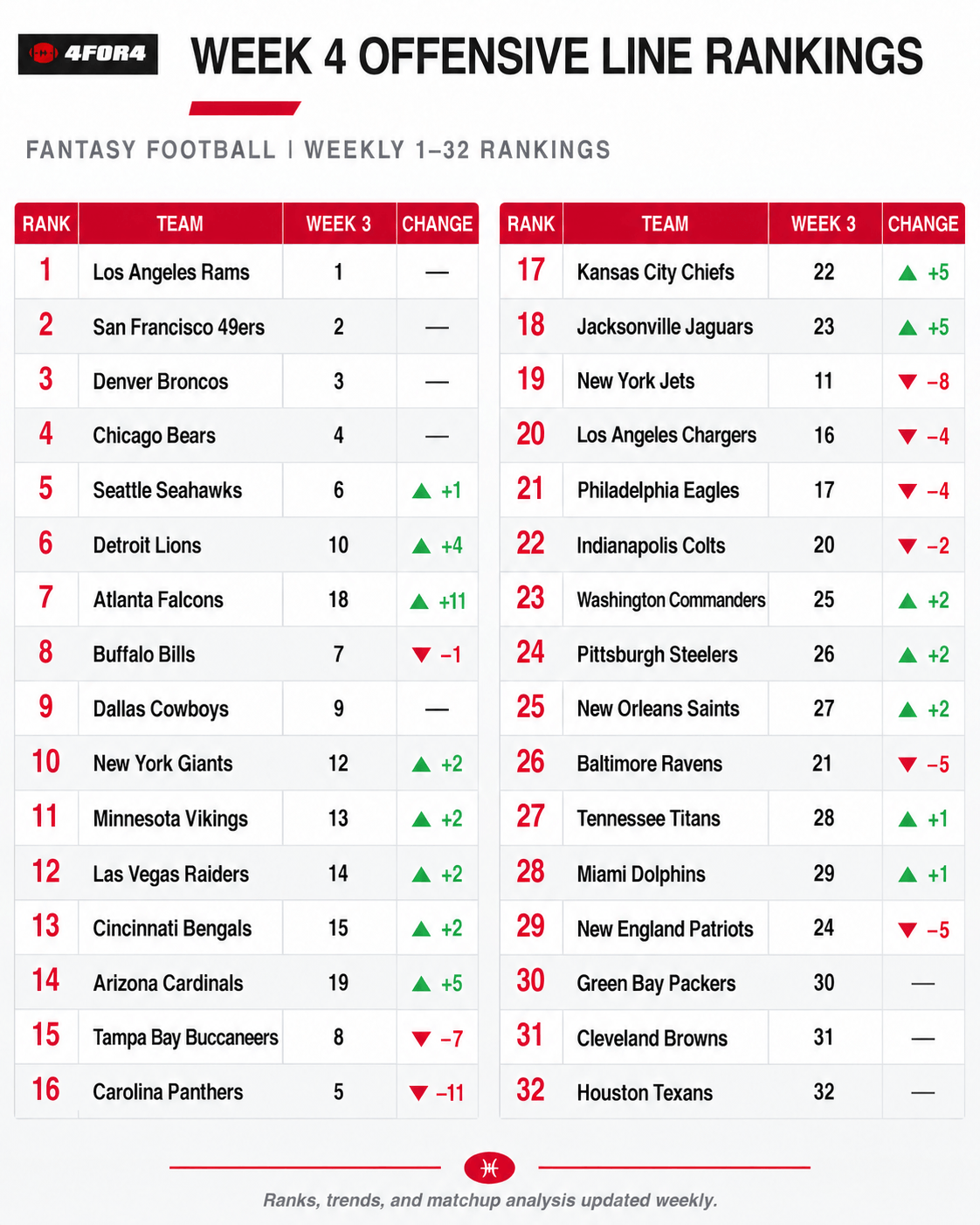
These rankings reflect overall offensive line performance, injuries, recent play, and how each unit is trending entering the week. The change column compares each team’s Week 4 ranking with its Week 3 ranking.
Biggest Offensive Line Risers and Fallers
Risers
Atlanta Falcons (+11)
Atlanta makes the largest jump of the week after producing one of the league’s most balanced three-game blocking profiles.
The Falcons rank third in pressure rate, sixth in running back yards before contact, seventh in blown-block rate, and eighth in adjusted line yards. Their 9.3% adjusted sack rate is the lone obvious blemish, but that number has been inflated by Cooper Rush converting 38.5% of his pressured dropbacks into sacks. Michael Penix Jr. did not take a single sack in his Week 3 sample.
Chris Lindstrom has been the foundation of that success. He is one of only two qualified offensive linemen who has not allowed a pressure this season, while Atlanta’s entire starting five played all 71 offensive snaps against Green Bay. The combination of continuity and strong performance in both phases pushes the Falcons from 18th to seventh.
Arizona Cardinals (+5)
Arizona’s five-spot rise is almost entirely driven by its pass protection.
The Cardinals rank first in pressure rate, third in Pressure Rate Over Expectation, and sixth in adjusted sack rate through three games. Paris Johnson Jr. has continued to provide high-level protection on the edge, and the unit held up well enough for the passing game to remain productive against San Francisco.
The running game has not received the same support. Arizona ranks 25th in running back yards before contact, preventing the line from making a more aggressive climb. Still, the protection results are too strong to leave the Cardinals in the bottom half of the rankings, moving them from 19th to 14th.
Fallers
Carolina Panthers (-11)
Carolina’s Week 3 performance was concerning enough before Damien Lewis’ injury carried those problems into another matchup.
The Panthers allowed pressure on 51% of Bryce Young’s dropbacks against Cleveland, while the Browns repeatedly reset the line of scrimmage and eliminated the available rushing lanes. Carolina now ranks last in blown-block rate, 25th in pressure rate, and 22nd in Pressure Rate Over Expectation.
The run-blocking metrics remain inside the top 10, and Cleveland’s disruptive defensive front provides some opponent context. However, Lewis was Carolina’s best individual blocker and will miss Week 4 with a UCL injury in his elbow, a setback that could end up holding him out for “a few weeks”. With the protection already trending downward, his absence pushes the Panthers from fifth to 16th.
New York Jets (-8)
Geno Smith’s ability to produce under pressure has concealed one of the league’s weakest three-game blocking profiles. His 9.0 YPA against pressure ranks behind only Patrick Mahomes (10.7).
The Jets rank inside the bottom six in pressure rate, Pressure Rate Over Expectation, adjusted line yards, and blown-block rate. Their running backs are averaging only 0.67 yards before contact, the second-lowest mark in the league, while Smith has already taken nine sacks through three games.
The unit also lost starting left guard Dylan Parham to a knee injury against Detroit, and it’s looking like his Week 4 status is in jeopardy. Jordan Meredith struggled after replacing him, including a missed block on the game-sealing strip-sack. New York has added Nick Dawkins and Jimmy Morrissey to the practice squad, but those depth moves do not resolve the immediate interior concerns. The Jets fall from 11th to 19th.
Week 4 Fantasy Impact Players Helped by Their Offensive Line Matchup
A strong or weak offensive line matchup shouldn’t completely override volume, talent, or game environment, but it can help break ties between similarly ranked fantasy options.
Among the biggest Week 4 beneficiaries:
- Matthew Stafford, Rams: Los Angeles owns the top spot in this week’s offensive line rankings and now faces a Philadelphia defense ranked 22nd in QB aFPA. Stafford is projected for 16.1 fantasy points as the QB20, placing him directly in the Superflex and deeper-league streaming conversation. The Rams’ strong run blocking should also keep the offense out of obvious passing situations and create opportunities for play-action.
- Jared Goff, Lions: Detroit’s restored offensive line ranks sixth after rebounding in Week 3, while Carolina enters the matchup ranked 26th in QB aFPA. Goff projects for 18.9 fantasy points as the QB6, and the Panthers will be without their top two cornerbacks. Amon-Ra St. Brown remains an automatic start, while Sam LaPorta and Jameson Williams receive additional matchup-driven upside.
- Aaron Jones, Vikings: Minnesota’s offensive line has performed considerably better than its sack totals suggest, with strong pressure, PrROE, and blown-block marks through three weeks. Jones now faces a Miami defense ranked 31st in RB aFPA and projects for 15.2 fantasy points as the RB15. That combination keeps him firmly in the RB2 conversation with legitimate top-12 upside if he finds the end zone.
- D'Andre Swift and Kyle Monangai, Bears: Chicago’s fourth-ranked offensive line continues to produce one of the league’s strongest rushing profiles. The Bears now face a Jets defense ranked 27th in RB aFPA, giving Swift one of the slate’s largest positive line-versus-matchup discrepancies. Swift projects for 16.3 fantasy points as the RB9, while Monangai’s 7.9-point projection makes him a deeper FLEX consideration.
- Bucky Irving, Buccaneers: Tampa Bay’s offensive line has fallen to 15th, but its matchup against the league’s 32nd-ranked defense in RB aFPA provides an opportunity to lean on the running game while Jalon Daniels starts for the injured Baker Mayfield. Irving projects for 11.6 fantasy points as the RB24. The blocking concerns lower his floor, but the matchup and potential volume keep him in RB2/FLEX consideration.
Best Quarterback and Passing Game Matchups
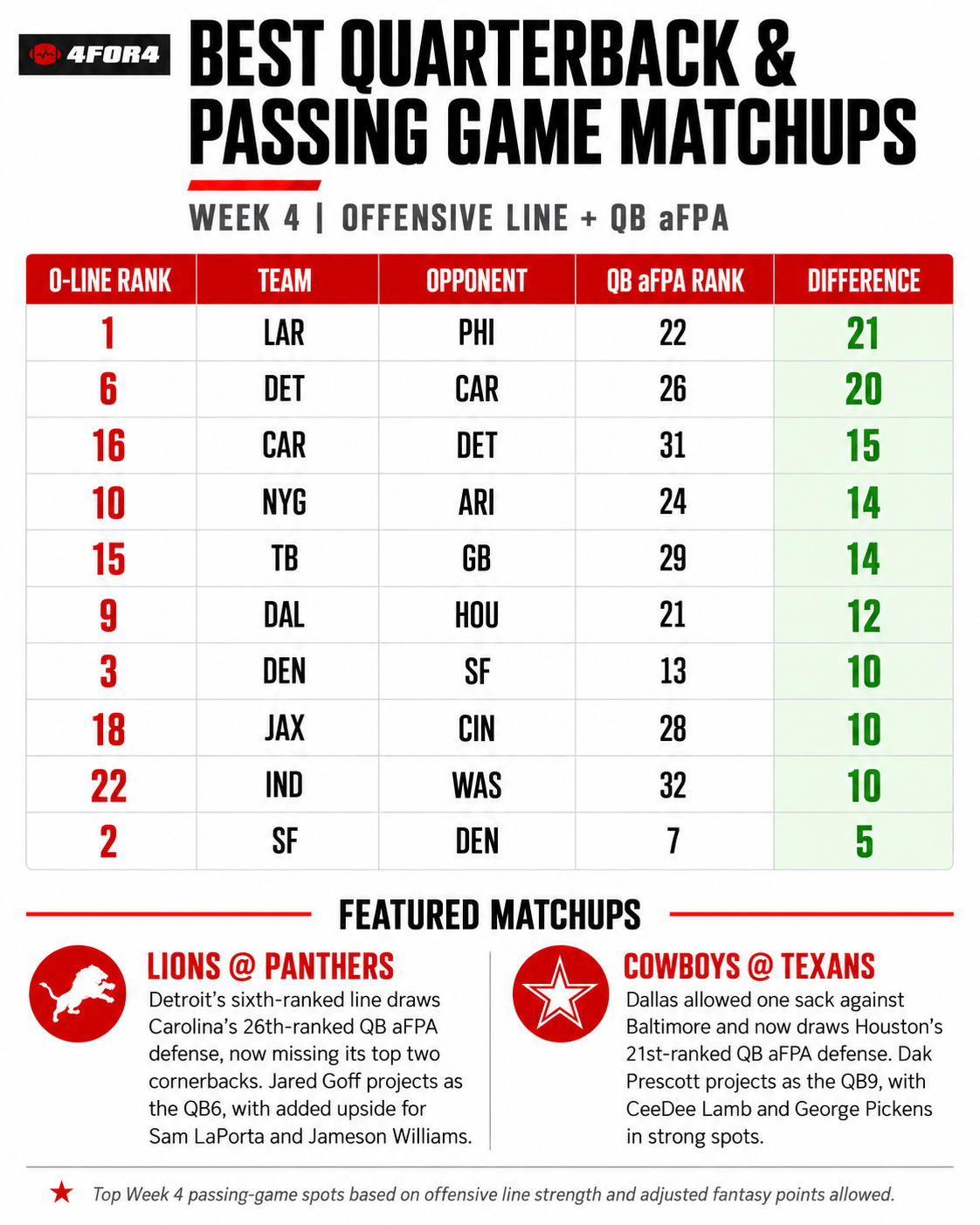
Lions at Panthers
Detroit’s offensive line climbs to sixth after getting Christian Mahogany and Blake Miller back into the starting lineup. The Lions now rank inside the top 10 in pressure rate, Pressure Rate Over Expectation, adjusted line yards, and running back yards before contact.
Detroit generated 125 rushing yards between Jahmyr Gibbs and Sione Vaki in Week 3, while Jared Goff took only two sacks. One of those was charged to Gibbs after losing a pass-protection rep, further supporting the line’s performance.
Goff now faces a Carolina defense ranked 26th in QB aFPA. The Panthers will also be without their top two cornerbacks for at least four games, per Greg Auman, leaving an already favorable matchup even thinner in the secondary.
Goff projects for 18.9 fantasy points as the QB6. Amon-Ra St. Brown carries a 15.6-point projection as the WR2, while Sam LaPorta projects for 10.0 points against a defense ranked 26th in tight end aFPA. Jameson Williams is the most lineup-sensitive option of the group, but his 9.7-point projection and WR28 ranking give him a strong opportunity to rebound in one of the week’s best passing environments. It’s been a rough start, but a “boom” week could be on the horizon.
Cowboys at Texans
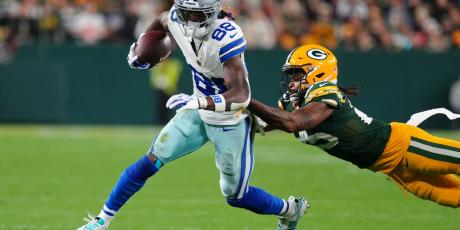
Dallas’ offensive line produced its best complete performance of the season against Baltimore, generating 148 rushing yards while allowing only one sack. That result came against a defense that entered Week 3 among the league leaders in pressure rate, making it a meaningful step forward after an uneven opening two weeks, and now it looks like guard Tyler Smith could be returning to the lineup as soon as Week 5.
The Cowboys rank ninth this week and now face a Houston defense ranked 21st in QB aFPA and 32nd in WR aFPA. Dak Prescott projects for 17.9 fantasy points as the QB9, while CeeDee Lamb and George Pickens rank as the WR4 and WR18.
This is not a completely clean matchup. Will Anderson Jr. and Danielle Hunter helped Houston pressure Daniel Jones on 46.3% of his Week 3 dropbacks, and Dallas’ season-long protection metrics remain closer to league average than elite. Prescott’s 6.7% pressure-to-sack rate has also helped limit the damage when protection breaks down.
Still, the improved performance against Baltimore and favorable fantasy results allowed by Houston make Prescott a strong QB1 option. Lamb remains an automatic start, while Pickens’ 12.0-point projection places him firmly in the WR2/FLEX conversation.
Fantasy Football D/ST Matchups to Target
Vikings D/ST vs. Dolphins
Miami’s offensive line produced a much cleaner Week 3 performance, keeping Malik Willis from taking a sack or quarterback hit against Kansas City. That result deserves credit, but it does not erase a three-game profile that still includes a poor adjusted sack rate, below-average Pressure Rate Over Expectation, and one of the league’s least stable offensive environments.
The Dolphins remain 28th in this week’s offensive line rankings and now face a Minnesota defense ranked third in QB aFPA and second in RB aFPA. Willis carries a 12.8-point projection as the QB32, while Jaylen Wright and Ollie Gordon are sitting in the RB4/5 desert.
Willis’ 26.5% pressure-to-sack rate creates additional upside when Minnesota wins up front. Miami’s Week 3 improvement may prevent this from being a complete calamity, but the combination of quarterback play, offensive line ranking, and a difficult matchup gives the Vikings one of the slate’s best D/ST ceilings.
Rams D/ST vs. Eagles
The Rams are rostered in 88% of leagues, but fantasy managers may be questioning whether to keep them active against Jalen Hurts, Saquon Barkley, and an offense that still carries considerable name value.
Philadelphia’s current atmosphere makes the matchup much more approachable. The Eagles have fallen to 21st in the offensive line rankings after another uneven game in which they produced only 248 total yards and seven points. Their run blocking and adjusted sack rate both rank in the bottom quarter of the league, while recurring communication issues have continued to create free rushers.
Los Angeles enters the matchup ranked 12th in QB aFPA and third in RB aFPA. Hurts’ mobility can erase some protection losses, but his 20% pressure-to-sack rate has not hidden the line’s recent problems. Barkley remains an automatic fantasy start, although the combination of Philadelphia’s blocking and the Rams’ early run-defense results lowers his efficiency ceiling.
This is not a reason to bench the Rams solely because the opponent is Philadelphia. Their ability to create negative plays against the Eagles’ struggling front keeps them firmly in the Week 4 starting conversation.
Best Running Back Matchups
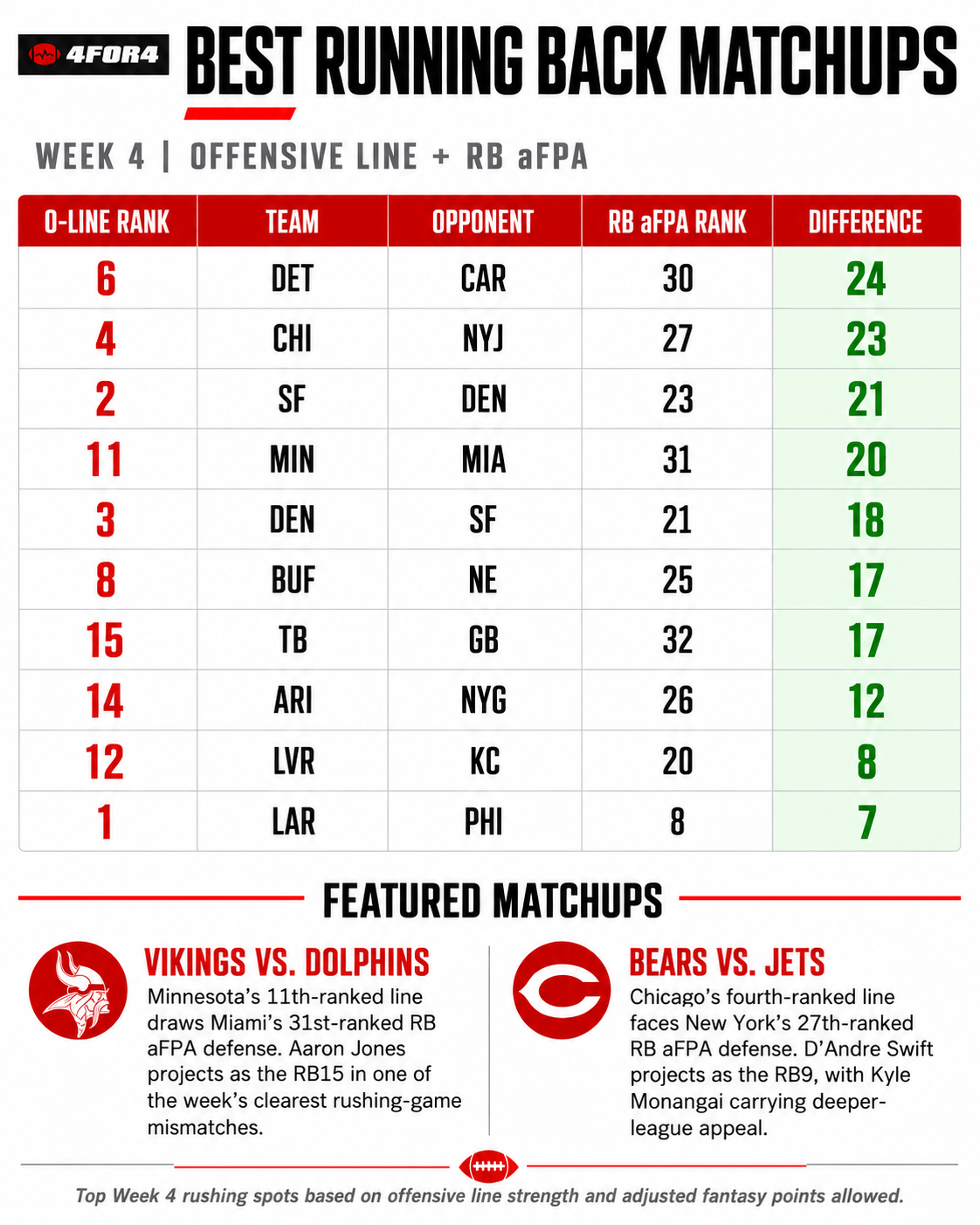
Vikings vs. Dolphins
Minnesota’s offensive line has produced a better three-game profile than its sack totals suggest. The Vikings rank well in pressure rate, Pressure Rate Over Expectation, and blown-block rate, with quarterback play accounting for part of the negative results that have occurred behind the unit.
Aaron Jones has been more than serviceable as he fights against father time, and his line has allotted him 2.25 yards before contact on the season; the 13th-best mark among 43 qualifying backs. He projects for 15.2 fantasy points as the RB15, while the Vikings are massive 10.5-point favorites, with a 25-point implied team total.
Bears vs. Jets
Chicago remains one of the league’s strongest run-blocking units despite falling from the top overall spot earlier this season. The Bears have consistently created space before contact, and their fourth-ranked offensive line continues to provide a strong foundation for the backfield, helping D'Andre Swift to notch a lowly 38.9% stuff rate, the 10th-best mark in the league.
That advantage should be especially useful against a Jets defense ranked 27th in RB aFPA. New York has also lost starting left guard Dylan Parham on the other side of the ball, potentially making it more difficult for the Jets to sustain drives and avoid a favorable rushing game script for Chicago.
Swift projects for 16.3 fantasy points as the RB9 and should remain the obvious priority in the backfield. Kyle Monangai projects for 7.9 points as the RB32, giving him deeper-league FLEX appeal and additional upside if Chicago controls the game.
Running Backs to Downgrade in Week 4
These players aren’t automatic sits, but their offensive line and defensive-front matchups lower their Week 4 ceilings:
- Saquon Barkley, Eagles: Philadelphia has fallen to 21st in the offensive line rankings after another poor rushing performance against Chicago. The Eagles now face a Rams defense ranked third in RB aFPA. Barkley projects for 15.4 fantasy points as the RB14 and remains an automatic start, but the blocking concerns and difficult opponent lower his overall ceiling.
- Alvin Kamara, Saints: New Orleans remains without Kelvin Banks Jr. while its offensive line adjusts to another altered starting combination. The Saints rank 25th entering a matchup with an Atlanta defense ranked fourth in RB aFPA. Kamara figures to continue splitting reps with both Kendre Miller and CJ Donaldson, and while he’s a fine plug-and-play fringe RB2/3, we’ve continued to see his per-touch efficiency nosedive over the last couple seasons.
- Omarion Hampton, Chargers: Los Angeles ranks 20th after finishing 29th in pressure rate, 30th in Pressure Rate Over Expectation, and 27th in RB yards before contact through three games. Joe Alt’s individual performance has improved without Maxx Crosby lining up against him, but the offense is still operating with instability at left guard and center while receiving less blocking assistance from an injured tight end room. Hampton projects for 10.2 fantasy points as the RB28 against a Seattle defense ranked 10th in RB aFPA, placing him closer to FLEX territory than a locked-in RB2.
- Quinshon Judkins, Browns: Cleveland ranks 31st after finishing inside the bottom four across all six primary offensive line metrics. Elgton Jenkins remains in the concussion protocol, creating the possibility of another lineup change at center on a short week. Judkins projects for 12.1 fantasy points as the RB20 against a Pittsburgh defense ranked 11th in RB aFPA. His workload keeps him usable, but the blocking environment and potential for early penetration limit his rushing ceiling.

How These Offensive Line Rankings Work
These rankings are designed specifically for fantasy football and are not intended to function as a pure evaluation of NFL offensive line talent.
The weekly process incorporates injuries, projected starters, recent performance, individual line play, and opponent context. Metrics such as pressure rate, blown-block rate, adjusted sack rate, adjusted line yards, and running back yards before contact help identify how each unit is performing in pass protection and the running game.
Pressure Rate Over Expectation provides additional context by comparing a team’s actual pressure rate with the rate expected based on its quarterback’s time to throw. That helps identify whether a quarterback is creating additional pressure by holding the ball or whether the offensive line is allowing disruption more quickly than expected.
Pressure rate and blown-block rate receive particular consideration because they more directly reflect offensive line performance. Sack rate remains useful for fantasy purposes, but quarterback decision-making, mobility, and pocket management can significantly affect the final result. Pressure-to-sack rate is used to help separate those quarterback effects from the protection itself.
Penalties receive very little weight and are generally referenced only when they become an extreme or repeated part of a unit’s performance.
The offensive line rankings are then compared with 4for4’s adjusted fantasy points allowed to quarterbacks and running backs. aFPA improves upon raw fantasy points allowed by accounting for the quality of each defense’s opponents and now updates weekly throughout the season.
Even with those adjustments, three games remain a relatively small sample. Matchup rankings should complement offensive line strength, injuries, expected player usage, and the quality of the opposing defensive front instead of replacing those evaluations.