NFL Offensive Line Rankings Week 9: Matchups to Exploit

 Make us preferred on Google
Evaluating offensive line play through a fantasy football lens can reveal matchup advantages that traditional rankings or defensive fantasy points allowed don't always show.
Each week, we’ll rank all 32 offensive lines, track the biggest movers, and compare those units against the opposing defense’s adjusted fantasy points allowed (aFPA) to identify the quarterback, running back, and D/ST matchups most affected by trench play.
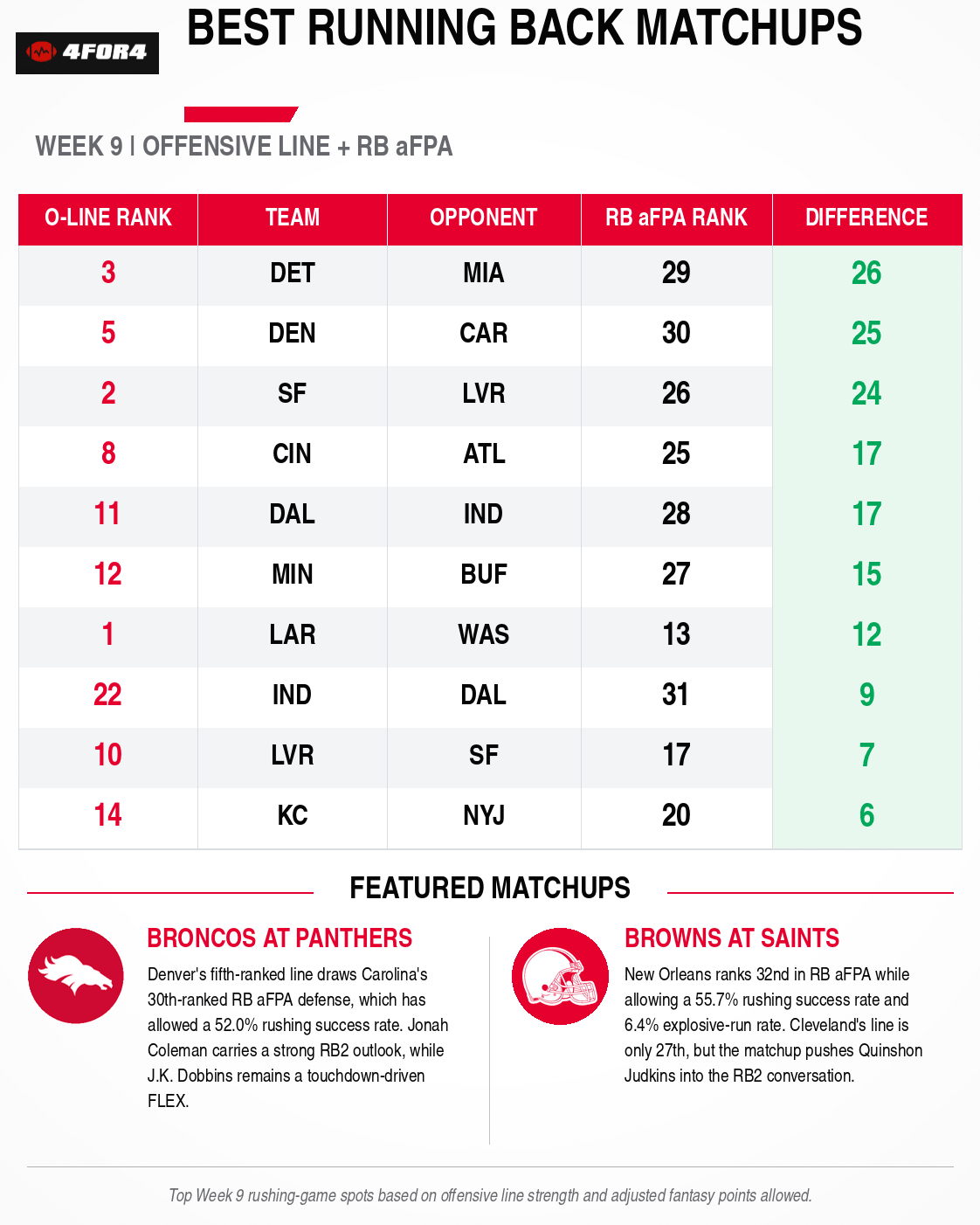
For Week 9, San Francisco and Seattle draw two of the slate’s most favorable passing matchups, while Detroit and Green Bay offer widely available D/ST options against struggling protection units. Denver has one of the week’s cleanest rushing setups, while Cleveland gets a chance to overcome its poor blocking results against the league’s most vulnerable run defense.
With eight weeks complete, aFPA provides a stronger opponent-adjusted sample, but underlying pressure and rushing metrics still help identify matchups where fantasy production and defensive performance tell different stories.
These rankings reflect overall offensive line performance, injuries, recent play, and how each unit is trending entering the week. The change column compares each team’s Week 9 ranking with its Week 8 ranking.
Editor’s Note: Check out the complete set of Week 9 fantasy football rankings here.
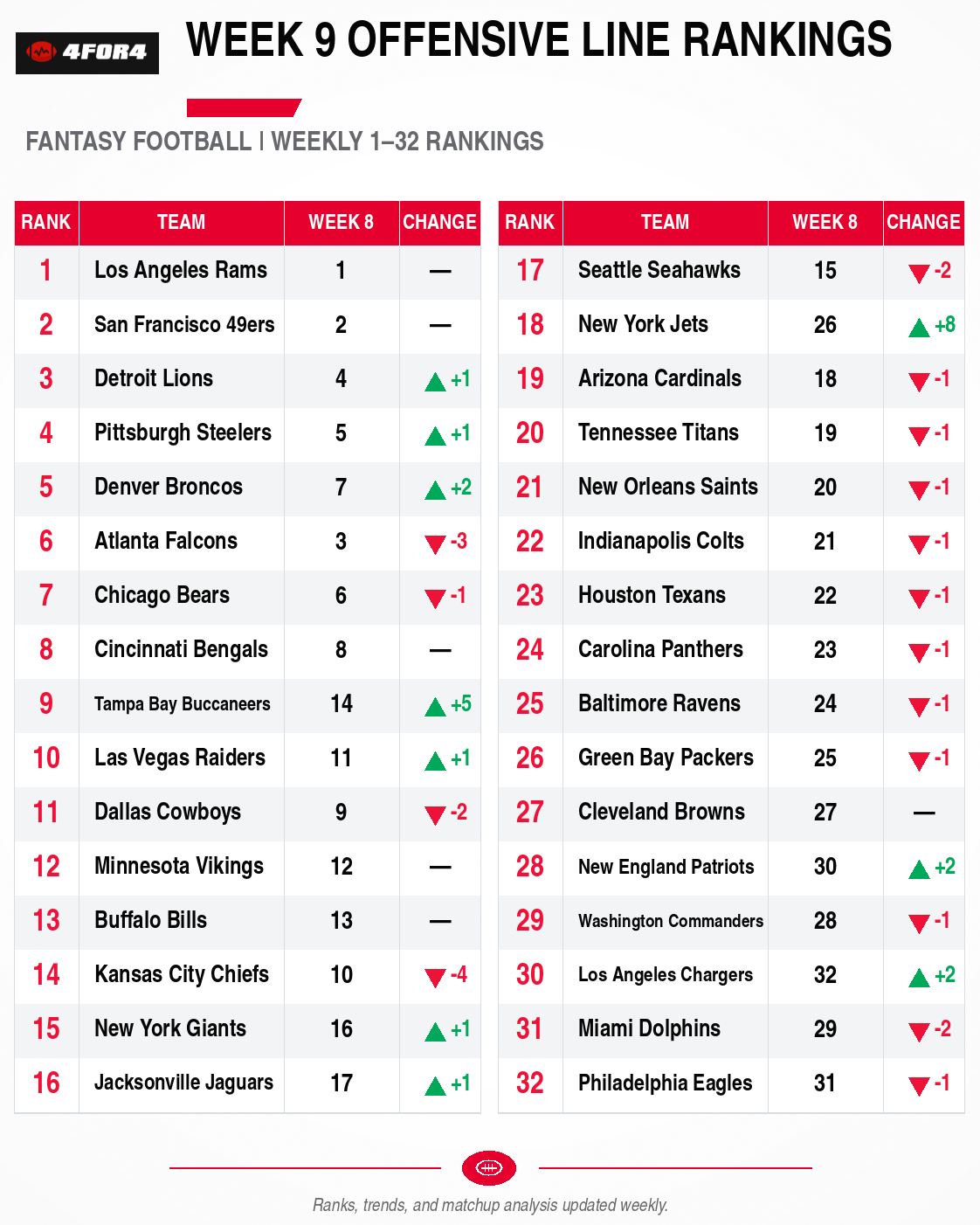
Biggest Offensive Line Risers and Fallers
Risers
New York Jets (+8)
The Jets make the week’s largest climb after producing legit improvement in both phases. New York’s pressure rate has fallen from 39.5% to 36.3%, while its Pressure Rate Over Expectation improved from +6.5% to +2.6%. The running game has jumped even more, with the Jets climbing to 11th in adjusted line yards and eighth in running back yards before contact.
The recent film supports the broader improvement. Olu Fashanu has begun settling in after an uneven start (see: Week 3), while Armand Membou has gone 102 consecutive pass-blocking snaps without allowing a sack or quarterback hit.
Tampa Bay Buccaneers (+5)
Tampa Bay’s rise is powered by a punishing rushing attack. The Buccaneers followed 241 rushing yards in Week 5 and 258 in Week 7 with a franchise-record 324 yards against Atlanta. Those performances have pushed Tampa Bay to 12th in adjusted line yards and ninth in running back yards before contact after a sluggish opening month.
The pass-protection profile remains less convincing. Tampa Bay ranks in the bottom half of the league in adjusted sack rate and Pressure Rate Over Expectation, preventing a larger jump. The line has still created enough consistent movement in the running game to establish an identity that was missing early in the season.
Fallers
Kansas City Chiefs (-4)
Kansas City’s strong rushing results and low sack total have hidden a protection profile that has become increasingly difficult to overlook.
The Chiefs rank fifth in adjusted line yards and third in running back yards before contact, but they have fallen to 30th in blown-block rate and 20th in Pressure Rate Over Expectation. Patrick Mahomes has converted only 9.8% of his pressures into sacks, allowing Kansas City to maintain one of the league’s best adjusted sack rates despite more frequent disruption.
The personnel concerns are also beginning to accumulate. Josh Simmons remains on injured reserve, and the move from Kingsley Suamataia to Mike Caliendo immediately created another problem. Caliendo allowed five pressures in his extended action, matching the number Suamataia had surrendered all season.
Kansas City remains an effective run-blocking unit, but its pass protection has become too dependent on Mahomes preventing pressures from becoming negative plays.
Dallas Cowboys (-2)
Dallas gives back part of last week’s seven-spot rise after its rushing improvement failed to carry into another game.
The Cowboys remain excellent in adjusted sack rate (4.5%, 2nd), although Dak Prescott’s league-low 9.5% pressure-to-sack rate deserves substantial credit. Their broader pass-protection profile sits closer to league average, with Dallas ranking in the middle of the pack in pressure rate (35.2%, 18th) and Pressure Rate Over Expectation (2.87%, 17th).
The larger concern comes on the ground. Dallas has fallen to 25th in running back yards before contact, and the blocking struggled regardless of Arizona’s defensive alignment. The Cowboys produced only 29 yards on 17 carries against boxes with eight or more defenders and 35 yards on 12 attempts against light boxes.
Dallas still has enough talent to stabilize, but its Week 7 rushing performance now looks less like the beginning of a trend. The Cowboys move from ninth to 11th.
Week 9 Fantasy Impact Players Helped by Their Offensive Line Matchup
A strong or weak offensive line matchup shouldn’t completely override volume, talent, or game environment, but it can help break ties between similarly ranked fantasy options.
Among the biggest Week 9 beneficiaries:
- Brock Purdy and the 49ers’ passing game: San Francisco’s second-ranked offensive line faces a Las Vegas defense sitting 26th in QB aFPA and bottom-10 in the underlying pressure metrics. Purdy can be started comfortably as a QB1, while George Kittle carries one of the week’s strongest tight end outlooks. The matchup creates opportunity for the depleted wide receiver room, although the target distribution remains difficult to predict, should Mike Evans miss another game.
- Matthew Stafford and the Rams’ passing game: Los Angeles owns the top-ranked offensive line and draws a Washington defense ranked 30th in QB aFPA. The Commanders’ pressure profile is more competitive than that ranking suggests, but the Rams’ protection keeps Stafford in the QB2 conversation. Puka Nacua remains an elite option, while Tyler Higbee gets a Washington defense sitting 31st in TE aFPA.
- Sam Darnold and AJ Barner, Seahawks: Seattle’s line could climb considerably as Quenton Nelson settles in and Charles Cross works his way back. Arizona ranks 31st in QB aFPA and bottom-six in pressure disruption, keeping Darnold near the QB1/2 border. Barner has played enough snaps to remain a fallback streamer against a defense ranked 27th in TE aFPA, even if his recent fantasy production has mostly amounted to cardio.
- Jonah Coleman and J.K. Dobbins, Broncos: Denver’s fifth-ranked line faces a Carolina defense sitting 30th in RB aFPA and bottom-three across the underlying run-defense metrics. Coleman belongs comfortably in the RB2 conversation, while the matchup gives Dobbins enough touchdown and efficiency upside to remain a viable FLEX.
- Quinshon Judkins, Browns: Cleveland’s offensive line remains 27th, but New Orleans ranks last in both RB aFPA and the combined underlying rushing metrics. The Saints have allowed the league’s second-highest rushing success rate while producing its lowest stuff rate. Judkins moves into matchup-driven RB2 territory despite the blocking concerns.
Best Quarterback and Passing Game Matchups
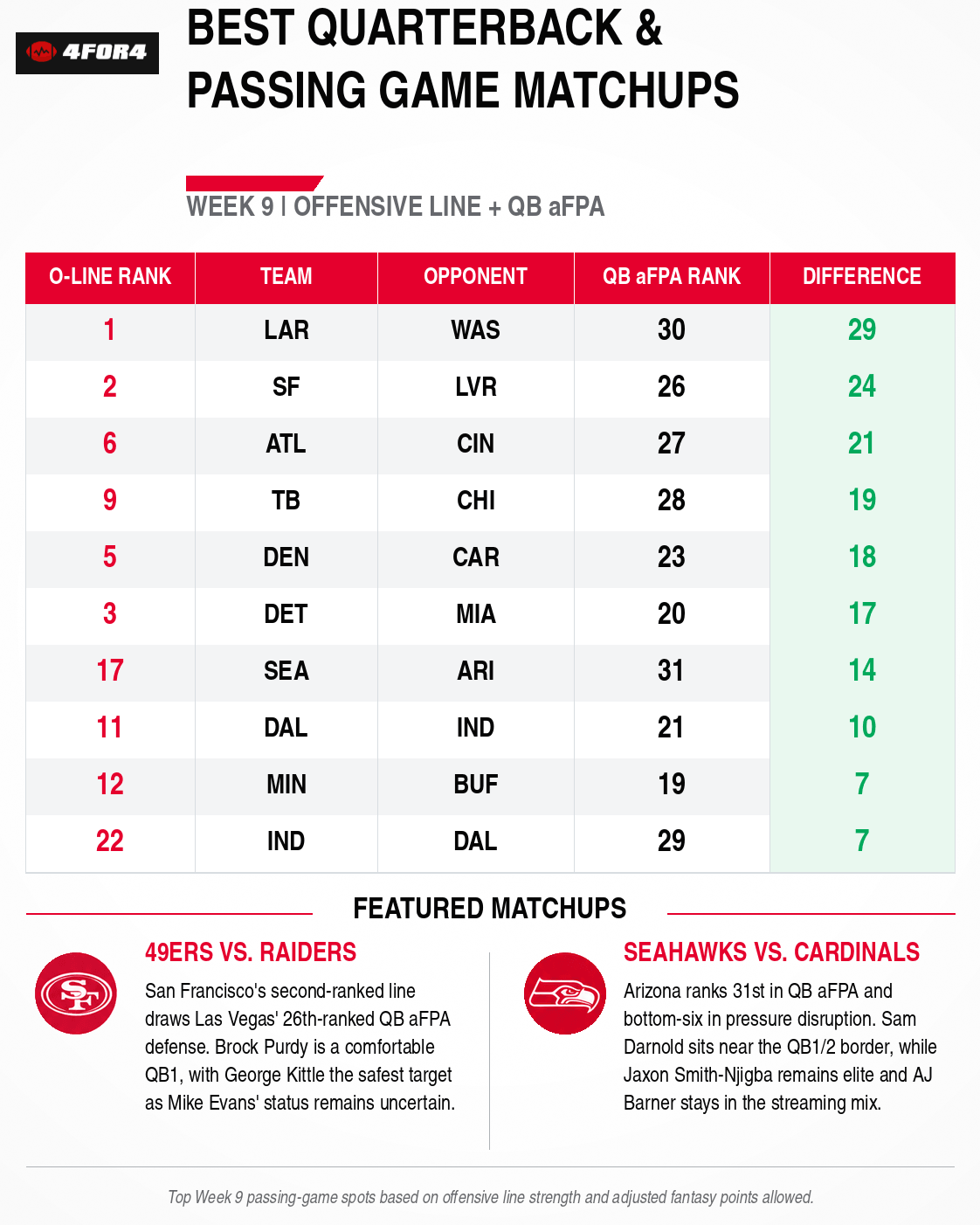
49ers vs. Raiders
San Francisco’s offensive line continues to provide one of the league’s cleanest environments for its passing game.
The 49ers rank inside the top eight in pressure rate, Pressure Rate Over Expectation, and blown-block rate while sitting fourth in adjusted line yards. Brock Purdy has also converted only 9.7% of his pressures into sacks, allowing San Francisco to prevent disruption from becoming drive-ending negative plays.
Las Vegas ranks 26th in QB aFPA while generating pressure on 33.0% of opposing dropbacks with a -0.6% defensive Pressure Rate Over Expectation. Both figures place the Raiders in the bottom half of the league and give Purdy a strong chance to operate from clean pockets.
Purdy can be started comfortably as a QB1, while George Kittle carries one of the week’s strongest tight end outlooks. The remaining pass catchers will depend heavily on Mike Evans’ availability. His return would raise Purdy’s ceiling, while another absence would create additional opportunity for San Francisco’s depleted receiving room without providing a particularly trustworthy target distribution.
Seahawks vs. Cardinals
Seattle’s No. 17 ranking reflects its current production more than the unit’s eventual ceiling.
The Seahawks have allowed a 37.0% pressure rate and rank last in running back yards before contact, but the addition of Quenton Nelson gives the line a significantly different outlook once the new configuration settles in. Nelson strengthens the interior and allows Gray Zabel to move to the right side, while Charles Cross’ eventual return should stabilize the most important position on the line.
That process may take time, but Arizona provides a forgiving opponent. The Cardinals rank 31st in QB aFPA while producing a 31.0% pressure rate and +0.7% defensive Pressure Rate Over Expectation. Both marks place Arizona inside the bottom six.
Sam Darnold remains near the QB1/2 border, with Jaxon Smith-Njigba carrying another elite wide receiver outlook. AJ Barner remains a fallback tight end streamer against a defense ranked 27th in TE aFPA, although the playing time still hasn’t produced much fantasy value.
Barner played 95% of Seattle’s offensive snaps Monday night and drew five targets, finishing with two catches for 23 yards and a TE31 result. He has been targeted on only 15% of his routes for the season, making it difficult to treat the massive snap share as anything more than opportunity. Another week of cardio isn’t going to help anyone, but the playing time and matchup keep him in consideration for managers digging deeply at the position.
Best D/ST Matchups
Lions at Dolphins
Detroit requires us to look past the most obvious matchup indicator; the Lions rank last in QB aFPA, but their underlying pressure production has been considerably stronger. Detroit has generated pressure on 37.5% of opposing dropbacks with a +6.2% defensive Pressure Rate Over Expectation, placing the defense inside the top 10 in both categories. The Lions have also climbed to second in sacks per game (3.4).
Miami provides plenty of opportunity for that disruption to continue. The Dolphins rank 31st in our offensive line rankings while allowing a 42.9% pressure rate and a league-worst +12.5% Pressure Rate Over Expectation. They have surrendered the league’s second-highest sack rate and average only 16.7 points per game.
Malik Willis has converted 21.6% of his pressures into sacks (24th) and carries a 4.6% turnover-worthy play rate (30th). Detroit has forced only one takeaway per game, but the combination of pressure, sacks, and Miami’s offensive struggles provides a clear path to improving that number.
The Dolphins carry a modest 21.75-point implied team total, and Detroit is available in 71% of Yahoo leagues. The poor aFPA creates risk, but the Lions’ pressure production makes them a viable contrarian streamer.
Packers vs. Patriots
Green Bay draws an offensive line that continues to allow disruption at an alarming rate.
New England ranks 28th in our offensive line rankings while allowing pressure on a league-high 44.5% of its dropbacks. Its +8.5% Pressure Rate Over Expectation ranks 28th, indicating that the protection issues extend beyond Drake Maye holding the football.
The Packers have produced a more balanced defensive profile. Green Bay ranks 13th in both pressure rate and defensive Pressure Rate Over Expectation while sitting sixth in QB aFPA. This is not an elite pass rush, but the matchup provides enough opportunity for an average unit to create sacks and negative plays.
Maye has converted only 13.0% of his pressures into sacks, limiting the ceiling of opposing defenses despite the frequency of defenders inside the backfield. Green Bay will need to continue winning quickly instead of relying on Maye to turn every pressure into a mistake.
The Packers lack Detroit’s recent sack production, but the combination of New England’s No. 28 offensive line and league-worst pressure rate keeps Green Bay firmly in the Week 9 streaming conversation.
Best Running Back Matchups
Broncos at Panthers
Denver’s fifth-ranked offensive line has been more impressive in pass protection than in the running game, but Carolina gives the rushing attack a chance to catch up. The Broncos rank first in blown-block rate, fifth in Pressure Rate Over Expectation, and 10th in pressure rate. Their rushing metrics sit closer to league average, with Denver ranking 19th in adjusted line yards and 17th in running back yards before contact.
Carolina sits at 30th in RB aFPA and owns the league’s third-worst combined run-defense profile, allowing a 52.0% rushing success rate (29th) while stuffing only 39.5% of opposing attempts (28th). They also sit in the bottom third of the league in explosive-run rate and missed tackles forced per attempt.
Jonah Coleman belongs comfortably in the RB2 conversation and should get enough early-down and receiving work to take advantage of the matchup after his fantastic Week 7, while J.K. Dobbins remains a more touchdown-dependent FLEX; Carolina’s inability to stop successful runs gives both backs a path to usable production.
Browns at Saints
The Browns rank last in adjusted sack rate, 28th in pressure rate, 30th in Pressure Rate Over Expectation, and 31st in blown-block rate; however, their rushing profile has been somewhat more encouraging, with Cleveland ranking 15th in running back yards before contact despite sitting 26th in adjusted line yards.
On the flip side, New Orleans ranks 32nd in RB aFPA and owns the league’s weakest combined run-defense profile. The Saints have allowed a 55.7% rushing success rate, the second-highest mark in the league, while stuffing only 35.2% of opposing attempts, which is dead last. They have also surrendered an explosive run on 6.4% of carries, the fourth-highest.
Quinshon Judkins moves into matchup-driven RB2 territory despite Cleveland’s blocking concerns. Dylan Sampson remains a deeper option, but the Saints’ inability to consistently win at the line of scrimmage gives the entire Browns backfield a better outlook than the No. 27 offensive line ranking would typically suggest.
Fantasy Players to Downgrade in Week 9
These players aren’t automatic sits, but their offensive line and defensive-front matchups lower their Week 9 ceilings:
- Josh Allen, Bills: Buffalo’s 13th-ranked line faces a Minnesota defense ranking first in QB aFPA, pressure rate, and the combined defensive pressure metrics. The Bills have allowed pressure on 41.8% of their dropbacks with a +8.3% Pressure Rate Over Expectation. Allen’s 13.1% pressure-to-sack rate helps him survive those issues, and he remains an elite QB1, but this is one of his most difficult protection matchups of the season.
- Justin Herbert, Chargers: Los Angeles ranks 30th up front while sitting 27th in pressure rate and 31st in Pressure Rate Over Expectation. Houston’s defense ranks fourth in pressure rate and 10th in defensive Pressure Rate Over Expectation, creating another difficult setup for an offense that has struggled to keep Herbert clean. His 22.5% pressure-to-sack rate adds further downside and leaves him in volatile QB2 territory.
- Derrick Henry, Ravens: Baltimore’s 25th-ranked line faces a Jacksonville defense sitting fifth in RB aFPA with the league’s strongest underlying run-defense profile. The Jaguars have limited opponents to a 42.5% rushing success rate, stuffed 51.0% of attempts, and allowed the NFL’s lowest missed-tackle rate. Henry’s volume keeps him in starting lineups, but the matchup and another quarterback change threaten his ceiling.
- Josh Jacobs, Packers: Green Bay ranks last in adjusted line yards and 31st in running back yards before contact. The Packers now face a New England defense sitting third in RB aFPA and third in explosive-run rate allowed. Jacobs’ workload keeps him in the RB2 conversation, but the blocking and opponent make another inefficient rushing performance a legitimate concern.

How These Offensive Line Rankings Work
These rankings are designed specifically for fantasy football and are not intended to function as a pure evaluation of NFL offensive line talent.
The weekly process incorporates injuries, projected starters, recent performance, individual line play, and opponent context. Metrics such as pressure rate, blown-block rate, adjusted sack rate, adjusted line yards, and running back yards before contact help identify how each unit is performing in pass protection and the running game.
Pressure Rate Over Expectation provides additional context by comparing a team’s actual pressure rate with the rate expected based on its quarterback’s time to throw. That helps identify whether a quarterback is creating additional pressure by holding the ball or whether the offensive line is allowing disruption more quickly than expected.
Pressure rate and blown-block rate receive particular consideration because they more directly reflect offensive line performance. Sack rate remains useful for fantasy purposes, but quarterback decision-making, mobility, and pocket management can significantly affect the final result. Pressure-to-sack rate helps separate those quarterback effects from the protection itself.
Penalties receive very little weight and are generally referenced only when they become an extreme or repeated part of a unit’s performance.
The offensive line rankings are then compared with 4for4’s adjusted fantasy points allowed to quarterbacks and running backs. aFPA improves upon raw fantasy points allowed by accounting for the quality of each defense’s opponents and updates weekly throughout the season.