NFL Offensive Line Rankings Week 11: Matchups to Exploit

 Make us preferred on Google
Evaluating offensive line play through a fantasy football lens can reveal matchup advantages that traditional rankings or defensive fantasy points allowed don’t always show.
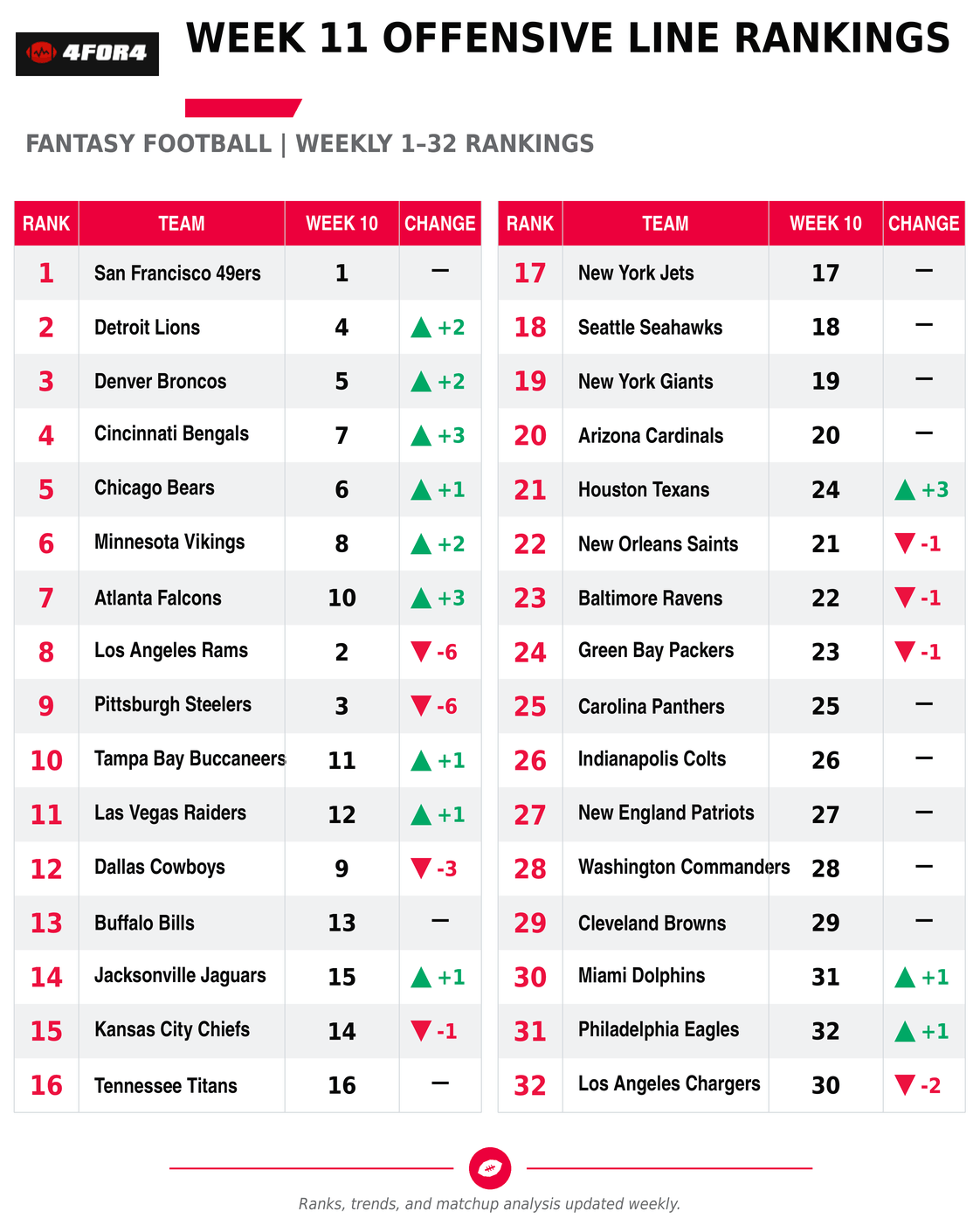
Each week, we rank all 32 offensive lines, track the biggest movers, and compare those units against the opposing defense’s adjusted fantasy points allowed (aFPA) to find the quarterback, running back, and D/ST matchups most affected by trench play.
Week 11 gives Kirk Cousins and Dak Prescott favorable passing environments, while Jonah Coleman and James Cook draw defenses that have struggled to control the running game. The Bears and Jets also enter the D/ST streaming conversation with both units available in more than half of Yahoo leagues.
Editor’s Note: Check out the complete set of Week 11 fantasy football rankings here.
Biggest Offensive Line Risers and Fallers
Risers
Cincinnati Bengals (+3)
The Bengals have spent most of the season hovering just outside the top tier, but there is no longer much reason to hold them back. Cincinnati has used only five starters and allowed pressure on 31.9% of its dropbacks, while a 5.4% adjusted sack rate reflects protection that has held up without requiring Joe Burrow to rescue it.
The individual run-blocking results are even cleaner across most of the line. Orlando Brown Jr. and Dylan Fairchild have yet to be charged with a blown block, while Dalton Risner and Amarius Mims sit at 0.6% and 1.1%, respectively. Center Ted Karras has been the clear outlier at 4.4%, but the other four starters have helped Cincinnati overcome more ordinary team-level rushing production.
Atlanta Falcons (+3)
Atlanta climbs without any dramatic news because its performance has continued to age well while several lines above it have lost important pieces. The Falcons have allowed pressure on only 27.1% of their dropbacks, created 4.57 adjusted line yards, and needed just six different starters through ten weeks.
The 6.8% adjusted sack rate is closer to average, but the broader profile points toward a line doing its job in both phases. Atlanta enters its bye at No. 7, regaining some of the ground it lost earlier in the season.
Fallers
Los Angeles Rams (-6)
Dropping the Rams this far feels like a little much when we look at the season-long metrics; Los Angeles leads the league in adjusted line yards, sits second in running back yards before contact, and has allowed pressure on only 26.0% of its dropbacks.
The problem is determining how much of that production can survive a dramatically different interior. Coleman Shelton is expected to miss four to six weeks, Dylan McMahon is on injured reserve with a partial patellar tear, and Steve Avila is dealing with a hamstring injury. Beaux Limmer is positioned to take over at center, with Bill Murray (not that one) potentially stepping in at left guard.
Pittsburgh Steelers (-6)
Mason McCormick’s injury removes one of Pittsburgh’s most reliable blockers from a line that had established itself as one of the league’s better all-around units. McCormick produced a 1.1% blown-block rate (12th/70 qualifying guards) across 183 run-blocking snaps before suffering what appears to be a significant leg injury, leaving Spencer Anderson as the likely replacement at left guard.
The Steelers have still allowed pressure on only 31.9% of their dropbacks while ranking inside the top half of the league in adjusted line yards and running back yards before contact. Those results keep Pittsburgh in the top 10, but the loss of McCormick makes its previous No. 3 ranking difficult to defend.
Week 11 Fantasy Impact Players Helped by Their Offensive Line Matchup
The featured matchups below aren’t the only places where the trenches can swing a fantasy decision. Three more situations worth circling:
- Joe Burrow and the Bengals’ passing game: Cincinnati’s fourth-ranked line faces a Washington defense sitting 28th in QB aFPA without an overwhelming underlying pressure profile. Burrow carries one of the week’s strongest quarterback outlooks, while Ja’Marr Chase and Tee Higgins remain locked into lineups. Mike Gesicki also draws a Commanders defense ranked 31st in TE aFPA, giving him some deeper streaming appeal.
- Patrick Mahomes and Travis Kelce, Chiefs: Kansas City’s offensive line enters the week with several health concerns, but Arizona has generated pressure at the league’s third-lowest rate while ranking 31st in QB aFPA. Mahomes belongs comfortably in the QB1 tier, while Kelce draws an Arizona defense ranked 30th against tight ends.
- Tony Pollard, Titans: Losing Peter Skoronski prevents Tennessee’s matchup from being completely clean, but Dallas ranks last in RB aFPA and has allowed a 50.2% rushing success rate with one of the league’s highest explosive-run rates. Pollard’s projected workload keeps him in the RB2 range, with Tyjae Spears carrying more appeal as a passing-game complement and deep-league, PPR flex option for managers struggling with byes.
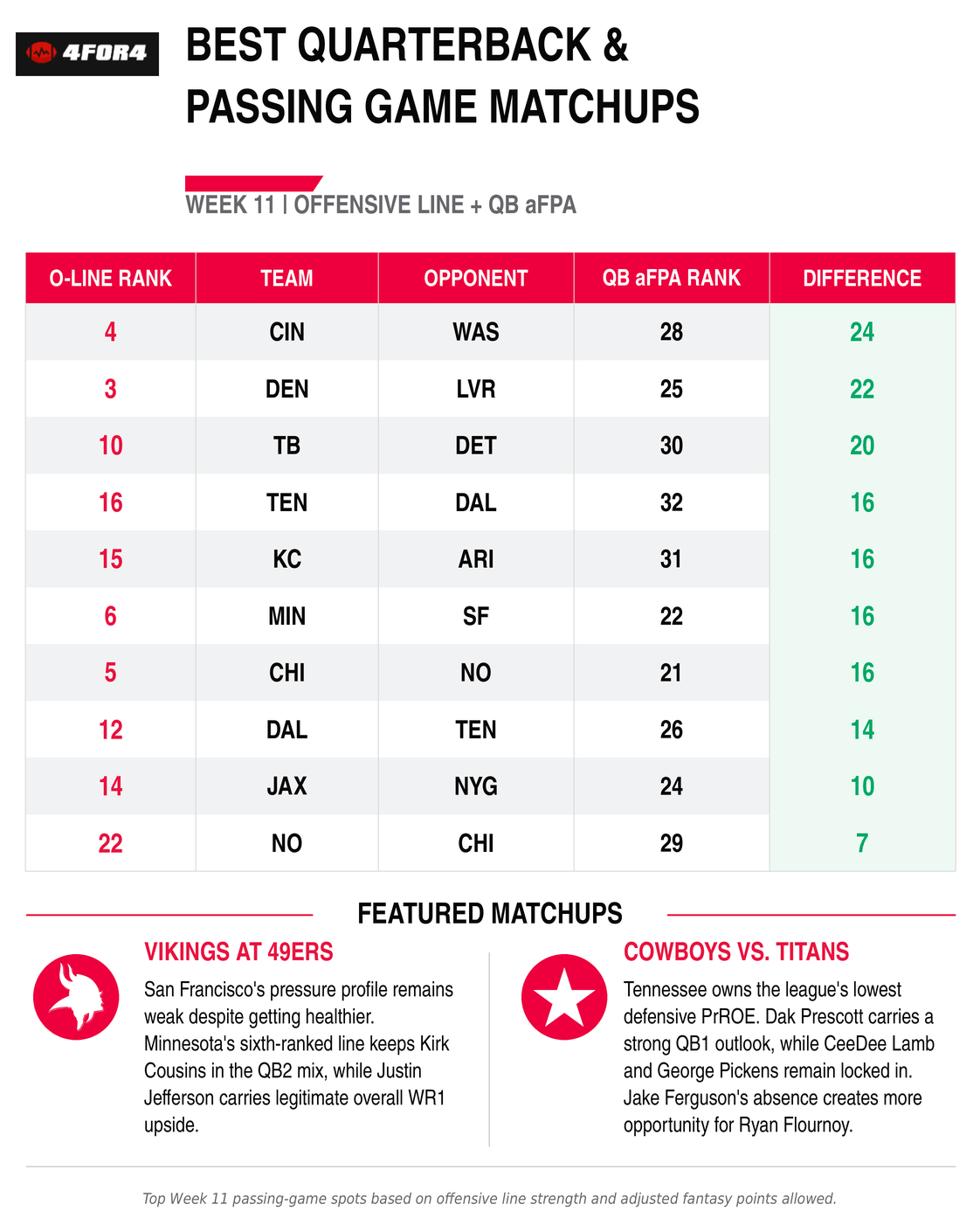
Best Quarterback and Passing Game Matchups
Vikings at 49ers
San Francisco’s pass rush should be stronger than its season-long numbers would hint now that Nick Bosa is back, but the group still hasn’t shown that it can consistently disrupt opposing quarterbacks. The 49ers have generated pressure on 29.9% of dropbacks with a -2.7% Pressure Rate Over Expectation, giving Minnesota’s sixth-ranked offensive line an opportunity to keep Kirk Cousins comfortable.
Cousins sits in the QB2/streaming range as opposed to an automatic start, but the matchup raises his floor and gives Justin Jefferson legitimate overall WR1 upside. Jordan Addison’s move to injured reserve should concentrate the passing game even further around Jefferson, creating the potential for the kind of target volume we regularly saw in his first stint with Cousins.
T.J. Hockenson has a chance to return to practice this week, although his status needs to be monitored before we treat him as part of the matchup. Gavin Bartholomew would remain a (deep) deep-league option if Hockenson sits.
Cowboys vs. Titans
Dallas and the boys don’t need pristine protection to take advantage of this matchup; Tennessee has generated pressure on only 29.4% of opposing dropbacks and owns the league’s lowest defensive Pressure Rate Over Expectation, leaving Dak Prescott in one of the week’s cleaner passing environments.
Prescott can be started as a strong QB1, with CeeDee Lamb and George Pickens carrying their usual ceilings against a defense ranked 26th in QB aFPA. The absence of Jake Ferguson also opens secondary work behind Dallas’ top two receivers.
Ryan Flournoy is the most interesting candidate after turning seven targets into six catches, 71 yards, and a touchdown last week. Brevyn Spann-Ford should handle more of the tight end work, but he remains a consideration primarily in tight end-premium or two-TE formats.
Best D/ST Matchups
Bears vs. Saints
Tyler Shough has done a reasonable job avoiding turnover-worthy throws and escaping pressure, with 11 scrambles over his last two games, so Chicago’s case isn’t built around expecting the rookie quarterback to hand over fantasy points.
However, the broader offense still gives the Bears plenty to work with. Shough needed 35 attempts to produce 187 yards against Carolina, while the Saints’ running backs combined for only 24 rushing yards. Chicago has generated pressure at a top-eight rate, and New Orleans enters the matchup with our 22nd-ranked offensive line after injuries to Taliese Fuaga, Erik McCoy, and Justin Herron disrupted an already inconsistent unit.
Available in 51% of Yahoo leagues, the Bears offer a strong combination of pressure potential and a favorable game environment against an offense carrying an 18.5-point implied total.
Jets at Chargers
The Jets have been a difficult defense to trust, but there may not be a better matchup for turning disruption into fantasy production. New York ranks inside the top 10 in pressure rate and defensive Pressure Rate Over Expectation, while the Chargers enter Week 11 with the league’s 32nd-ranked offensive line.
Justin Herbert has taken a sack on 24.8% of his pressured dropbacks, giving the Jets a legit D/ST floor, even if he protects the football. Los Angeles’ protection problems have extended well beyond one weak spot, making it difficult to scheme around the pressure without shrinking the passing game.
With the Jets available in roughly 94% of Yahoo leagues, they are the deeper streaming option for managers looking beyond the more obvious defenses.
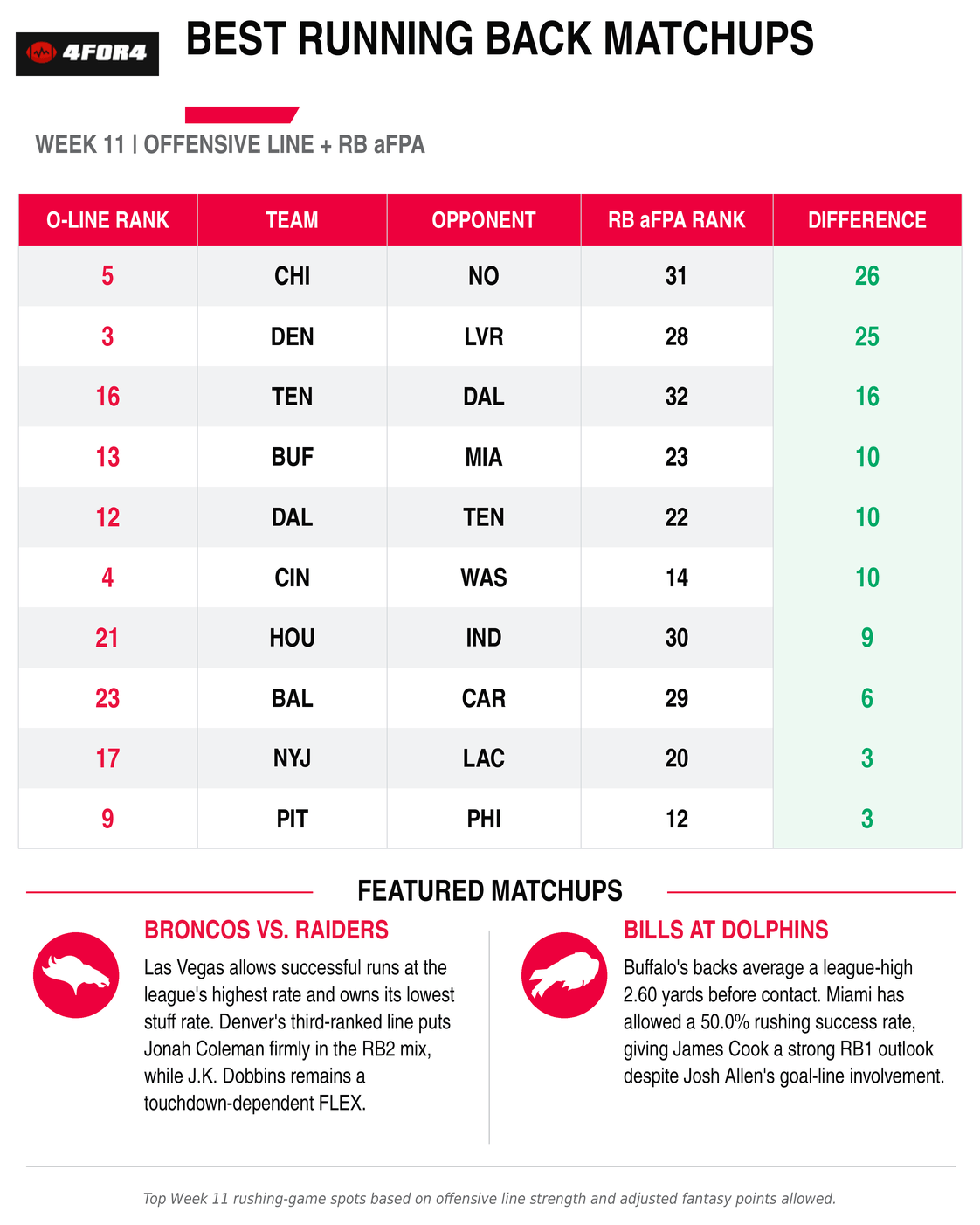
Best Running Back Matchups
Broncos vs. Raiders
Denver’s third-ranked offensive line should control this matchup against a Las Vegas defense allowing successful runs at the league’s highest rate while stuffing fewer attempts than any other unit.
That creates a strong setup for Jonah Coleman, whose workload has continued to leave J.K. Dobbins in the dust. Coleman belongs firmly in the RB2 mix with room for more if Denver plays from ahead, while Dobbins remains a touchdown-dependent FLEX whose fantasy value will depend on whether he receives enough work near the goal line.
Bills at Dolphins
Buffalo’s uneven pass protection has kept the line outside the top 10, but its run blocking has been a completely different story. Bills running backs are averaging a league-high 2.60 yards before contact, and the offense ranks near the top in adjusted line yards.
Miami has allowed successful runs on half of its opponents’ attempts while ranking near the bottom in stuff rate and missed tackles forced per carry. That should give James Cook room to reach the second level before first contact, with his expected workload supporting a strong RB1 outlook even if Josh Allen continues to claim some of the scoring opportunities near the goal line.
Fantasy Players to Downgrade in Week 11
These aren’t automatic sits, but each carries more downside than usual because of the matchup up front.
- Brock Purdy and the 49ers’ passing game: Minnesota leads the league in pressure rate and defensive Pressure Rate Over Expectation while ranking first in QB aFPA. San Francisco’s top-ranked offensive line keeps Purdy in the starting conversation, but this is a difficult spot to expect ceiling performances from Deebo Samuel or Keenan Allen. George Kittle remains the easiest member of the passing game to trust.
- Justin Herbert, Chargers: The Jets have produced top-10 pressure results, while Los Angeles enters the week last in our offensive line rankings. Herbert’s ability to create outside structure keeps him viable as a QB2, but his elevated pressure-to-sack rate gives this matchup a lower floor than the Jets’ season-long reputation might suggest.
- Saquon Barkley, Eagles: Pittsburgh has stuffed more than half of its opponents’ rushing attempts and allowed successful runs at one of the league’s lowest rates. Barkley’s receiving work and touchdown equity prevent him from falling out of lineups, but Philadelphia’s 31st-ranked line gives him a difficult path to efficient rushing production.
- Bucky Irving, Buccaneers: Detroit ranks first in RB aFPA and has consistently prevented opposing rushing attacks from staying on schedule. Tampa Bay’s top-10 offensive line gives Irving a better chance than most backs would have in this matchup, although the opponent lowers his efficiency ceiling and makes another backfield split with Kenneth Gainwell more difficult to overcome.

How These Offensive Line Rankings Work
These are fantasy football rankings, not a pure evaluation of offensive line talent, so the effect each unit has on quarterback and running back production matters more than how its five starters might be graded in isolation.
The weekly order combines injuries, projected starters, lineup continuity, recent film, and results across pressure rate, blown-block rate, adjusted sack rate, adjusted line yards, and running back yards before contact. Pressure rate and blown-block rate receive particular weight because they identify how often protection or rushing assignments break down before quarterback play can influence the result.
The number of starters a team has used provides additional context, especially when injuries force repeated changes at multiple positions, but continuity alone doesn’t guarantee effective blocking. A stable line can still perform poorly, while a well-coached unit can survive one or two replacements without collapsing.
Sacks still matter for fantasy purposes, but quarterbacks have considerable control over whether pressure becomes a negative play. Pressure-to-sack rate helps separate that influence from the blocking, while Pressure Rate Over Expectation compares actual pressure with the rate expected based on the quarterback’s time to throw. Penalties receive very little weight unless they become an extreme or recurring problem.
The final rankings are compared with 4for4’s adjusted fantasy points allowed to quarterbacks and running backs, which accounts for opponent quality and updates throughout the season.