The Most Predictable Tight End Stats

 Make us preferred on Google
It was fortunate timing for Nathan Jahnke of PFF to post this on Bluesky today: “I hope to live in a world where the Seahawks replace Zach Charbonnet's goal-line carries with AJ Barner tush push touchdowns”. The importance of TE rushing is one of the more interesting things I found in this series. It’s the sixth-most important variable in providing additional context beyond ADP to future TE fantasy points.
More Predictable Stats: QB | RB | WR
The graph below shows a TE’s average rush attempts per game at some point in the season on the x-axis. The y-axis shows their fantasy points in the following week. Look at the scale on the x-axis; we’re not asking for much. Literally 0.1 rush attempts per game is enough to improve a TE’s projection.
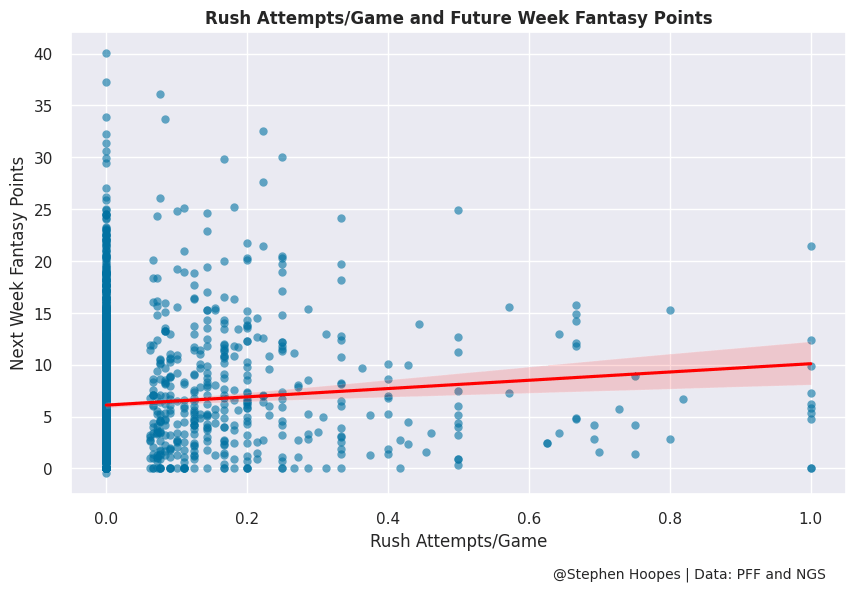
So, it’s really not the fantasy points we’re getting from rushing that matter. It’s more an indication of talent and a willingness to get a TE involved in the offense. The list of qualifying players with more than 0.1 rushing attempts per game last year was Brock Bowers, Tyler Warren, Tucker Kraft, Harold Fannin, Mark Andrews, and the aforementioned AJ Barner. These players are dynamic enough and trusted enough in their offenses to earn these opportunities, which is a signal to fantasy managers that they will project well in future weeks. Let’s dig more into the other variables in the model below.
Modeling Process and Results
I go deeper into this in the Most Predictable QB Stats article, but I’ll summarize the modeling process here. We’re not going to look at the linear correlation of a bunch of variables in a vacuum. That’s going to be a key point for tight window target rate. Instead, we’re going to look at everything simultaneously, along with market ADP, to see what variables actually give us insight. And we’re using weekly, rather than seasonal, data because the more data for our models, the better.
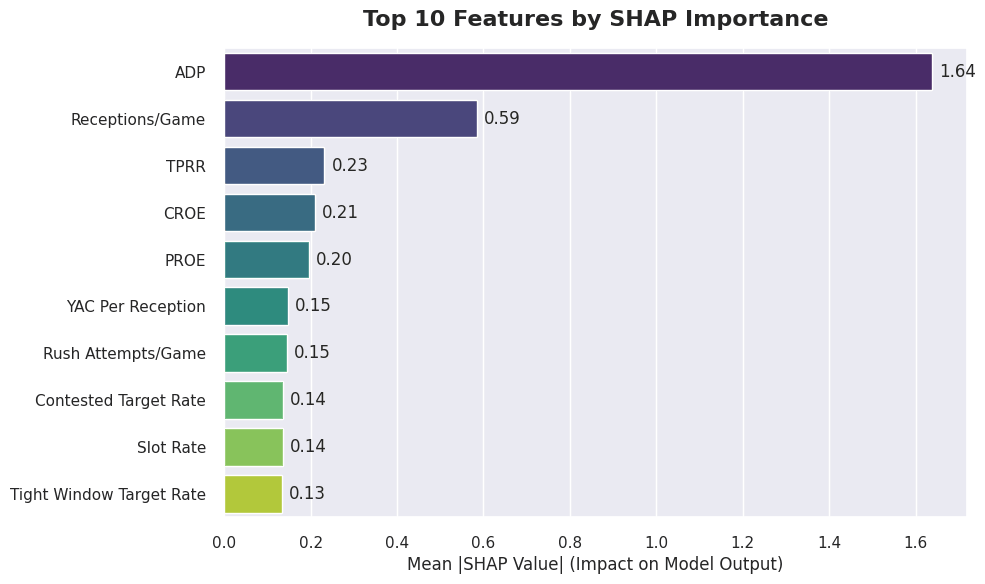
The graph below is a summary of the key variables in our TE fantasy point model. The larger the number for a given variable, the more important it was in improving our fantasy point prediction. Unsurprisingly, ADP is by far the most important variable, just like it was for the other positions in the series. ADP in this sense is the weekly position rank from John Paulsen’s projections dating back to 2021. And for this offseason exercise, where we don’t have weekly ADP, we’re using Underdog positional rank.
And we can dig further into how the model sees each of these variables. One way to do that is through a partial dependence plot. These plots isolate the variable(s) we’re looking at and show how future fantasy points change as you adjust their values. For example, the graph below shows the partial dependence plot for receptions per game and slot rate.
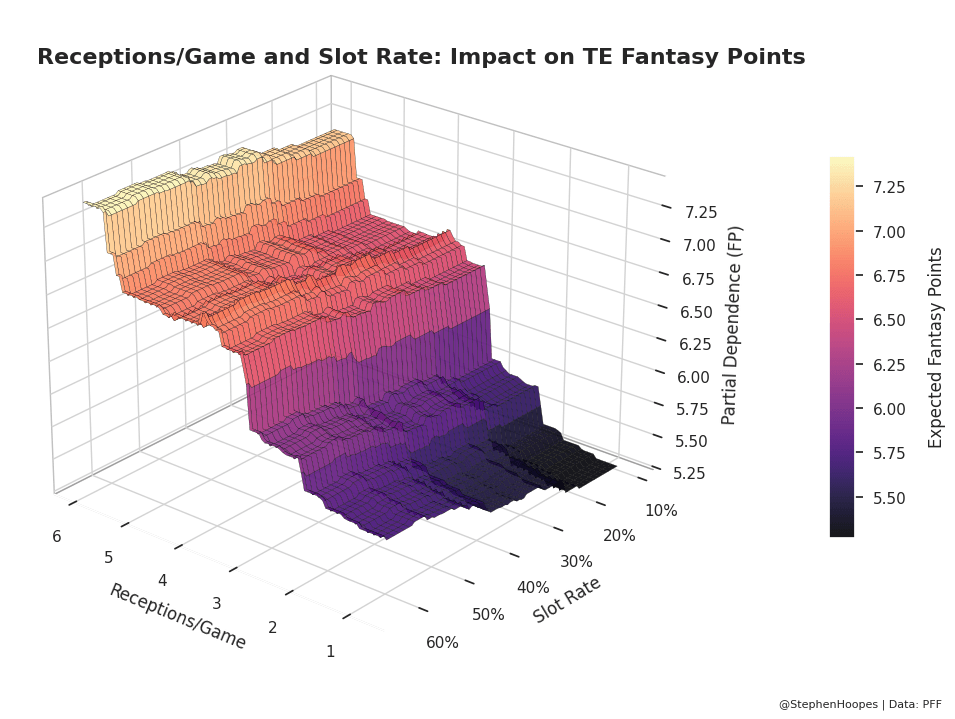
The lighter the color on the graph, the higher the expected fantasy points. And the result is intuitive. TE’s that aren’t earning volume and aren’t given the opportunity to run routes from the slot have their future-week projection dinged.
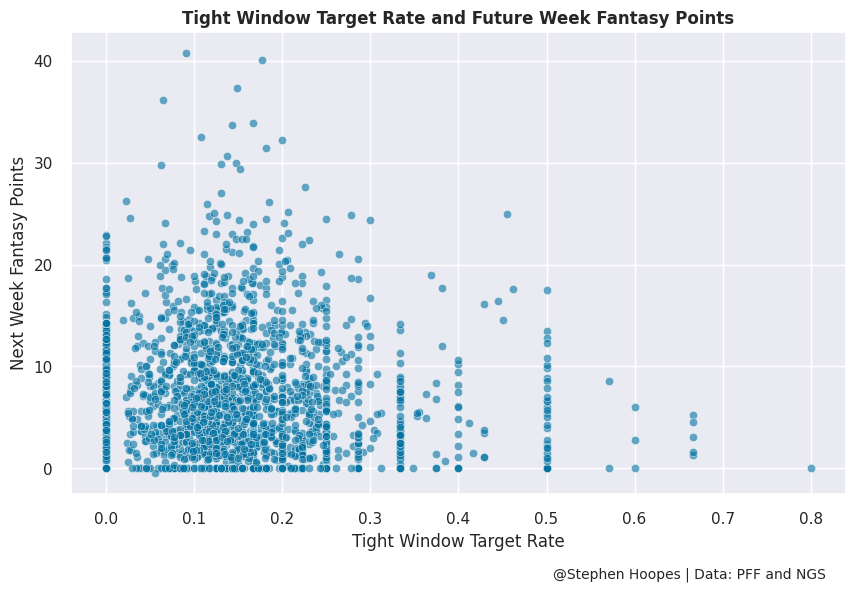
I mentioned tight window target rate earlier so I wanted to get to that now. This is a stat from Next Gen Stats that counts a tight window target as one where the separation between the receiver and the nearest defender is less than one yard at pass arrival. In most analyses like these, you’d be reading a lot about correlation. But specifically, linear correlation. There’s nothing wrong with that, but it is one particular way to look at things. And that way of looking at things would miss the relationship we see between tight window target rate and future TE fantasy points.
The graph below shows a TE’s tight window target rate at a particular point in the season on the x-axis. The y-axis shows their fantasy points in their next game. Future week fantasy points tend to be smaller on both the left and right sides of the graph. My hypothesis is we want *some* tight window targets, because it indicates that a QB trusts our fantasy TE to make a catch even when he’s not fully open. But when this value gets too high, we might start questioning whether our TE can consistently separate on his routes.
2026 TE Predictions
The table below sorts veteran TEs by their projected fantasy points per game using the above methodology. And I’ve highlighted in green the stats where a TE exceeded a key benchmark and in yellow where they hit a decent-enough value.
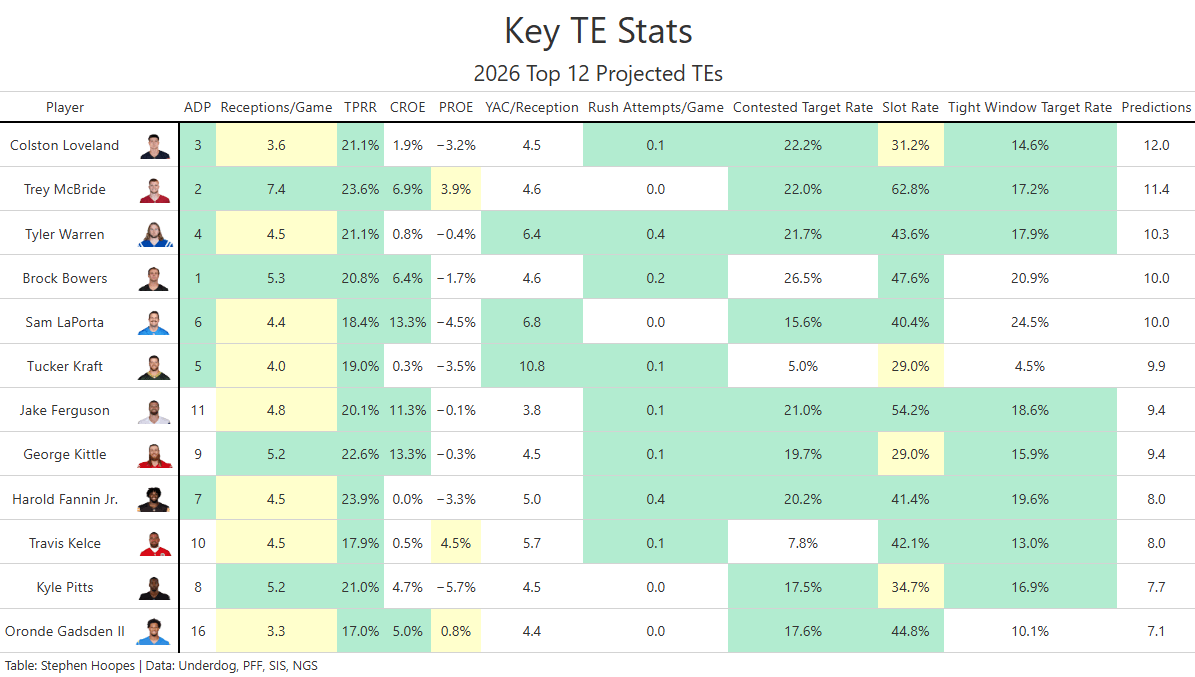
First and foremost, we want our TE to have a low (better) ADP. Beyond that, we want as many receptions as we can get, but ideally above five per game. Similarly, we want our TEs to earn volume on a per-target basis, with a targets per route run (TPRR) above 15%. Catch rate above expectation (CROE) gets some signal as both a talent and offensive situation indicator, with values about 5% more promising. In an ideal world, our TE’s offense has a pass rate over expectation (PROE) above 7%, but that’s almost impossible to find these days.
Continuing through the table, we like YAC per reception to exceed six yards, likely as an indicator of a TE’s dynamism. Tucker Kraft completely lapped the field here last year. And we’ve already touched on the remaining variables that are most important to the model.
I’ll be honest, I was also surprised that Colston Loveland landed as the TE1. Realistically, I’m a drafter that likes to stick closer to ADP, especially since I’m drafting hundreds of best ball teams in a year. There’s no reason to take Loveland over someone like Brock Bowers, especially since Bowers was never going to look good in an analysis relying on the 2025 Raiders’ offense. But Loveland is my most-drafted player on Underdog at the moment.
The graph below shows TE routes per game on the x-axis and TPRR on the y-axis. I hope you’ll grant me one completely cherry-picked graph in this series. If so, I’m using that now. You’ll find Colston Loveland’s playoff run in the top-right corner of the graph. Now, Loveland is almost certainly not going to run that many routes per game over the course of a season. It’s one of the biggest knocks on Trey McBride’s projection relative to last year. But you have to admit that 32.5% TPRR is tantalizing. And I’ve already personally guaranteed he’ll hit that over the course of the entire 2026 season.
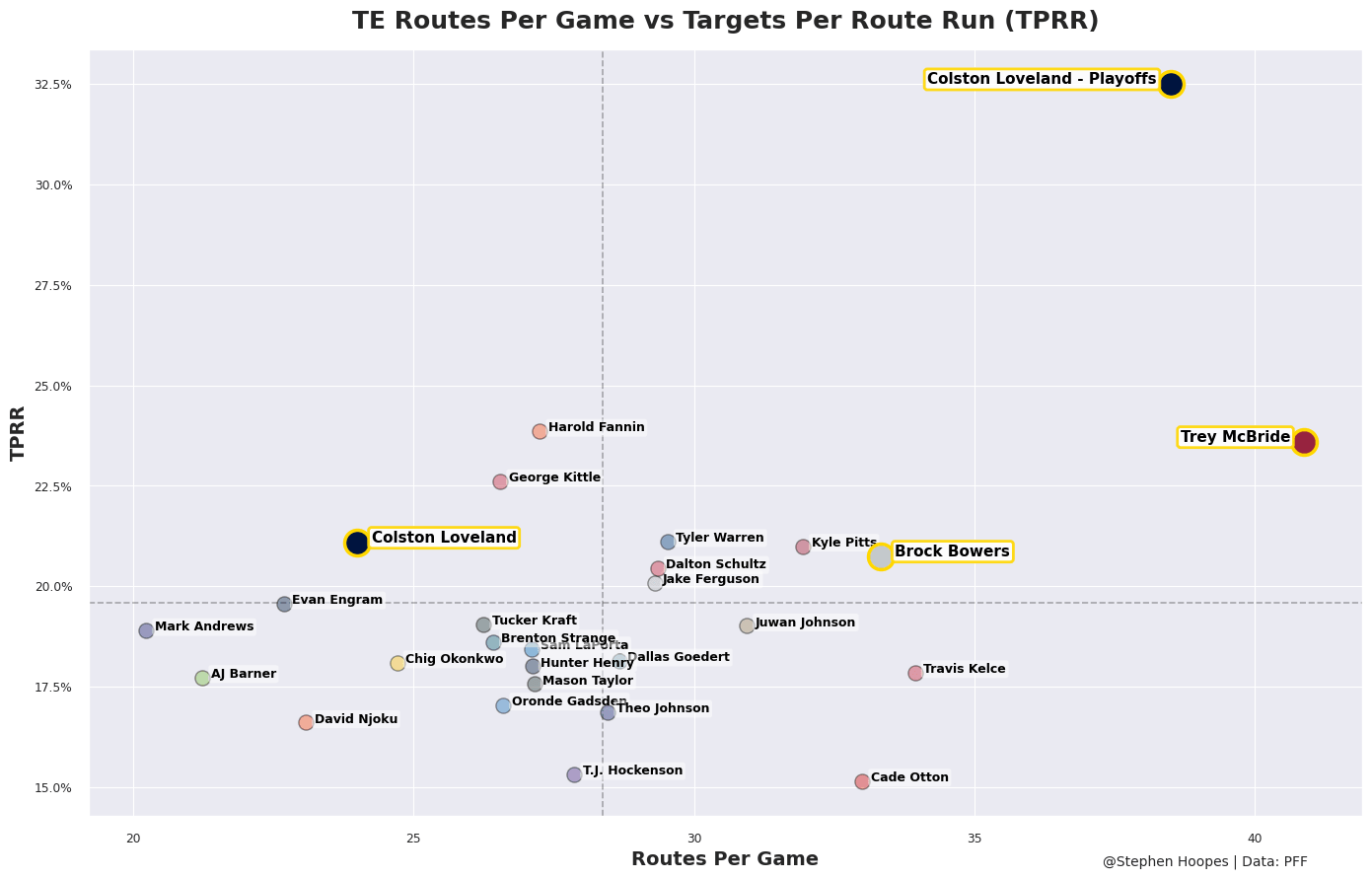
So, Loveland is a key part of how I’m playing the TE position this year. I don’t think there is a systemic reason why the elite TEs need to continue disappointing. As mentioned, last year, Bowers was stuck on a Raiders offense that was incapable of protecting Geno Smith for more than a second. There’s hope that he could truly ascend if the offense is simply functional this year.
But with the later-round TE options scoring more than ever, we’re really going to need Bowers and McBride specifically to go nuclear in order to justify the opportunity cost. And that opportunity cost, to me, is higher than ever this year. As mentioned in the WR article, there is a very small list of elite WRs that are projected to separate from the WRs you can select even in Round 3. Meanwhile, there are very few high-upside RB options after the third round, especially with a weak rookie RB class. Both Bowers and McBride are going at the 2/3 turn.
And so, I’m finding myself waiting on TE at least until Loveland in most cases. And regardless if I miss or pass on Loveland, I’m trying to attack the TE window that starts in Round 11. I think a lot of guys in this range are undervalued. Guys like Jake Ferguson, Dallas Goedert, and Brenton Strange. And then you have some higher upside plays like Oronde Gadsden, especially with his price falling after the David Njoku signing. But that advice is specific to best ball, where I’m likely taking three TEs and just hoping one of them scores a TD in a given week. I think the Loveland pick is even stronger in redraft leagues, where you have to actually pick the TE you’re going to start in a given week.

Bottom Line
- Just like last year, I’m incorporating ADP in order to find variables that provide additional context beyond existing market assumptions.
- Having said that, 4for4’s weekly position ranking is the most important variable when predicting future week fantasy points.
- From there, we care about volume, both on a game-level through receptions and on a route-basis through targets.
- And then we’re looking for talent indicators through catch rate over expectation, YAC per reception, rushing attempts, and contested / tight window target rates.
- I’ve struggled with the opportunity cost of Bowers and McBride so far this offseason, and I’ve been more willing to take the bet on Loveland to turn in a TE1 season with the Bears running through offense through him.
- And if I miss or pass on Loveland, I’m more interested in waiting on the position and attacking it through volume rather than draft capital.