The Most Predictable Running Back Stats

 Make us preferred on Google
De'Von Achane was the cover photo for the article last year, and we’re running it back this year. To give the cliff notes at the top of the article, we want three things from our fantasy RBs. The first two are receiving volume/efficiency and explosive runs. Alright, Achane is crushing those boxes so far. But the third thing is TD potential. Welp…we get two of three for Achane.
More Predictable Stats: QB | WR | TE
Modeling Process and Results
I go deeper into this in the Most Predictable QB Stats article, but I’ll summarize the modeling process here. Instead of looking at the linear correlation of a bunch of variables in a vacuum, we’re going to look at everything simultaneously, along with market ADP, to see what variables actually give us insight. And we’re using weekly, rather than seasonal, data because the more data for our models, the better.
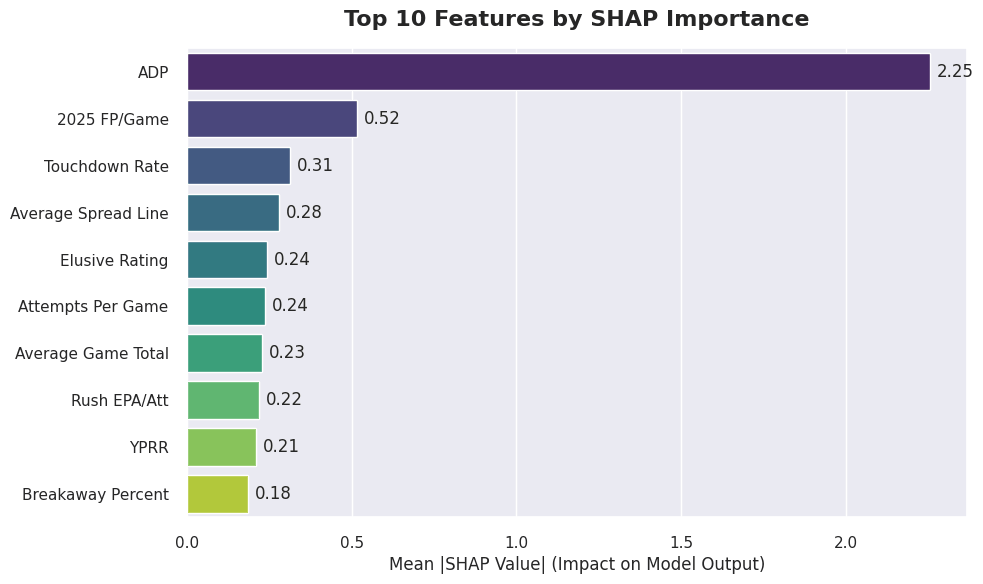
The graph below is a summary of the key variables in our RB fantasy point model. The larger the number for a given variable, the more important it was in improving our fantasy point prediction. Unsurprisingly, ADP is by far the most important variable, just like it was at QB. ADP in this sense is the weekly position rank from John Paulsen’s projections dating back to 2021. And for this offseason exercise, where we don’t have weekly ADP, we’re using Underdog positional rank.
And we can dig further into how the model sees each of these variables. One way to do that is through a partial dependence plot. These plots isolate the variable(s) we’re looking at and show how future fantasy points change as you adjust their values. For example, the graph below shows the partial dependence plot for both team spread and game total, the variables with the fourth- and seventh-most importance to our model.
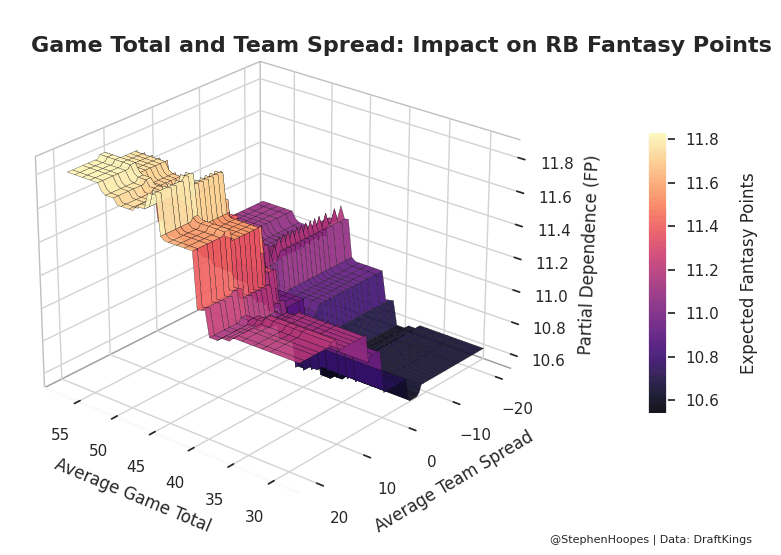
The lighter the color on the graph, the higher the expected fantasy points. And the result is intuitive. The highest projected outcomes for our RBs come in games with expected totals above 50 points. And we don’t just want our RB to be in that game environment. Ideally, their team is also favored to win and positioned to capture as many of those points as possible.
One more example before turning to the 2026 RB predictions. The graph below is the partial dependence plot for breakaway rate and YAC per reception. And again, the result is intuitive. The more explosive the runner and the more dynamic the receiver, the better the odds they can hit a fantasy points ceiling.
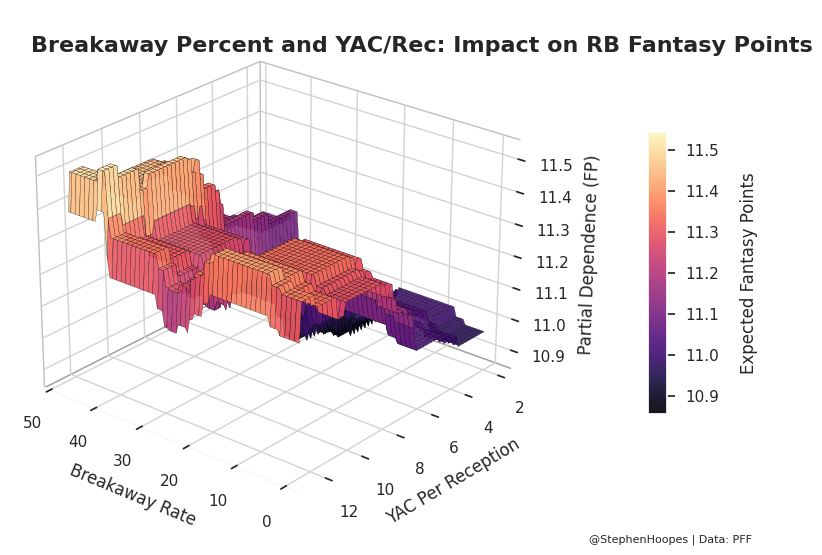
I pick on Kyren Williams every year, and then every year he dunks on me through TDs. But Williams was 33rd out of 45 qualifying RBs in breakaway rate last year and dead-last in YAC per reception. We’ll get to this later, but an important caveat was that he was 3rd in aDoT, with higher aDoTs making YAC more challenging.
But enough of the boring modeling stuff; what RBs should we draft?
2026 RB Predictions
The table below sorts veteran RBs by their projected fantasy points per game using the above methodology. And I’ve highlighted in green the stats where an RB exceeded a key benchmark and in yellow where they hit a decent-enough value.
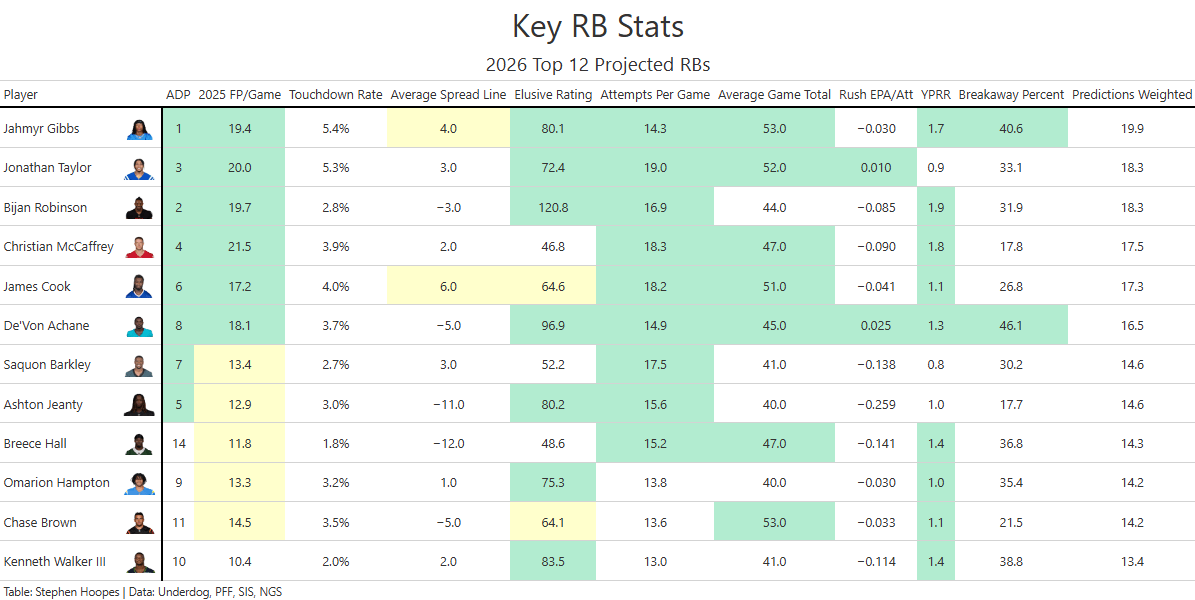
As mentioned, we obviously want our RB to have a low (better) ADP and high fantasy points per game in the previous week/season. We want their previous average game totals from DraftKings to be at least 45 points and favored by ideally seven points but at least three. We want their elusive rating to ideally be above 70 but no lower than 60. We’d like at least 14 rushing attempts per game and rushing EPA per attempt to be above zero, though that’s hard to do. And then, as we saw in the first partial dependence plot above, we want a breakaway rate above 40% on the ground and then efficiency as a pass catcher through a yards per route run (YPRR) mark above 1.0.
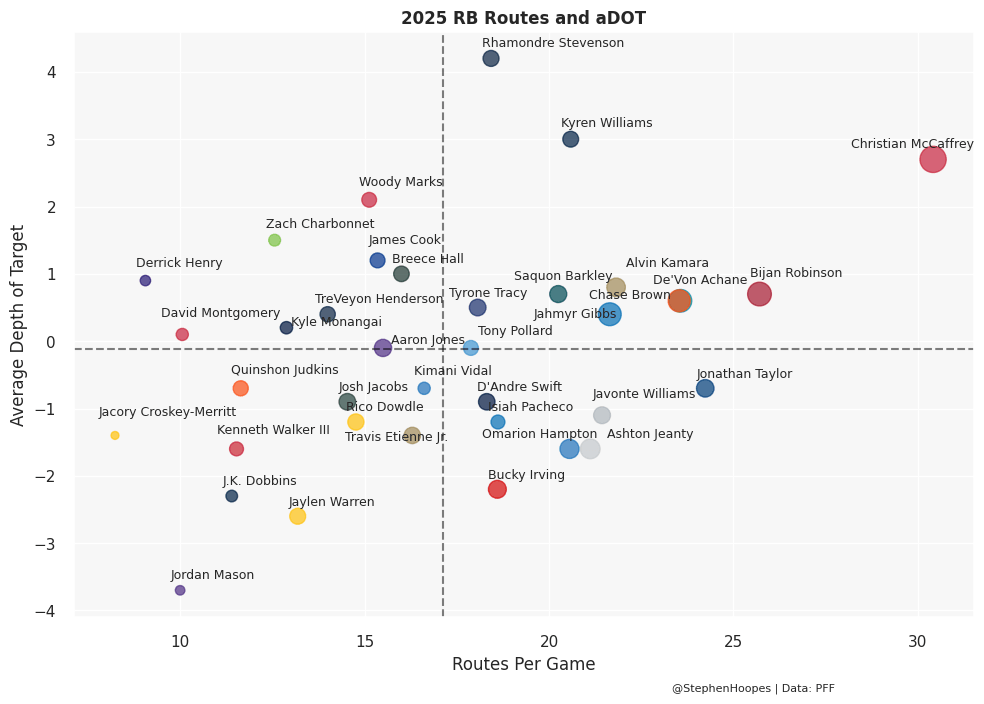
Before turning to how I’m playing RB this year, I wanted to go deeper on RB receiving. The graph below shows routes per game on the x-axis and aDoT on the y-axis. I just like the clarity of the trend. I think it shows that coaches recognize RBs that are skilled receivers and allow these backs to run actual routes or at least run routes farther down the field. One counter-point to this is…Kyren Williams (sorry, Williams). Almost everyone in the top-right corner is one of the most effective receiving RBs in the league. But then there is Williams, who was 34th among our RB sample in targets per route run.
So, how am I actually playing RB this year? Well, I guess it’s not through Williams (he’s fine at cost). To be honest, it gets ugly *fast* at RB after Round 3 this year. You’re limited to just a handful of upside bets at the position, almost exclusively from second-year players with volume or offensive question marks like TreVeyon Henderson, Quinshon Judkins, and RJ Harvey. And of course, Bhayshul Tuten, as Chris Rodriguez has six *career* receptions.
And we didn’t get bailed out by the 2026 rookie class, with only one RB drafted in rounds two or three. There is no guarantee that the biggest RB hits will always come from the top of the draft board. There is also no guarantee that this recent stretch of RB health will continue. But I’m also not seeing nearly enough high-upside bets available in the later rounds to justify a zero-RB approach. If it’s helpful, I just finished an article where I called Jonathon Brooks the *only* exciting late-round RB.
With that in mind, I’ve been leaning toward an absolute minimum of two RBs through Round 5 in early drafts this year, but ideally even more. And perhaps as the summer progresses and we get more information from training camp, we'll get new late-round RB bets in our lives.

Bottom Line
- Just like last year, I’m incorporating ADP in order to find variables that provide additional context beyond existing market assumptions.
- Having said that, 4for4’s weekly position ranking is the most important variable when predicting future week fantasy points.
- From there, we care about an RB’s TD opportunities, their receiving volume/efficiency through YPRR and YAC per reception, and their explosiveness through breakaway rate.
- I’m leaning toward heavier-RB starts this year because we’re lacking in late-round RB options that have true potential without an injury ahead of them.
- But I want to be selective in the specific early-round RB that I’m taking, hitting as many of the three pillars of TDs, receiving, and explosiveness as possible.