The Most Predictable Wide Receiver Stats

 Make us preferred on Google
There are two big benchmarks that a WR has to clear in order to be fantasy-relevant. The first is that they simply have to be on the field enough. That’s become an increasingly important point in a league fascinated by two-TE sets. That’s necessary but not sufficient, which brings us to our second benchmark. Our WR has to get open. Yes, it’s nice if they actually catch the ball and do something dynamic after the catch, and those variables pop up in our predictable stats. But most of the variables we’ll see are either directly or indirectly related to the ability to separate from their defender on a route.
More Predictable Stats: QB | RB | TE
Modeling Process and Results
I go deeper into this in the Most Predictable QB Stats article, but I’ll summarize the modeling process here. We’re not going to look at the linear correlation of a bunch of variables in a vacuum. That’s going to be a key point for WR slot rates. Instead, we’re going to look at everything simultaneously, along with market ADP, to see what variables actually give us insight. And we’re using weekly, rather than seasonal, data because the more data for our models, the better.
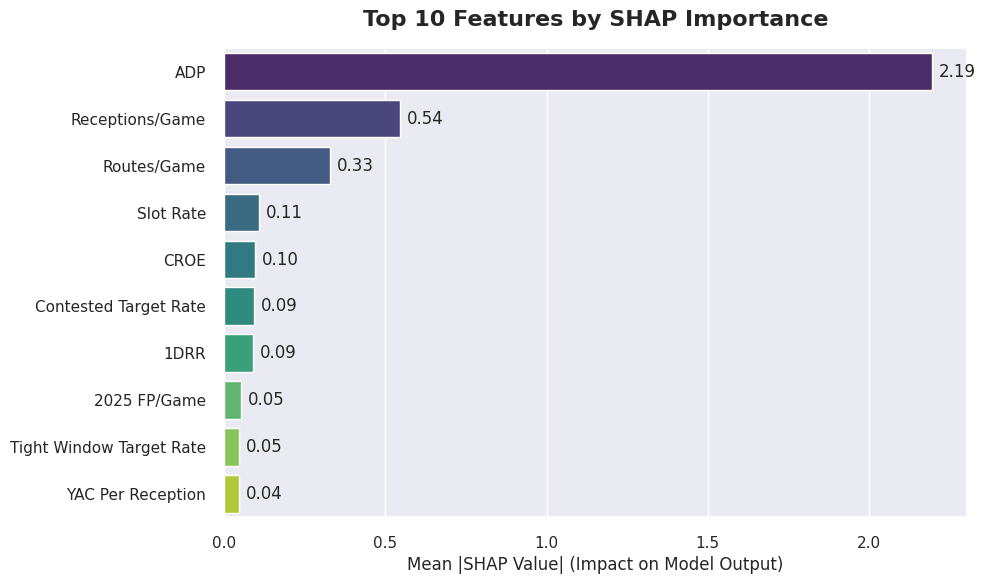
The graph below is a summary of the key variables in our WR fantasy point model. The larger the number for a given variable, the more important it was in improving our fantasy point prediction. Unsurprisingly, ADP is by far the most important variable, just like it was at QB and RB. ADP, in this sense, is the weekly position rank from John Paulsen’s projections dating back to 2021. And for this offseason exercise, where we don’t have weekly ADP, we’re using Underdog positional rank.
And we can dig further into how the model sees each of these variables. One way to do that is through a partial dependence plot. These plots isolate the variable(s) we’re looking at and show how future fantasy points change as you adjust their values. For example, the graph below shows the partial dependence plot for both contested and tight window target rates.
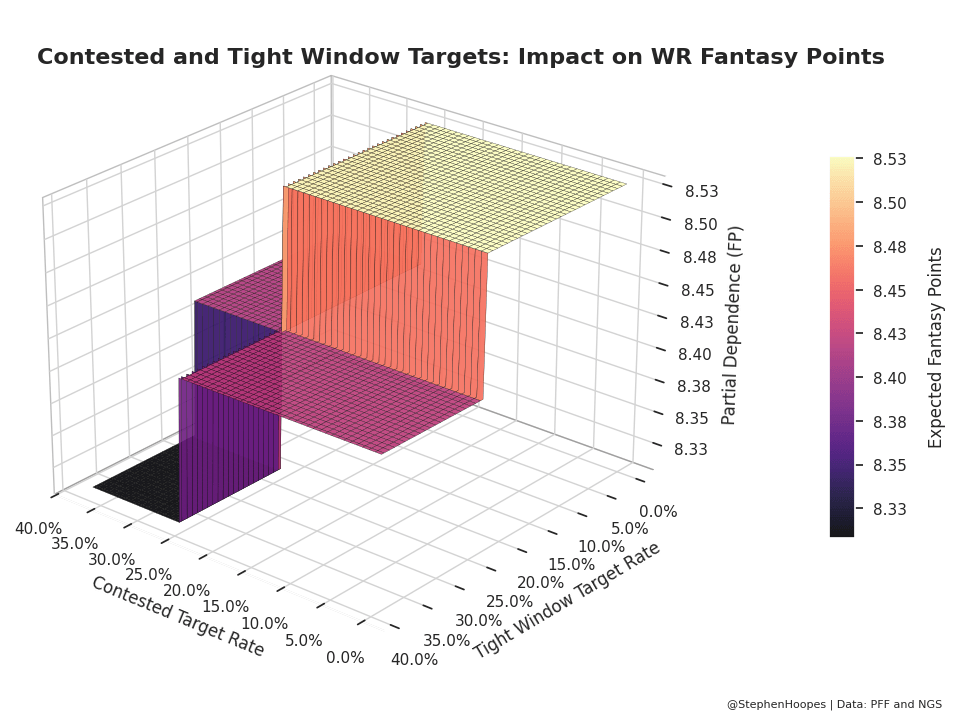
The lighter the color on the graph, the higher the expected fantasy points. And the result is intuitive. We don’t mind some contested and tight window targets. Particularly tight window targets because it shows that the QB trusts our fantasy WR to make a play even when they’re covered. But generally, the skill to keep these values down is an indicator of our WR’s ability to get open on their routes.
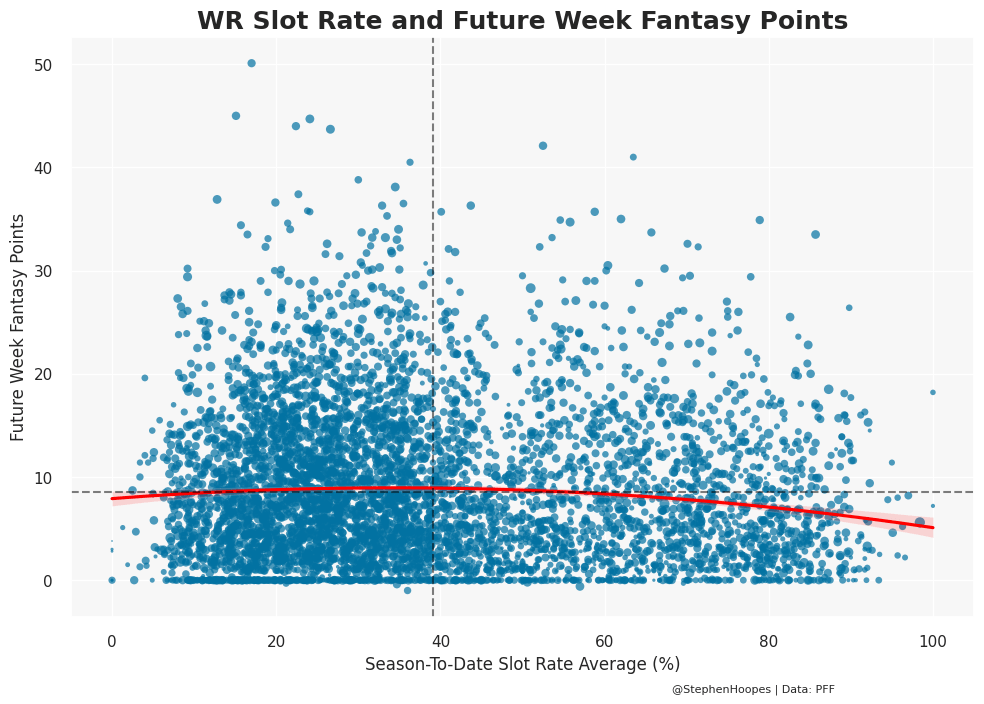
I mentioned slot rate earlier, so I wanted to get to that now. In most analyses like these, you’d be reading a lot about correlation. But specifically, linear correlation. There’s nothing wrong with that, but it is one particular way to look at things. In that analysis, slot rate wouldn’t pop up. There is no linear correlation between a WR’s slot rate and their future fantasy points. But there is an interesting relationship nonetheless.
The graph below shows a WR’s share of routes from the slot at a particular point in the season on the x-axis. And the y-axis shows their fantasy points in their next game. You can kind of draw an arch or half-circle over the data. The values tend to be smaller on both the left and right sides of the graph. And that makes sense. We want our WRs to have the skill to win on the outside and the offensive focus to be pushed into the slot. That alignment flexibility is itself a talent metric. And it’s why the best WRs in fantasy, the ones we’ll see in the next section, have a slot rate from 20-60%.
2026 WR Predictions
The table below sorts veteran WRs by their projected fantasy points per game using the above methodology. And I’ve highlighted in green the stats where a WR exceeded a key benchmark and yellow where they hit a decent-enough value.
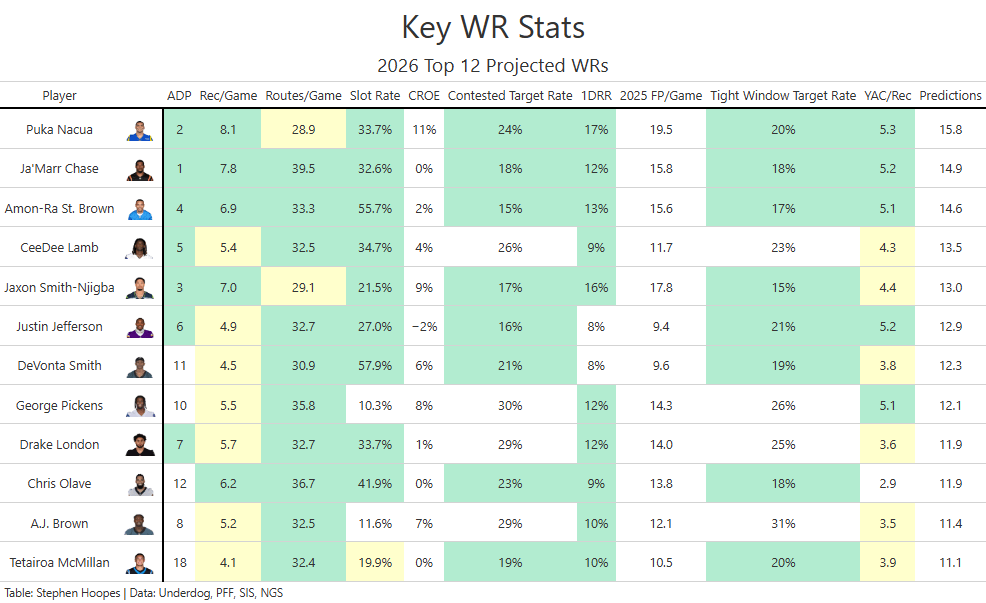
As mentioned, we obviously want our WR to have a low (better) ADP and high previous week/season fantasy points per game. We want volume in receptions per game (ideally above six) and opportunity in routes per game (ideally above 30). As mentioned, we want a slot rate above 20% but not exceeding 60%. We want a contested target rate below 25% and a tight window target rate below 22%. And we’d also like YAC per reception above 5 yards.
And I wanted to dig more into first downs per route run (1DRR). It’s my preferred pure efficiency stat above yards per route run (YPRR) for WRs. The graph below shows routes per game on the x-axis and 1DRR on the y-axis. Puka Nacua and Jaxon Smith-Njigba are absolutely insane, skewing the entire graph upward. Both combat slightly below-average route volume due to the Rams’ 3-TE sets and the Seahawks’ heavy-run attack with other-worldly efficiency.
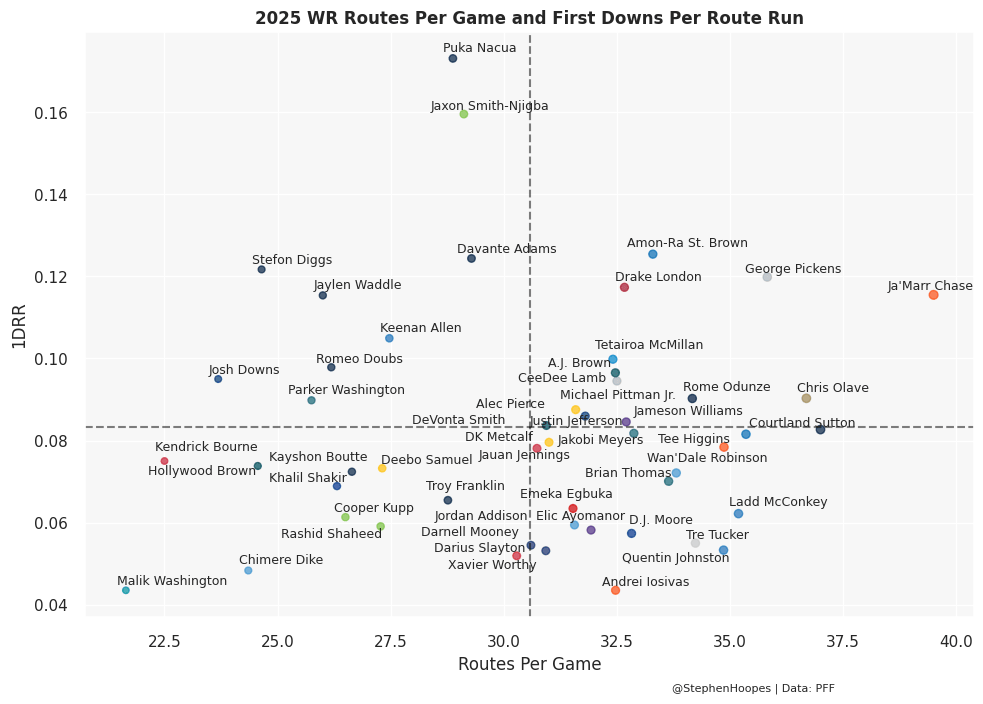
In general, though, we want as many players in the top-right quadrant as possible. It’s impressive to hit a 1DRR above 9% on a small route sample, like personal favorite Josh Downs did last year. But we need that efficiency to hold on a large route sample to be really interesting in fantasy football. It’s nice to see efficiency in flashes, and that makes guys like Luther Burden fun bets, but it’s the blend of efficiency with volume that generates ceiling outcomes.
So, how am I playing WR this year? From the Key WR stats table above, I’m projecting a few WRs to separate from the field. Because of that, I’m willing to take guys like Nacua, Ja’Marr Chase, and Amon-Ra St. Brown in the first round of drafts. But then I’m taking my foot off the WR pedal for a bit. If last year’s trend continues, then fantasy points at the WR position quickly flatten. And that makes late WR1s and WR2s less valuable than their RB counterparts.
So, if I get one of those WRs at the tippy-top of the rankings, great. But if I don’t, then I take an RB in Round 1. Regardless, I’m trying to focus more on RBs near the top of the draft before switching to back to WRs. As mentioned in the QB article, I like the QBs in Round 6 this year, but otherwise, you have to prioritize QB in Round 8 through 10, especially since the last starter we’re very confident actually plays the entire season goes off the board in Round 12.
Meanwhile, last year was not great for elite TE. That doesn’t have to be the case again, and I could see guys like Brock Bowers separating from the rest of the position. But the opportunity cost in Round 2 is especially high this year. Regardless, all of this keeps the window of Round 3 to 5 focused on the WR position.

Bottom Line
- Just like last year, I’m incorporating ADP in order to find variables that provide additional context beyond existing market assumptions.
- Having said that, 4for4’s weekly position ranking is the most important variable when predicting future week fantasy points.
- From there, we care about both route opportunity and the ability to get open on those routes.
- Receptions per game, contested target rate, 1DRR, and tight window target rate are all directly or indirectly related to a WR’s ability to separate from their defender.
- How I’m playing WR this year is being willing to take a handful of players that could truly be difference-makers at the position, like Nacua, Chase, and St. Brown.
- But then I’m prioritizing the RB position as I see WR fantasy points quickly flatten after the tippy-top players.