The Most Predictable Quarterback Stats

 Make us preferred on Google
I’m going to get the super nerdy stuff out of the way in the QB article so I can just reference it for the other positions. Apologies if that’s not your thing; I’ll make it as painless as possible. In past iterations of this series, we looked at each variable in a vacuum and how well it correlated with future fantasy points.
More Predictable Stats: RB | WR | TE
Modeling Process and Results
But last year, I introduced two key changes. The first was the evaluation of all variables at once, and that included market ADP. The goal of that change was to highlight only the variables that provided additional context beyond existing market assumptions. The second change was the use of weekly data rather than seasonal data. The big advantage to that approach is that it greatly increased how much data we can use for modeling.
For this season, I’m again using a tree-based machine learning algorithm called XGBoost. But new this season is the addition of a deep learning model designed specifically for tabular data called TabNet. The model results are a function of both the XGBoost and TabNet models.
One big benefit to these models is that they don’t assume every variable is linearly related to future fantasy points. There are actually a lot of examples like slot rate for WRs where you want to avoid very low *and* very high values. And while these types of models are more difficult to explain, there are two ways to dig into how they work.
The first is something called SHAP. Think of our fantasy point prediction as a game. And each of the variables in the model is trying to contribute as much to the model as possible in order to win that game. SHAP shows the final standings of our game, or how important each variable was in making our prediction. That’s what the graph below shows.
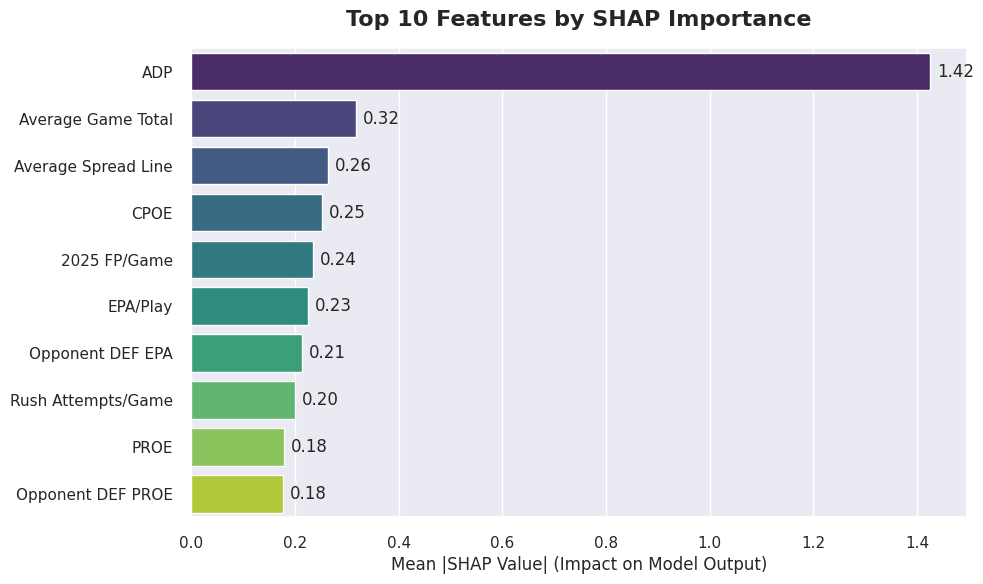
ADP is by far the most important variable in the model. ADP in this sense is the weekly position rank from John Paulsen’s projections dating back to 2021. And for this offseason exercise, we’re using Underdog positional rank.
Let’s dig into the second way of dissecting these models, which is partial dependence plots. These plots isolate the variable(s) we’re looking at and show how future fantasy points change as you adjust their values. For example, the graph below shows the partial dependence plot for both game total and team spread, the variables with the second- and third-largest SHAP values.
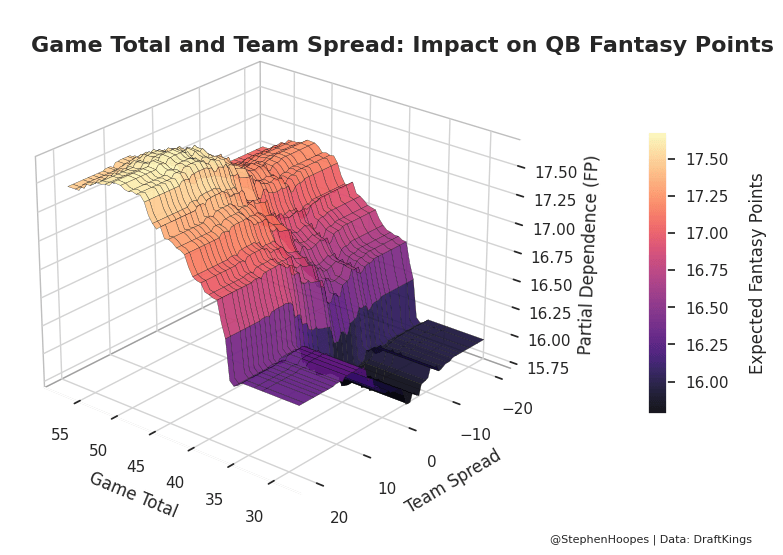
The lighter the color, the higher the expected fantasy points. And the result is intuitive. The highest projected outcomes for our QBs come in games with expected totals above 50 points. And we don’t just want our QB to be in that game environment. Ideally, their team is also favored to win and positioned to capture as many of those points as possible.
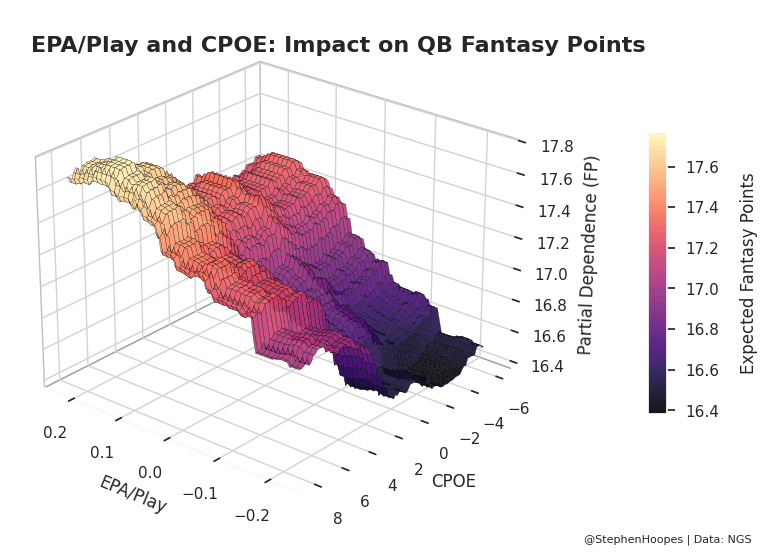
One more example before turning to the 2026 QB predictions. EPA per play and completion percentage over expectation (CPOE) were also important variables in the model. And again, the relationship to expected fantasy points is intuitive. EPA per play and CPOE, while not perfect, are some of the best talent indicators we have at QB. And higher ceiling fantasy point outcomes are more likely when a QB has excellent marks in both variables.
2026 QB Predictions
So, what does the 2026 veteran QB landscape look like? The table below sorts them by their projected fantasy points per game using the above methodology. And I’ve highlighted in green the stats where a QB exceeded a key benchmark and in red when they failed to hit a key value.
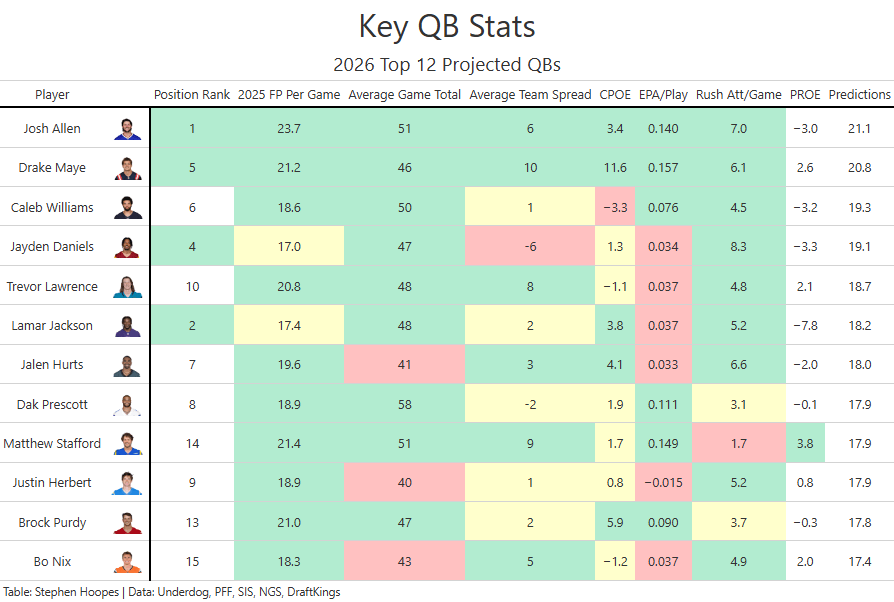
Unsurprisingly, we want our QB to have a low (better) ADP and high previous week/season fantasy points per game. We want their previous average game totals from DraftKings to be at least 45 points and favored by at least three points. We’d like their CPOE to be 2%+ and their EPA per play to be above 0.05. And the more rushing attempts, the better, but at least four per game.
So, how am I actually playing QB this year? It’s a strange season for QB ADPs. We only have one “elite” QB in Josh Allen. This is the cheapest the second tier of QBs has ever been, with players like Lamar Jackson and Jalen Hurts going well past previous-year ADPs. Simultaneously, this is the most expensive later-round QBs have ever been. I’d argue Sam Darnold at QB24 is the last QB you can be reasonably confident starts the entire year. And he’s being drafted in the 12th round.
I really like a lot of the guys in the Round 6 range. These are “elite” QB profiles that we’re getting a discount relative to prior years. But Lamar Jackson had a really rough year last year, as shown in the Key QB Stats table above. It’s a bet I’m making, but you do have to bet that the decline was fully a function of injury. That injury context is something the model isn’t capturing.
And then if you miss on that range, you’re ideally hunting for QBs that will spike in passing TD rate. To do that, I’d argue we should focus on offenses that the market projects for top-10 upside, but where we can draft their QB at a much cheaper cost. Now usually, a spiked TD rate season in the prior year causes a big increase in ADP for the current season. That’s what happened with Baker Mayfield following his TD spike in 2024. But the market isn’t doing that this year with guys like Matthew Stafford or Brock Purdy. So, I think they’re completely reasonable bets given we’re not paying for last season’s results.

Bottom Line
- Just like last year, I’m incorporating ADP in order to find variables that provide additional context beyond existing market assumptions.
- Having said that, 4for4’s weekly position ranking is the most important variable when predicting future week fantasy points.
- From there, we care about variables like projected offensive points, CPOE, EPA per play, and rush attempts per game.
- I’m drawn to the “elite” QB profile in the Round 6 range in best ball drafts that we’re getting a discount relative to prior years, especially since later round QBs are more expensive than ever.
- But if I can’t get those guys, I’m focusing on either rushing-only players or pocket passers on good teams that could see a TD rate spike.