How Play-Calling Tendencies Affect Fantasy Football

 Make us preferred on Google
“All NFL coaches are innovative geniuses. Also, all 32 offenses will be under center much more this year.” It’s such a great quote by Mike Tanier that I had to kick off the play-calling article with it. And it hits a point I want to drive home in this article. I wrote a long article in May talking about the league-wide trends from 2025 that will impact fantasy football this year. Well, today we get to dig into how specific teams will be impacted (or not) by these trends.
For example, the league is shifting toward heavier sets with multiple TEs on the field. But I’d still expect the Cowboys to largely ignore this. And that’s because they’re at their most explosive with CeeDee Lamb, George Pickens, and Ryan Flournoy on the field. I don’t think taking Flournoy off for Brevyn Spann-Ford is in the Cowboys’ interest. Similarly, the Jaguars have declared their intention to play more 2-TE sets after drafting Nate Boerkircher in the 2nd round of the NFL draft. But here are Boerkircher's receptions by season in his first four years of college: two, six, five, and six. Even if their early-season intent is for multi-TE sets, I don’t think it will work.
But today isn’t about the Cowboys or Jaguars. It’s about the 18 teams (!) with new offensive play callers in 2026. We’ll first re-introduce some key topics like pass rate over expected (PROE) and pace. These topics are key to understanding what these play callers want to do. And then I’ll go team by team, discussing what we’re likely to see with the league’s new play callers. I’m going to highlight only the teams where we have data from the 2025 season to back up our assumptions.
PROE and Weekly Variance
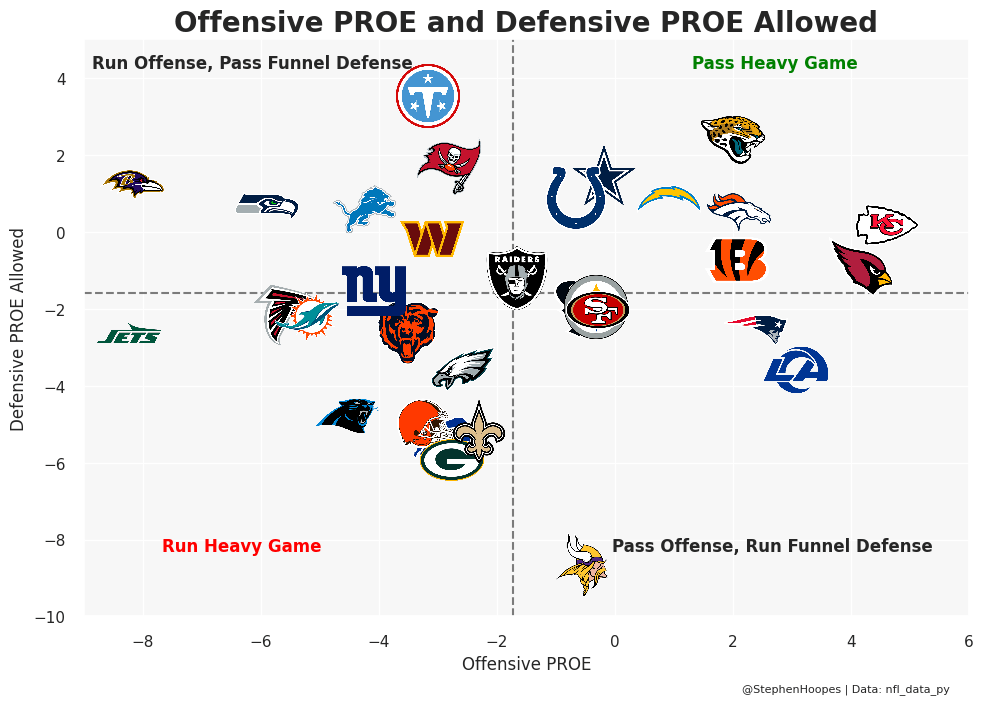
Let’s start with pass rate over expected (PROE). The graph below shows a team’s PROE on the x-axis and how opponents attacked their defense on the y-axis. PROE starts by calculating how often a typical team would pass in each situation (i.e., down, distance, score differential, etc.). And then it compares what a team actually did in that situation. Teams that passed more than expected have a PROE above zero, and the opposite is true for teams that passed less than expected. Last year, we saw the continued shift toward the run as indicated by the vertical dashed line on the graph showing the league-wide PROE average at about -2%.
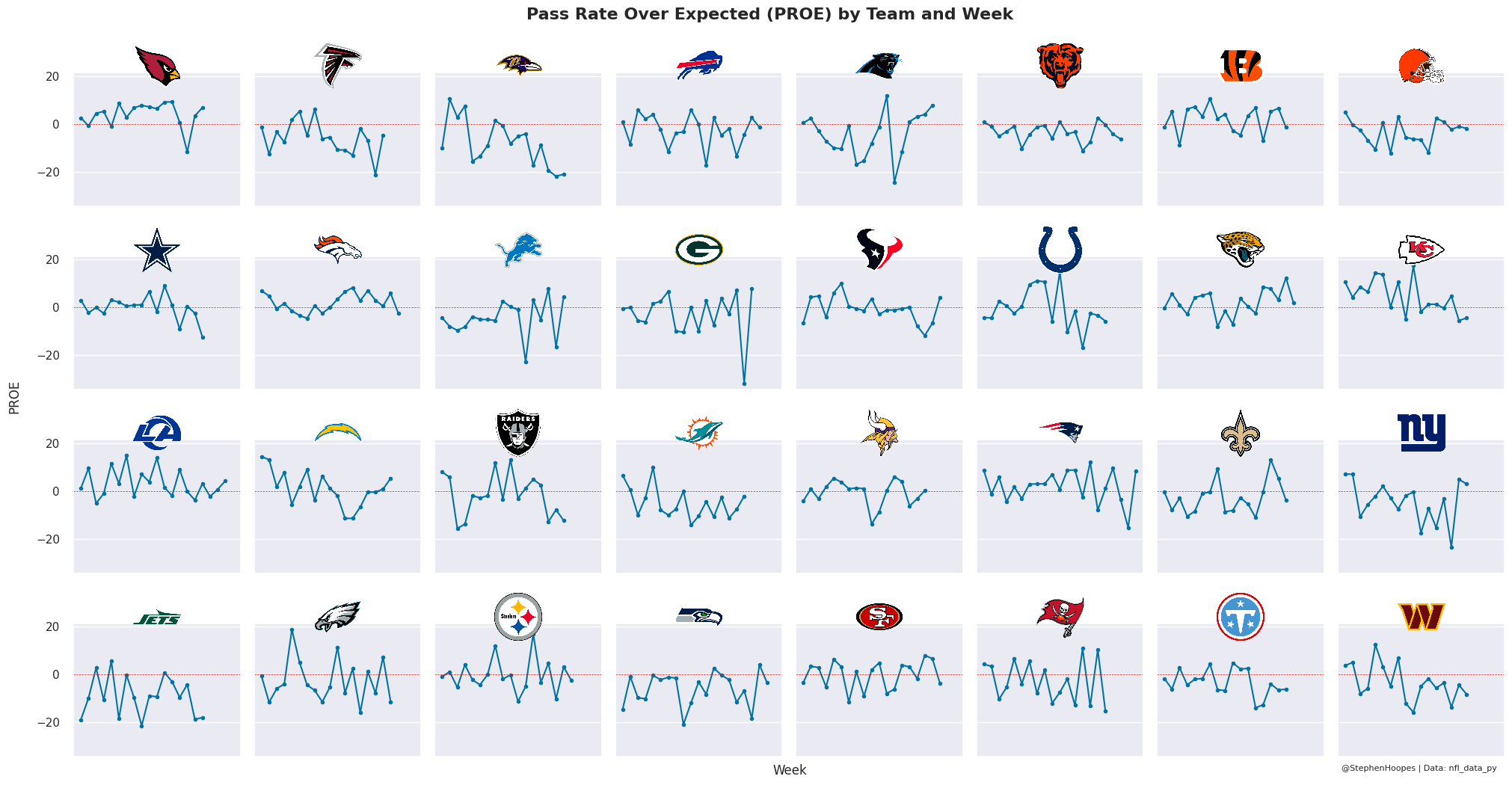
One additional graph on PROE. Each dot on the graph below is a team’s PROE in an individual week. For example, look at the Chargers on the middle-left of the graph. You’ll see they were one of the most pass-heavy teams in the league early last season. But offensive line injuries, particularly to Joe Alt, derailed that approach as the season continued.
Pace and No Huddle
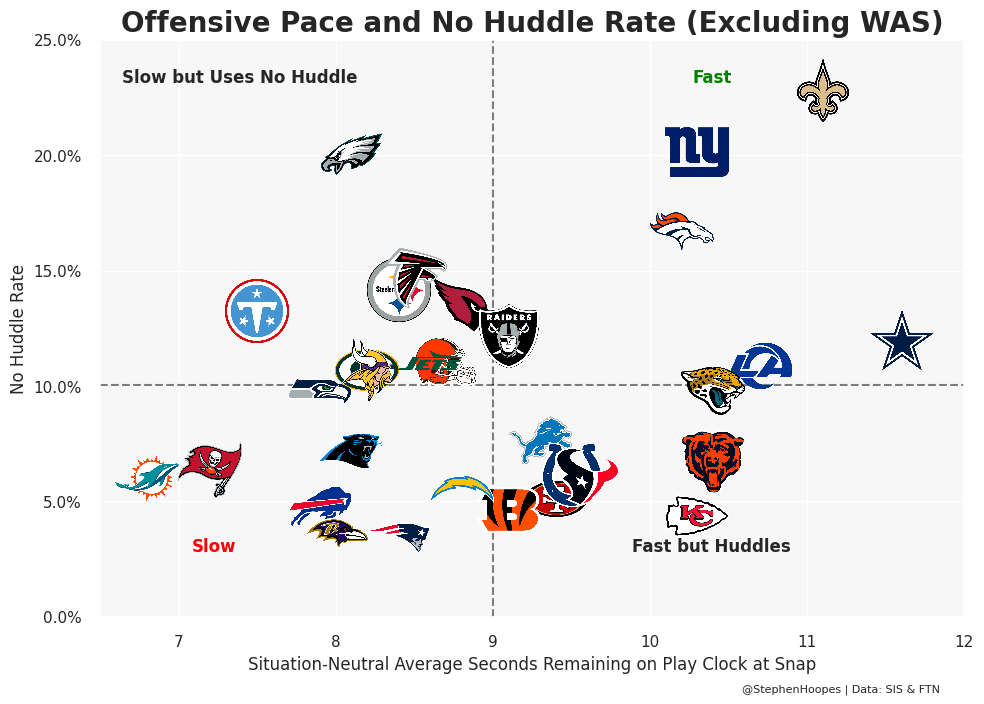
Next up is pace. The graph below shows team pace on the x-axis and their no-huddle rate on the y-axis. The pace metric is the average number of seconds remaining on the play clock at the snap. And we’re only looking at neutral situations. Those are plays in the first three-quarters of the game where the score is within eight points, excluding the last two minutes of the half. For the eagle-eyed readers, the Commanders are excluded from the graph to make it easier to see the other teams. But they would be in the top-left quadrant in their own stratosphere in terms of no-huddle use.
Play Action and Motion
Play action and motion are up next. I grouped these together because these are some “easy buttons” that offensive play callers can use to improve efficiency. The graph below shows the share of dropbacks where a team used play action on the x-axis and the share of dropbacks with motion on the y-axis. So, the y-axis is specific to motion on pass plays, not run plays.
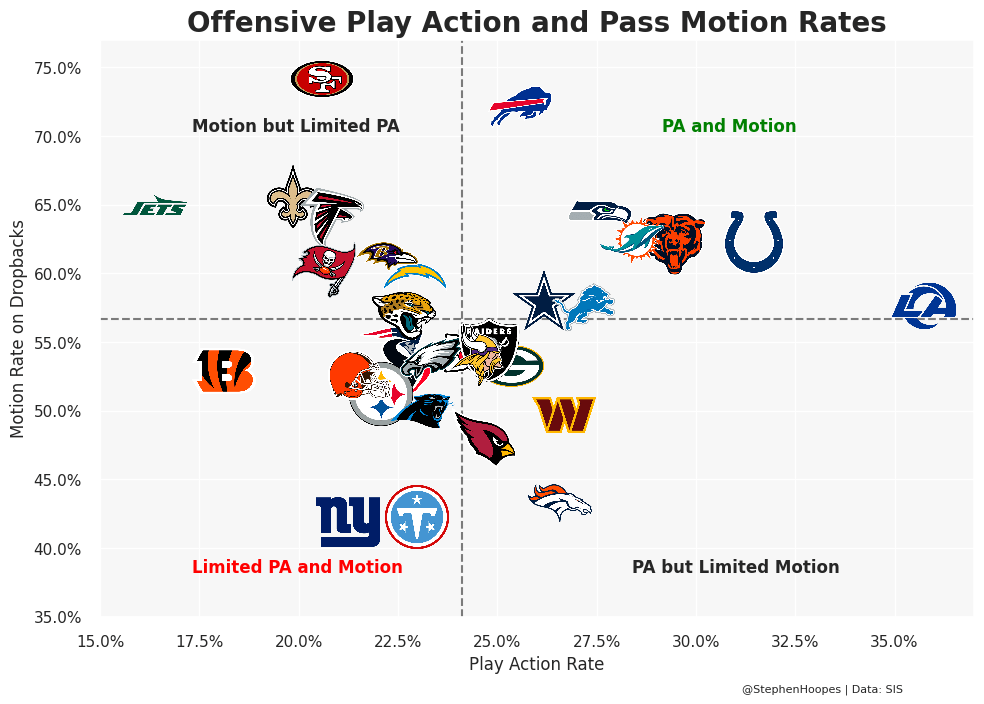
You’ll find some of the best play callers in the league in the top-right quadrant. That includes Sean McVay, Ben Johnson, Klint Kubiak, and Mike McDaniel. And it’s not just anecdotal evidence on the side of play action and motion. Pass plays without play action had an EPA per attempt of -0.01, according to SIS. Pass plays without motion had a similar +0.01 value. Now compare that to an EPA per attempt of 0.06 for plays with either play action or motion. These designs increase the efficiency of an offense and score us more fantasy points.
Under Center and Multi-TE Sets
The final topics before getting into the team-by-team analysis. The use of both under center and multi-TE sets has been a big talking point this offseason. I’ve grouped them together because they both can be seen as an offensive coordinator’s willingness to adapt to a changing defensive meta. That’s not a perfect description though, because as I said in the intro, it’s not always optimal for an individual team to use more multi-TE sets.
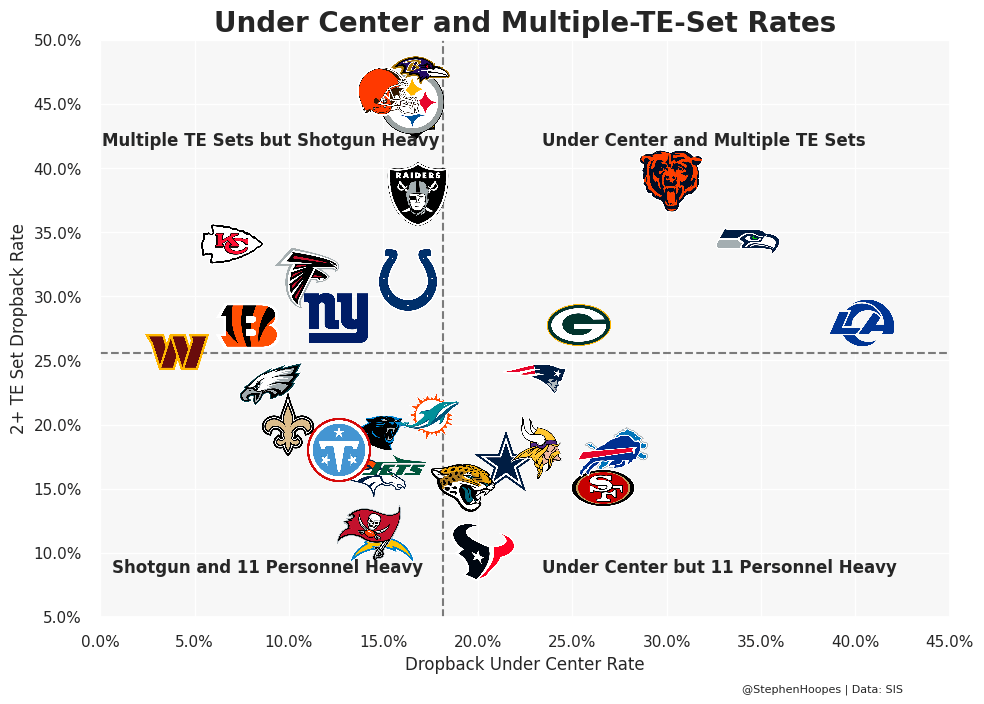
But, again, we’ve got McVay, Kubiak, and Johnson all in the top-right quadrant. Teams are going to see the success of those offenses and try to copy these approaches. But does each team have the personnel to execute these plays? And if they don’t, how quickly will they reverse course?
Team-by-Team Analysis
Atlanta Falcons
The Falcons hired Kevin Stefanski as their new head coach and Tommy Rees as their new offensive coordinator. Both had the same roles last year on the Browns. And I’m generally more positive on Stefanski than the Browns’ metrics last year will imply. Speaking of which, the Browns had the 2nd-worst offense last year, narrowly beating out the Raiders. But they were about league-average in plays per game, thanks to a pace that was near league-average and an elite defense that handed the ball back to them.
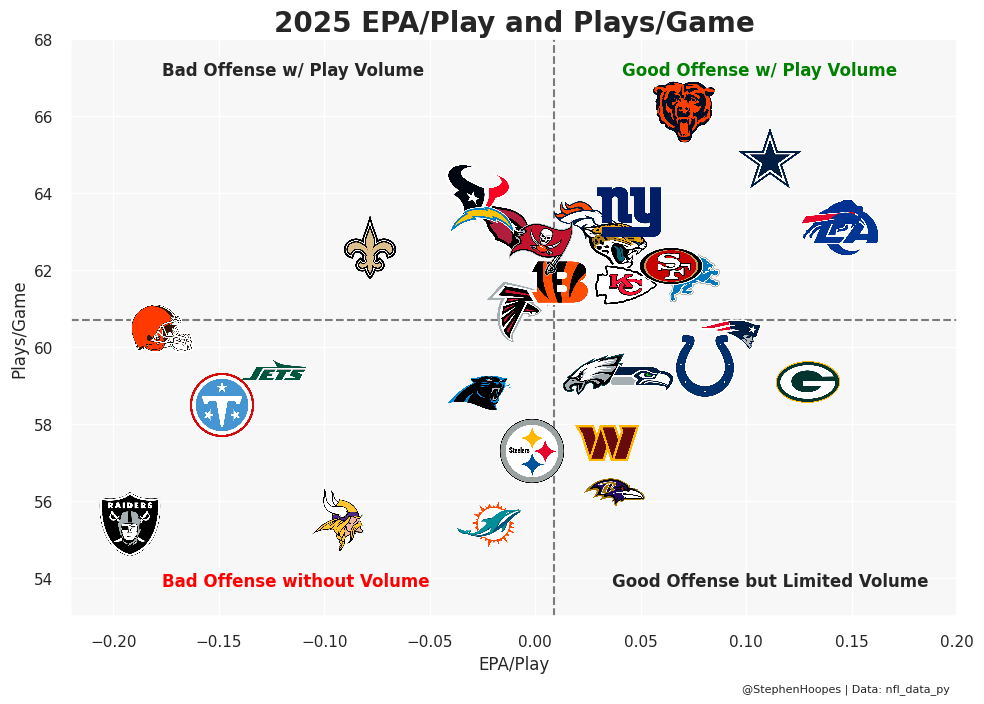
But perhaps the most notable thing about the Browns’ play-calling tendencies was their use of multi-TE sets. They were 2nd only to the Ravens in their share of dropbacks with two or more TEs on the field, nearly 20% above the league average. So, in terms of what changes we’ll see in Atlanta this year, the biggest one will be the increase in multi-TE sets from an already high rate. That feels reasonable for a team whose WR2 might be Jahan Dotson. And that’s good for the concentration of the offense. Drake London, Bijan Robinson, and Kyle Pitts will be running more routes against teammates less likely to earn a target. Now we just need a healthy QB to throw them the ball.
Cleveland Browns
We just detailed what the Browns did last year. So, what will Todd Monken bring to this offense? Well, the Ravens were the only team with a higher rate of multi-TE dropbacks than the Browns, so I’d bet that stays. The Ravens had a similarly low use of play action and were on the slower side (about half a second slower than the Browns in neutral situations).
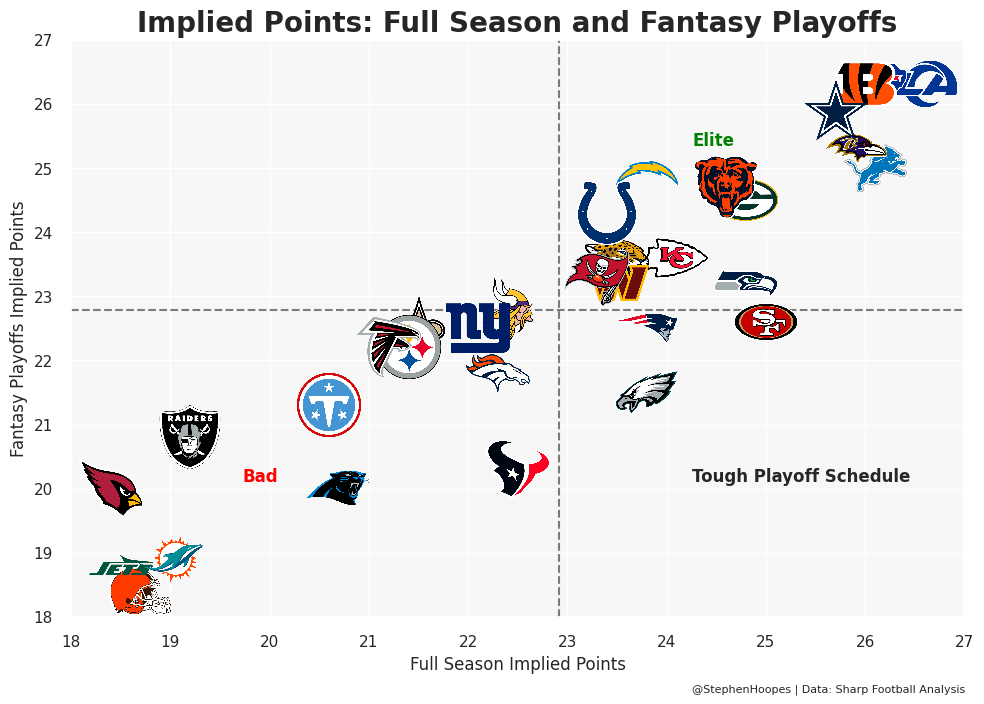
Wait, so what is changing? The big thing to me is the use of motion. The Ravens used motion on 10% more of their dropbacks compared to the Browns last year. That should create some more easy buttons for the Browns’ WRs. Speaking of which, much has been made this offseason of Monken’s success with Zay Flowers, who many are using as their comp for the Browns’ rookie KC Concepcion. I think he can do it, but we’ll need Concepcion to play in 2-WR sets and not be limited to a slot-only role. And we’ll also need him to overcome the Browns’ QB situation. The market is less optimistic about that, with the Browns’ implied for the lowest average points per game in the league.
Detroit Lions
The Lions hired Drew Petzing from the Arizona Cardinals as their new offensive coordinator. This comes off a season where Dan Campbell took back play-calling duties from John Morton mid-season. Two big things to keep in mind with Petzing. The first is he loves 3-TE sets. The Cardinals were one of only three teams with over 40 dropbacks in 3-TE sets last year, according to SIS.
Now, I’d be surprised if the Lions follow suit with 3-TE sets. I don’t see a reason to take your extremely explosive WR Jameson Williams off the field to make room for Anthony Firkser. Which leads to the second thing to keep in mind with Petzing. And that is he’s known around the league as someone who understands modern run-game concepts. That, to me, is the real reason for the Petzing hire. The Lions had a poor rushing success rate last year, and my bet is we see a stark improvement there, especially with Jahmyr Gibbs as the bell cow.
I’m really interested in all of the key Lions’ pieces this year in fantasy. There is simply no one after the top four players that has any chance to eat into their volume. The Lions have the 3rd-highest implied points per game this year. Their secondary has already been gashed by injuries and off-the-field issues. And if Petzing is a bad play caller, we have the security that Campbell will once again take back play-calling duties mid-season.
Los Angeles Chargers
The Chargers were about average in pace last year. And for all the justified excitement with the Mike McDaniel hire, that pace is going to slow down considerably in 2026. The Dolphins had the slowest situation-neutral pace in the league last year, taking about five more seconds off the play clock per play than the Cowboys, as an example. And the reason is that McDaniel’s use of motion simply requires more time to execute before the snap.
But we also know that McDaniel is a sharp play caller. We’ll see more play action, more under center use, and more multi-TE sets in Los Angeles this year relative to 2025. We’ll especially see more 2-RB sets as that is something McDaniel has always done. Overall, though, McDaniel is excellent at getting the ball in the hands of his stars and maximizing the talent of his offensive line. And that offensive line is already projected to be one of the best in the league with both starting tackles returning from injury.
That’s great news for both Ladd McConkey and Omarion Hampton. The Chargers had the 2nd-lowest rate of multi-TE dropbacks last year, with McConkey specifically running routes against more WRs than almost anyone else in the league. But we’re going to need this offense to be massively efficient to pay off their ADPs, especially since we have big play volume question marks given their snail's pace. It’s a bet I’m making.
Las Vegas Raiders
Klint Kubiak went on an absolute heater with the Seahawks last year, earning the Raiders’ head coaching gig after a Super Bowl win. You’ll find the Seahawks on the extremes of most of the graphs above. They were slow and run-heavy, prompting their play volume to be below average even with a good offense. But they also had a lot of play action, motion, under center use, and multi-TE sets. He has his work cut out for him with the Raiders, though.
The Raiders had the least-efficient offense in the league last year, finishing multiple games with fewer than 100 air yards. I think Kubiak’s ability to design an offense will provide at least a functional floor for the offense. The market agrees with the Raiders improving from 32nd to 28th in implied points for the full season and 26th during the fantasy playoffs. That’s not good by any means, but it’s at least not outlier-level bad. And Kubiak was relentless in his ability to target Jaxon Smith-Njigba at a rate that seemed unsustainable until it sustained for the entire season. I’ve struggled with the opportunity cost of the elite TEs this offseason, but there is a chance Kubiak just keeps hitting the Brock Bowers button until the button breaks.
New York Giants
Matt Nagy was handed the best QB on the planet and returned a league-average offensive finish. Now he gets the chance to work with Jaxson Dart instead. What could go wrong? All joking aside (though I’m not joking), I’m not sure how much of the stuff we saw in Kansas City will transfer to New York. The Chiefs were fast, consistently led the league in PROE, and used a lot of shotgun, though I’d bet these are mostly Patrick Mahomes stats.
The quote at the top of the article was in reference to a report that the Giants will use a lot more under center this season. My bet is the combination of John Harbaugh, Nagy, and offensive assistant Greg Roman will lead to a slow-paced offense trying to establish their identity through Cam Skattebo headbutts. But there’s uncertainty here, especially because the Giants were one of the fastest teams in the league last year when Dart was on the field. Was that a Dart stat, because that’s been his preferred way to play since his time at Ole Miss? Or was that just a Brian Daboll stat?
Tampa Bay Buccaneers
The Buccaneers hired Zac Robinson as their new offensive coordinator after he spent the last two seasons with the division rival Falcons. The Falcons were top-10 in the use of multi-TE sets last year, which would be a stark change relative to the Buccaneers, who were 30th in 2025. And sure, we’ll get more multi-TE sets this year, but you’d also expect Robinson to lean toward his talent at the WR position rather than force Payne Durham on the field.
One larger change should be the Buccaneers’ pace. Only the Dolphins played at a slower pace than the Bucs last year. It’s not like the Falcons were flying in 2025 with Robinson. But Robinson was also dealing with a rough QB combination of an injured Michael Penix and ancient Kirk Cousins. And if we go back one additional year, the Falcons had the 4th-fastest situation-neutral pace in the league. The Buccaneers managed good play volume last year despite their slow pace. We should see that bump up even further under Robinson.
Tennessee Titans
The Titans hired Brian Daboll as their offensive coordinator this offseason after getting fired as head coach of the Giants. The two big changes I think we’ll see are a faster pace and more multi-TE sets. Daboll has consistently ranked in the top-10 of situation-neutral pace, excluding the 2024 season when Daniel Jones was replaced by Drew Lock and Tommy DeVito. And it’s a safe bet that the Titans will move faster this year, given they operated with the 3rd-lowest pace last season. They even had an above-average no-huddle rate that was still nearly 10% below the Giants’.
Similarly, the Giants’ use of 2-TE sets was about 10% above the Titans’ last year. Given the Titans just paid Wan’Dale Robinson, my assumption is he’ll play in these 2-WR sets along with rookie Carnell Tate. But the ability for any of this to work is almost solely based on Cam Ward’s development. The market is skeptical at best. The Titans are firmly in the “Bad” quadrant of the implied points graph above, ranking 27th in full-season points per game. But they’re still three points above the Browns’ number.