2026 Fantasy Football Projections - QB
| # | Player | Team | BYE | FF Pts | Comp | Att | PaYdsPassing | PaTD | INT | Sacked | Pa1D | RuAtt | RuYdsRushing | RuTD | Ru1D | Fum |
|---|---|---|---|---|---|---|---|---|---|---|---|---|---|---|---|---|
| 1 | Josh Allen
Draft Note
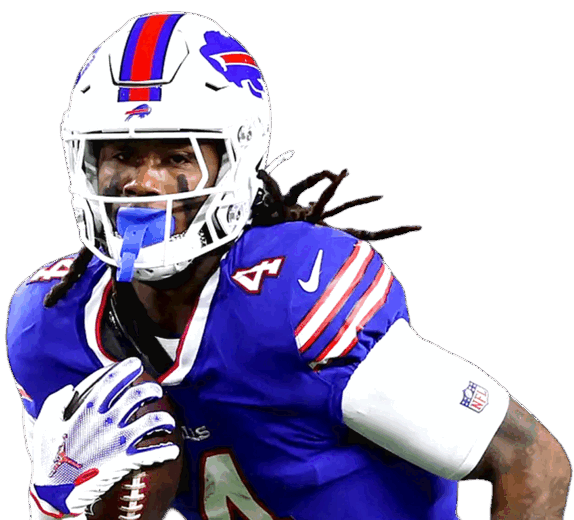
Allen is the safest pick at the quarterback position, and it's not particularly close. He's finished QB1 and QB2 the last two seasons while playing all 34 games, and his consistency is remarkable—he's scored 20-plus fantasy points in 59% of games over that stretch with only four games below 10. His 2025 efficiency was elite: 93rd percentile in EPA per dropback and 87th percentile in CPOE, and the rushing remains the league's best fantasy cheat code at the position. Allen averaged 37.4 rushing yards per start with 14 rushing touchdowns last season. That's a RB2 season's worth of rushing touchdowns on top of 25 passing touchdowns, and it’s his third consecutive season with at least 12 rushing touchdowns. The Bills added D.J. Moore to a receiving corps that already includes Khalil Shakir and Dalton Kincaid, giving Allen arguably his deepest set of pass-catchers since Stefon Diggs was in Buffalo. He's going as the QB1 off the board with an overall ADP around pick 30, and that's the right price. The only question is whether you want to spend that draft capital on a quarterback when you could wait and get a value QB significantly later. But if you want the highest floor and the highest ceiling at the position, Allen is the pick. If the draft gets weird and the available options in the third round aren’t too appealing, then Allen is an extremely safe pick.
| BUF | 7 | 342.5 | 311 | 459 | 3670 | 24.6 | 8.7 | 25 | 176.5 | 97 | 505 | 10.1 | 32.9 | 3 |
| 2 | Lamar Jackson
Draft Note
In 2024, Jackson was historically dominant—the overall QB1 at 25.5 points per game with 13 of 16 games over 20 points and zero games below 10. Then 2025 happened. Jackson missed five games, finished QB20 overall, and cratered in the second half of the season, averaging just 12.0 points per game after the midway point compared to 23.8 before it. The rushing, typically his fantasy floor, fell to 26.9 yards per game with just two rushing touchdowns—a fraction of his usual production. His efficiency slipped to the 60th percentile in EPA per dropback, still respectable but a far cry from the MVP-caliber play of the prior season. The offseason brings change. Isaiah Likely is gone, and while Mark Andrews is back, the Ravens are banking on rookie tight ends Ja'Kobi Lane and Elijah Sarratt to fill the void alongside him. New offensive coordinator Declan Doyle takes over play-calling duties. Zay Flowers remains a legitimate number-one receiver, but the overall supporting cast feels thinner than it was a year ago and he has missed 18% of his games in the last five seasons. Jackson is going as the QB2 with an overall ADP in the middle of the fifth round. The talent is undeniable—when healthy, Jackson has as high a ceiling as anyone in fantasy. But the second-half collapse, the reduced rushing, and a transitional roster make QB2 a price that carries more risk than it has in years.
| BAL | 13 | 318.7 | 264 | 412 | 3423 | 27.2 | 6.6 | 30 | 160.9 | 125 | 708 | 2.4 | 46.1 | 3 |
| 3 | Drake Maye
Draft Note
Maye's second-year leap was one of the best stories of the 2025 season. After taking over as a rookie in Week 6 of 2024 and posting QB15 numbers the rest of the way, he exploded into the overall QB2 last season at 21.0 points per game—and he did it with arguably the weakest supporting cast of any top-10 quarterback. His efficiency was excellent: 100th percentile in both EPA per dropback and CPOE among qualified passers, meaning he was literally the most efficient and most accurate passer in football. He threw for 4,394 yards and 31 touchdowns while completing 72 percent of his passes, and he added 26.5 rushing yards per game with four rushing touchdowns on the ground. Perhaps most impressive was the consistency—Maye scored 20-plus points in nine of 16 games and never once dipped below 12.0.
The Patriots have started to build around him. Romeo Doubs was added as a steady possession receiver, Hunter Henry returns, and with A.J. Brown now in the fold, the Patriots’ offensive is dangerous. Even without Brown, Maye proved last year that he can produce elite fantasy numbers with limited weapons, which means any upgrade to the skill positions is pure upside.
| NE | 11 | 297.0 | 324 | 451 | 3753 | 25.6 | 11.0 | 42 | 181.3 | 103 | 423 | 3.2 | 27.5 | 3 |
| 4 | Jayden Daniels
Draft Note
Daniels was electric as a rookie in 2024, finishing as the overall QB4 at 22.0 points per game with 10 of 16 games over 20 points. Then injuries derailed his sophomore season. He appeared in just seven games in 2025, finishing QB33 overall, but the per-game production when fully healthy was still impressive—he averaged 19.6 points in his four full games and posted 17.7 and 15.2 in two additional contests where he played only 69 and 88 percent of the snaps, respectively. The efficiency metrics in his limited action (47th percentile EPA, 24th percentile CPOE on just 186 attempts) are hard to read much into given the small sample and the fact that he was clearly battling through injuries. The rushing was still there: Daniels averaged 45.4 rushing yards in the five games where he played at least 87% of the snaps. The supporting cast has turned over. Terry McLaurin remains the alpha, and the Commanders possibly upgraded at tight end by bringing in Chigoziem Okonkwo to replace Zach Ertz. They lost Deebo Samuel but drafted Antonio Williams and added Rachaad White and Jerome Ford to reshape the backfield. It's a transitional roster, but Daniels' rushing ability gives him a floor that's almost impossible to replicate at the position. He's going as the QB4, and that's a price built entirely on the 2024 version of Daniels. If he's healthy, the rushing alone makes him a weekly QB1.
| WAS | 7 | 295.0 | 307 | 462 | 3389 | 22.4 | 9.0 | 41 | 165.8 | 133 | 637 | 3.7 | 41.5 | 4 |
| 5 | Jalen Hurts
Draft Note
Hurts has been one of the most bankable fantasy quarterbacks in football, finishing QB6 and QB7 the last two seasons while playing nearly every game. His per-game average dipped from 21.0 to 18.7 points last year, but the rushing production continued to anchor his floor—26.3 yards per game with eight rushing touchdowns. His accuracy was strong (82nd percentile in CPOE) and the efficiency was solid (67th percentile in EPA per dropback), though the second half of last season was uneven, as he averaged 21.7 points in the first eight games and 15.7 the rest of the way. The big question heading into 2026 is the receiving corps. A.J. Brown is gone, though the Eagles moved up in the first round to nab Makai Lemon and added Dontayvion Wicks and Hollywood Brown. DeVonta Smith is more than capable of stepping into the WR1 role and Dallas Goedert provides a reliable safety valve. Hurts offers solid value at QB7.
| PHI | 10 | 294.7 | 291 | 439 | 3080 | 21.8 | 6.3 | 34 | 152.3 | 118 | 457 | 8.5 | 29.7 | 3 |
| 6 | Joe Burrow
Draft Note
When Burrow is on the field, he's one of the best fantasy quarterbacks in football. He finished QB3 in 2024 at 22.5 points per game—his second top-four finish in three seasons—and was dominant down the stretch, averaging 26.4 points per game in the second half. His 2025 was derailed by injury yet again: he played just seven games, though his accuracy upon return was outstanding—91st percentile in CPOE and 73rd percentile in EPA per dropback. In the five games after coming back from his midseason absence (Weeks 13–17), he averaged 19.5 points per game, suggesting the arm talent was still very much intact. The problem is that the arm talent has never been the question. Burrow has missed 16 games over the last three seasons, and that kind of volatility is difficult to build a roster around, especially at a QB3 ADP. The rushing offers almost nothing—5.1 yards per game last season, 11.8 in 2024, 8.8 in 2023—so he's mostly pass-dependent, which makes him more vulnerable to bad game scripts and low-volume weeks than the dual-threat quarterbacks going around him. On the other hand, Ja'Marr Chase is the best receiver in fantasy football, Tee Higgins gives him an elite second option, and the Bengals' defense has a way of keeping Burrow in high-volume passing situations. At QB3, the ceiling is there—he's finished top four twice in four full seasons—but you're paying a premium that doesn't account for the very real chance he misses a month.
| CIN | 6 | 294.0 | 403 | 573 | 4122 | 31.7 | 9.4 | 39 | 205.7 | 44 | 136 | 0.7 | 8.9 | 3 |
| 7 | Trevor Lawrence
Draft Note
Lawrence has quietly put together a strong case as one of the most undervalued quarterbacks at his price point. After back-to-back injury-shortened seasons, he returned healthy in 2025 and finished QB4 overall at 19.7 points per game—and the second-half surge was striking, improving from 16.6 points per game before the midpoint to 22.7 after it. The rushing is underrated: Lawrence averaged 21.6 yards per start with nine rushing touchdowns last season, a number that rivals some of the best dual-threat weeks at the position. His accuracy still lags—29th percentile in CPOE—but the EPA per dropback (69th percentile) and the touchdown production suggest he makes enough plays where it counts. The Jaguars lost Travis Etienne but added Chris Rodriguez to help carry the backfield load, and it's Year 2 with Liam Coen, who is making the case that he’s one of the best offensive minds in the league. The receiving corps features Brian Thomas Jr. as a possible WR1, Jakobi Meyers as a reliable slot option, the efficient Parker Washington, and Travis Hunter, who has the talent to produce, provided he gets enough run on offense. Lawrence is going as a midrange QB1, and given his QB4 finish last year and the rushing floor he provides, that price looks fair. If the second-year Coen offense unlocks another level, there's top-five upside here once again.
| JAX | 7 | 287.0 | 312 | 517 | 3553 | 23.8 | 11.7 | 34 | 172.4 | 74 | 340 | 5.5 | 22.2 | 3 |
| 8 | Justin Herbert
Draft Note
Herbert has settled into low-end QB1 territory, finishing QB13 and QB9 the last two seasons. His passing efficiency was middling last year—53rd percentile in EPA per dropback, 60th percentile in CPOE—but the big story was his legs. Herbert rushed for a career-high 498 yards (31.1 per game) and two touchdowns, and wants to keep running. That's meaningful for his fantasy outlook because the rushing floor is what separates the elite fantasy quarterbacks from the pack. The Chargers have a solid receiving corps with Ladd McConkey, Quentin Johnston, and second-year players Tre Harris and Oronde Gadsden, and they added Brenan Thompson in this year's draft and David Njoku late in free agency. Mike McDaniel will be calling the plays, and has said that he would like Herbert to get the ball out more quickly and not have so much on his shoulders. Reading between the lines, this sounds like less running to me, but Herbert will still need to scramble and will pick his spots to use his legs. Where I think McDaniel can really help is Herbert’s efficiency. Herbert averaged 7.3 yards per attempt last season and has a career 7.2 YPA. McDaniel took over the Dolphins’ offense in 2022 and took Tua Tagovailoa from a career-to-date 6.6 YPA to 8.9 YPA in his first season. I’m not expecting that sort of leap for Herbert, but he could be a lot more productive as a passer under McDaniel, and that could offset a loss of rushing production.
| LAC | 7 | 286.6 | 325 | 487 | 3885 | 24.2 | 8.8 | 43 | 186.3 | 70 | 382 | 1.9 | 24.9 | 3 |
| 9 | Caleb Williams
Draft Note
Williams took a meaningful step forward in Year 2, improving from a solid QB14 rookie finish to the overall QB6 at 18.8 points per game, a 3.6-point-per-game increase. He showed the ability to spike with a 37.7-point explosion, and demonstrated that Ben Johnson's system fits his skillset. The rushing contribution (22.8 yards per start, three touchdowns) gives him a nice floor that his rookie season didn't always provide. The advanced stat concerns are real, though. His CPOE sat at the 16th percentile. He can make plays, but he remains an inconsistent thrower, and losing D.J. Moore, his veteran security blanket, matters. Rome Odunze, Colston Loveland, and second-year Luther Burden III all have upside, however. Year 2 in Johnson's system should help, and the ceiling is firmly top-five if the accuracy improves and the receiver group gels. He's going as a midrange QB1, which means you're paying for the upside while accepting the inconsistency. If the CPOE improves to match his EPA (62nd percentile), he's a borderline value. If it doesn't, he may be hard-pressed to match his ADP.
| CHI | 10 | 285.9 | 318 | 537 | 3733 | 25.3 | 7.0 | 39 | 179.8 | 75 | 336 | 2.5 | 21.9 | 3 |
| 10 | Dak Prescott
Draft Note
Prescott had a strong bounce-back season in 2025, finishing QB5 at 19.6 points per game after an injury-shortened QB31 the year before. His efficiency was excellent—89th percentile in EPA per dropback and 76th percentile in CPOE—and he was remarkably steady, averaging 19.2 points per game in the first half and 20.0 in the second. Nine of 16 games went over 20 points, and he only dipped below 10 twice. CeeDee Lamb and George Pickens give him two legitimate weapons on the outside, Jake Ferguson is a reliable tight end, and Brian Schottenheimer runs a pass-heavy offense that keeps Prescott in high-volume situations all season. The only structural concern is the lack of rushing—11.1 yards per start and two touchdowns last year—which makes him entirely dependent on passing volume and touchdown rate, both of which can fluctuate. He's going as a midrange QB1 for a player who finished QB5 last year and QB4 in 2023. The Cowboys are going to throw the football, and when they do, he's likely to be efficient.
| DAL | 14 | 285.6 | 371 | 548 | 4137 | 28.5 | 12.0 | 31 | 201.8 | 47 | 156 | 1.3 | 10.2 | 3 |
Spend more time winning, less time guessing. Stay ahead with accurate rankings, advanced tools, and data-driven content.
Fantasy Football Draft Rankings for 2023
Are you ready to master your fantasy football draft with the best Quarterbacks (QBs)? Look no further than the fantasy football QB draft rankings for 2023 to give you the needed edge.
With factors such as player statistics, performance history, injury concerns, and team dynamics taken into account, these QB rankings help you identify the most valuable signal-callers for your team. Whether you're aiming for a pocket passer with proven consistency or a dual-threat QB with game-changing abilities, these 2023 rankings offer the insights to make the right choice.
What are QB Draft Rankings?
QB draft rankings are a crucial tool in fantasy football that help you make informed decisions specifically about the quarterback position during your draft. These rankings list QBs based on their projected performance for the upcoming season.
They consider factors like passing volume, TD passes, offensive weapons, injuries, team offensive strategies, and potential opportunities within the game. By referring to the QB draft rankings, you can prioritize quarterbacks based on their expected value and choose the best available player to lead your fantasy football team when it's your turn to pick.
Fantasy football QB rankings for 2023 are regularly updated throughout the preseason to reflect changes in player performances and team dynamics. This constant updating ensures that you have the latest insights into the QB landscape. So, make sure to study these QB draft rankings and use them as a valuable resource to build a strong and competitive fantasy football team, with a standout quarterback at the helm.
How do Fantasy Football Draft QB Rankings Work?
Understanding how QB draft rankings work is essential for making smart decisions when selecting a quarterback during your fantasy football draft. QB draft rankings are used to rank quarterbacks based on their projected performance for the upcoming season.
These rankings are crafted by experts, such as those at 4for4, who meticulously analyze QB statistics, offensive team dynamics, and other factors affecting a quarterback's performance, including play style and injury history.
The QB rankings are specifically organized to make comparing players within the quarterback position easy. Higher-ranked QBs are generally expected to perform better, but it's essential to consider your team's needs and the overall strategy you want to implement when making your selections.
When drafting your QB, you can use these rankings to determine which signal-callers to select and when. Utilizing the QB draft rankings gives you a targeted insight into the quarterback landscape, allowing for a more precise decision-making process and enabling you to craft a powerful fantasy football team with a strong leader at the helm.
Draft Rankings Cheatsheet 2023
Use this Fantasy Football QB Draft cheatsheet for the upcoming 2023 season to ensure you have an edge in selecting the top-performing quarterbacks for your fantasy team.
The QB draft rankings cheatsheet for 2023 is a valuable tool that provides you with a comprehensive list of quarterbacks ranked by their projected performance for the upcoming season.
It considers various factors such as passing yards, rushing yards, matchups, team offensive strategies, and previous passing statistics to give you a clear picture of the top signal-callers in the league.
Using this QB-specific cheat sheet, you can strategically plan your draft picks and target the quarterbacks likely to have the biggest impact on your fantasy team. This focused approach allows you to hone in on the vital QB position and make informed selections that align with your overall strategy.
Seize the opportunity to gain a significant advantage over your opponents by utilizing the QB draft rankings cheat sheet for the 2023 season. It's the perfect resource to help you find the ideal quarterback to lead your fantasy football team to victory.
QB Draft Rankings Strategy
Developing a well-thought-out strategy for selecting quarterbacks in your fantasy draft can greatly increase your chances of building a championship-caliber team.
The best QB draft rankings strategy considers your league's scoring system and roster requirements, specifically regarding the quarterback position.
Understanding how QBs score in your particular league will help you prioritize and identify the quarterbacks with the most value.
Studying a quarterback's throwing performance from previous seasons and analyzing their potential for the upcoming season can give you a unique edge in selecting the perfect leader for your team.
It's also crucial to stay updated on injury reports and any changes in team offensive strategies or supporting casts that could affect a QB's performance.
Is the team run-heavy or pass-heavy?
Who are the supporting wide receivers and offensive line?
These factors can make a significant difference in a QB's success.
When considering QBs, don't be afraid to take calculated risks and trust your instincts. While QB draft rankings are an invaluable guide, they shouldn't be your only resource. Look at matchups, coaching changes, and even a player's motivation or contract year.
Lastly, consider the timing of selecting your quarterback. In some drafts, there may be a run on QBs early, while in others, waiting might allow you to secure top talent in later rounds still.
With a well-executed quarterback-focused strategy, you can secure the best signal-caller for your team and significantly increase your chances of fantasy football success
It's not just about grabbing any quarterback; it's about understanding the landscape and making the right choice at the right time.
This approach puts you in a strong position to navigate the all-important decision of selecting a quarterback in your fantasy football draft for the 2023 season.
Should I Draft QB Or RB First?
Should you first draft a Quarterback (QB) or Running Back (RB) in your fantasy football league? Drafting a QB first allows you to secure an elite talent, often providing consistent points, but you might miss out on valuable RBs or Wide Receivers (WRs).
On the other hand, drafting an RB first could give your team an edge, as elite RBs are rare and can contribute in multiple ways. However, they may be more injury-prone and dependent on team performance.
Typically, the common strategy leans towards drafting an RB first due to position scarcity, but the best decision depends on your league's scoring system, roster requirements, and personal strategy. Understanding the available players and your league's rules, along with a flexible approach, will guide you to the right choice for your team.
Most Accurate Fantasy Football Draft QB Rankings
When it comes to drafting the quarterback for your fantasy football team, accuracy is crucial. You want rankings that reflect QB performance and give you the best chance of success in the vital role of your team's leader.
That's why it's vital to consult the most accurate fantasy football QB draft rankings.
4for4 Fantasy Football has consistently provided precise preseason and in-season QB rankings, specifically tailored to help you find the best signal-callers.
4for4's success with QB rankings is built on a scientific approach focusing on offensive tendencies, strength of schedule, quarterback efficiency, and player talent through predictive modeling.
They delve into factors like passing accuracy, offensive line quality, and even receiver talent to predict QB performance. The result? Measurable, objective, and consistently replicated success in identifying the most promising quarterbacks in fantasy football.
So don't leave the all-important decision of selecting your quarterback to chance - trust the most accurate fantasy football QB draft rankings from 4for4 and increase your chances of victory in the 2023 season. With the right QB at the helm, your team is well-positioned to dominate the competition.
Fantasy Football Draft Rankings by Position
- Fantasy Football Draft Rankings - the latest fantasy football draft rankings.
- QB Draft Rankings: Check out the latest draft rankings for quarterbacks.
- RB Draft Rankings: See the draft rankings for running backs.
- WR Draft Rankings: Discover the draft rankings for wide receivers.
- TE Draft Rankings: Explore the latest draft rankings for tight ends.
- Kicker Draft Rankings: Get the latest rankings for kickers.
- Defense Draft Rankings: Review the latest draft rankings for defenses.
Fantasy Football QB Draft Rankings by Format
- Standard QB Draft Rankings: Explore the standard draft rankings for quarterbacks.
- PPR QB Draft Rankings: Explore the PPR draft rankings for quarterbacks.
- Half PPR QB Draft Rankings: Explore the latest Half-PPR QB draft rankings
Fantasy Football QB Draft Cheatsheets by League
- QB Best Ball Draft Rankings: Explore the top Best Ball QB draft rankings.
- QB Drafters Draft Rankings: Check the Drafters platform's QB draft rankings.
- QB CBS Draft Rankings: Discover CBS's QB draft rankings.
- QB DraftKings Draft Rankings: View DraftKings' QB draft rankings.
- QB ESPN Draft Rankings: Get ESPN's QB draft rankings.
- QB FanDuel Draft Rankings: Find FanDuel's QB draft rankings.
- QB FFPC Draft Rankings: See the FFPC's QB draft rankings.
- QB SBFFC Draft Rankings: Review SBFFC's QB draft rankings.
- QB SFB Draft Rankings: Explore SFB's QB draft rankings.
- QB Sleeper Draft Rankings: Check out the Sleeper's QB draft rankings.
- QB Underdog Draft Rankings: View Underdog's QB draft rankings.
- QB Yahoo Draft Rankings: Discover Yahoo's QB draft rankings.