NFL Offensive Line Rankings Week 7: Matchups to Exploit

 Make us preferred on Google
Evaluating offensive line play through a fantasy football lens can reveal matchup advantages that traditional rankings or defensive fantasy points allowed don't always show.
Each week, we’ll rank all 32 offensive lines, track the biggest movers, and compare those units against the opposing defense’s adjusted fantasy points allowed (aFPA) to identify the quarterback, running back, and D/ST matchups most affected by trench play.
For Week 7, Denver gets a chance to revive its underwhelming passing game against Arizona, while the Rams must redistribute targets following Davante Adams’ knee injury. The Jets and Browns draw offenses with serious protection concerns, and the Steelers and Vikings carry two of the slate’s better rushing setups.
With aFPA now updating weekly, those rankings provide a more current picture of each matchup. Six games remain a relatively small sample, so opponent quality, game script, quarterback play, and injuries remain important alongside the defensive rankings.
Editor’s Note: Check out the complete set of Week 7 fantasy football rankings here.
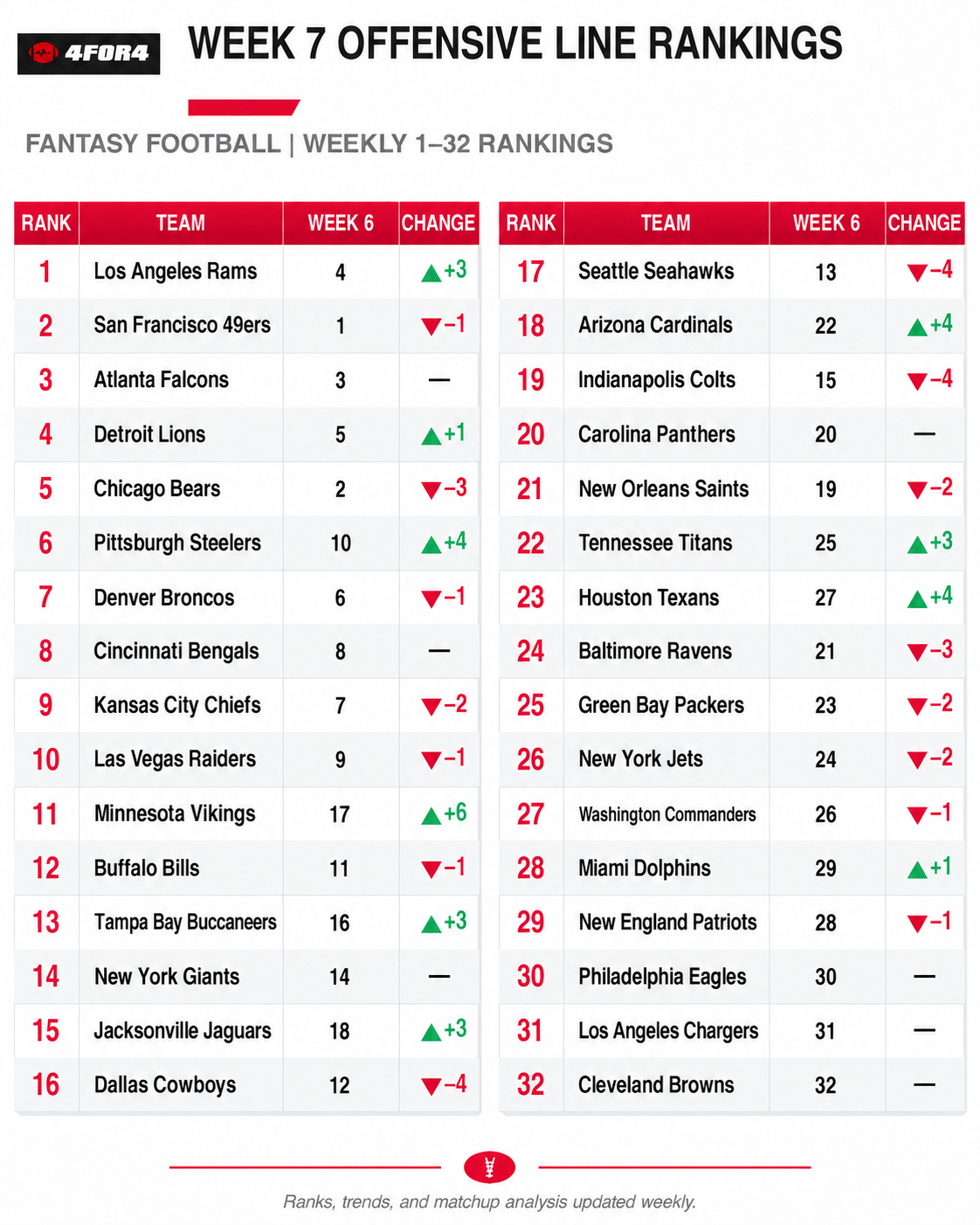 These rankings reflect overall offensive line performance, injuries, recent play, and how each unit is trending entering the week. The change column compares each team’s Week 7 ranking with its Week 6 ranking.
Biggest Offensive Line Risers and Fallers
Risers
Minnesota Vikings (+6)
Minnesota climbs to 11th after its broader blocking profile proved stronger than its sack production suggests.
The Vikings rank third in blown-block rate (1.97%), seventh in running back yards before contact (1.78), and 12th in adjusted line yards (4.16). Their 33.5% pressure rate is also a respectable 13th, giving the offense a relatively balanced foundation in both phases.
A 9.8% adjusted sack rate remains concerning, but Kyler Murray has converted 20.5% of his pressures into sacks. The line has not been dominant in pass protection, but it also has not lost often enough to justify keeping Minnesota in the bottom half.
Arizona Cardinals (+4)
Arizona moves to 18th behind one of the league’s most surprising pass-protection profiles.
The Cardinals have allowed pressure on only 22.2% of their dropbacks, the lowest rate in the league, while their -5.0% Pressure Rate Over Expectation ranks second. Arizona also sits eighth in adjusted sack rate despite Jacoby Brissett converting 21.4% of his pressures into sacks.
The run-blocking results remain considerably weaker, and the loss of Paris Johnson Jr. lowers the unit’s long-term ceiling. Arizona’s early pass-protection performance still supports a move out of the bottom quarter.
Fallers
Dallas Cowboys (-4)
Dallas falls to 16th as its league-low 3.8% adjusted sack rate continues to obscure a less convincing blocking profile.
The Cowboys rank 21st in pressure rate and 30th in RB yards before contact, with their 4.16 adjusted line yards landing right around league average. Dak Prescott has converted only 7.3% of his pressures into sacks, which has made the unit look a little bit better.
Prescott deserves considerable credit for the sack total. The offensive line has not created the same advantage snap to snap.
Seattle Seahawks (-4)
Seattle continues to slide as its protection and rushing results move in the wrong direction.
The Seahawks rank 25th in pressure rate, 24th in adjusted sack rate, and last in RB yards before contact. Their +5.5% Pressure Rate Over Expectation also indicates that the disruption cannot be explained entirely by quarterback time to throw.
Seattle’s 10th-ranked blown-block rate offers some encouragement, but the broader results no longer support keeping the line near the top 12.
Week 7 Fantasy Impact Players Helped by Their Offensive Line Matchup
A strong or weak offensive line matchup shouldn’t completely override volume, talent, or game environment, but it can help break ties between similarly ranked fantasy options.
Among the biggest Week 7 beneficiaries:
- Bo Nix and the Broncos’ passing game: Denver’s seventh-ranked offensive line faces an Arizona defense sitting 31st in QB aFPA and 29th against wide receivers. The Broncos’ passing offense has offered little reason for confidence, but the matchup moves Nix into the high-end QB2 conversation while strengthening the outlooks for Jaylen Waddle and Courtland Sutton.
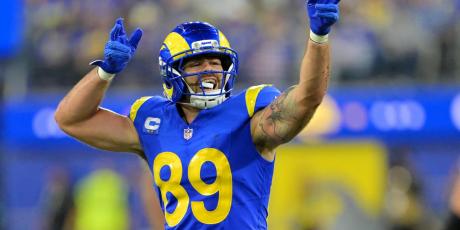
- Matthew Stafford and Tyler Higbee, Rams: Los Angeles owns our top-ranked offensive line and draws a Raiders defense ranked 26th in QB aFPA, 30th against wide receivers, and 28th against tight ends. Stafford remains a fringe QB1, while Davante Adams’ absence should consolidate opportunities around Puka Nacua, Higbee, and Colby Parkinson.
- Jaylen Warren, Steelers: Pittsburgh’s sixth-ranked line faces a New Orleans defense ranked 31st in RB aFPA. Warren belongs near the RB1/RB2 border, while Rico Dowdle remains a deeper FLEX option.
- Aaron Jones and Jordan Mason, Vikings: Minnesota has climbed to 11th and faces an Indianapolis defense ranked 27th in RB aFPA. Jones profiles as an RB2 if Mason returns, with the workload split dependent on how quickly Minnesota is willing to reincorporate Mason following his thumb injury.
- Dak Prescott and the Cowboys’ passing game: Dallas has fallen to 16th, but Philadelphia ranks 23rd in QB aFPA and 28th against wide receivers. Prescott’s pocket management continues to limit sacks, keeping him in the QB1 range while CeeDee Lamb and George Pickens draw one of the week’s more favorable secondary matchups.
Best Quarterback and Passing Game Matchups
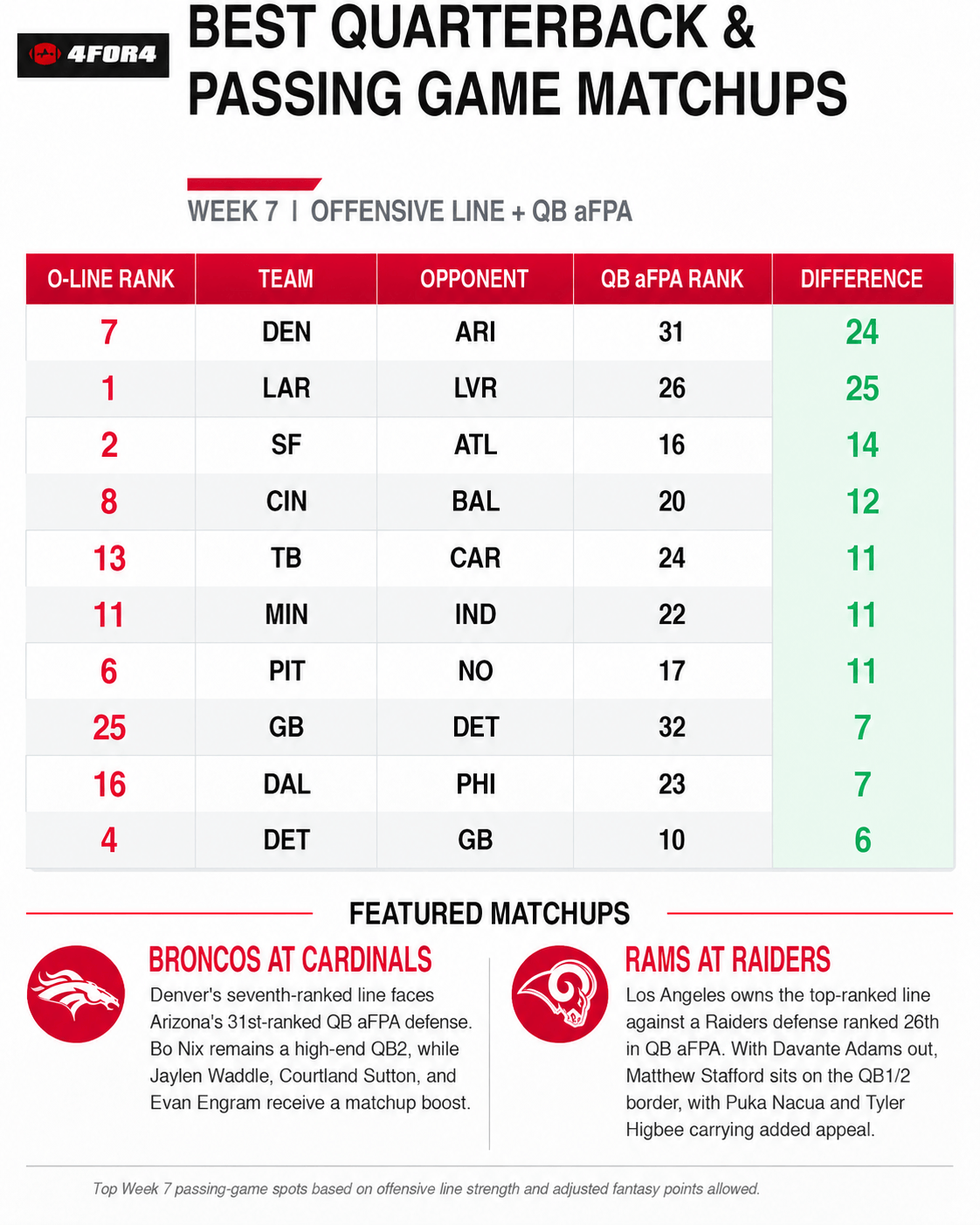
Broncos at Cardinals
Denver’s offensive line has performed considerably better than its passing offense.
The Broncos rank fourth in adjusted sack rate (4.5%) and blown-block rate (2.15%), while their -0.8% Pressure Rate Over Expectation ranks seventh. Bo Nix has also converted only 11.3% of his pressures into sacks, helping Denver avoid negative plays even when the offense fails to generate much of anything downfield.
Arizona ranks 31st in QB aFPA and has generated a 30.2% pressure rate with a nearly neutral defensive Pressure Rate Over Expectation. The Cardinals also rank 29th in aFPA against both wide receivers and tight ends.
Nix remains a high-end QB2 until the passing offense gives us more reason for confidence. Jaylen Waddle is in a terrific spot to pop back up on fantasy radars after four-straight disappointing outputs, while Courtland Sutton can be considered a deeper, WR4-type.
Rams at Raiders
Los Angeles moves into the top spot with Alaric Jackson returning from his one-game suspension, with the line ranking first in adjusted line yards (4.94), second in running back yards before contact (2.48), and fifth in pressure rate allowed (28.1%). The Rams have also performed 4.1% better than expected based on Matthew Stafford’s time to throw.
Las Vegas ranks 26th in QB aFPA, 30th against wide receivers, and 28th against tight ends. The Raiders have generated more pressure than those rankings suggest, but the Rams have consistently kept the offense from being derailed.
Davante Adams is slated to miss 6-10 weeks with his knee injury, while Terrance Ferguson remains on injured reserve. Tyler Higbee ran a route on 72.2% of the Rams’ dropbacks last week after entering the game with a 56.6% season-long rate. He also produced five catches for 83 yards on six targets in Week 5.
Stafford remains on the QB1/2 border, Puka Nacua is an elite WR1 with true 20-target upside, and Higbee returns to the streaming conversation after we were a week early on him. Colby Parkinson is the deeper option if/when Los Angeles continues to expand its multi-TE usage.
Best D/ST Matchups
Jets vs. Dolphins
Miami enters Week 7 with our 28th-ranked offensive line after allowing pressure on 42.2% of its dropbacks. Its +11.7% Pressure Rate Over Expectation ranks 30th, indicating that the disruption extends beyond quarterback time to throw.
The Jets have generated a 38.3% pressure rate with a +6.0% defensive Pressure Rate Over Expectation. Miami is averaging only 14 points per game, carries a 17.5-point implied team total, and has allowed at least eight fantasy points to every opposing D/ST.
New York remains available in approximately 67% of Yahoo leagues.
Browns at Titans
Cleveland has generated pressure on 39.9% of opposing dropbacks with a +6.2% defensive Pressure Rate Over Expectation. Both marks sit near the top of the league.
Tennessee’s full-season protection metrics are closer to average than its 22nd-place ranking might suggest, but the line unraveled during the second half of Week 6. The Titans carry an implied team total below 19 points after failing to provide Cam Ward with consistent protection when forced into obvious passing situations, which seems to be most of the 3rd and 4th quarters.
Ward has converted only 14.5% of his pressures into sacks, lowering Cleveland’s ceiling slightly. The Browns are still available in roughly 65% of Yahoo leagues and belong in the strongest streaming tier.
Best Running Back Matchups
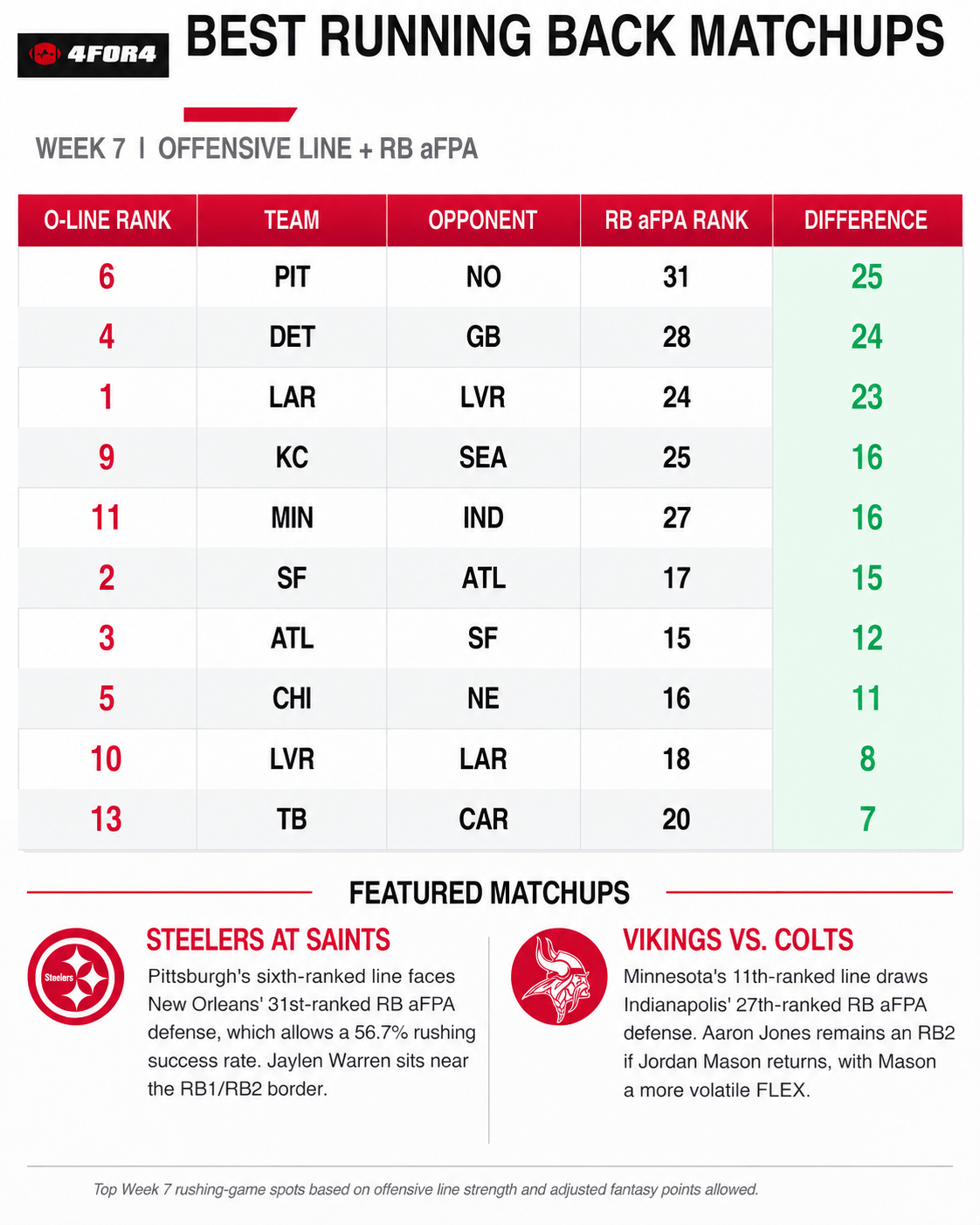
Steelers at Saints
Pittsburgh has continued its climb on the backs of 1.92 RB yards before contact (5th) and 4.30 adjusted line yards (10th). They’ve also allowed pressure only 26.7% of their dropbacks, despite Aaron Rodgers’ lack of movement nowadays.
New Orleans ranks 31st in RB aFPA and has struggled across every underlying run-defense metric, allowing a 56.7% rushing success rate and a 5.8% explosive-run rate while stuffing only 35.8% of opposing attempts.
Jaylen Warren sits near the RB1/RB2 border. Rico Dowdle remains a deeper FLEX option whose best path to production comes through a touchdown or a Pittsburgh-controlled game script.
Vikings vs. Colts
Similarly to Pittsburgh, the Vikings’ continued climb has come due to 1.78 RB yards before contact (7th) and 4.16 adjusted line yards (12th), while maintaining a minuscule 1.97% blown block rate (3rd).
Indianapolis ranks 27th in RB aFPA while allowing a 52.6% rushing success rate and a 5.2% explosive-run rate. The Colts have stuffed only 39.9% of opposing attempts.
Aaron Jones would carry RB1 upside if the backfield remained his, but Jordan Mason has returned to practice, and Minnesota is optimistic that he will play. Jones settles into the RB2 range if Mason is active, while Mason would return as a more volatile FLEX option until his workload becomes clearer.
Fantasy Players to Downgrade in Week 7
These players aren’t automatic sits, but their offensive line and defensive-front matchups lower their Week 7 ceilings:
Jordan Love, Packers: Green Bay’s 25th-ranked line faces a Detroit defense generating a 38.9% pressure rate with a league-high +9.1% defensive Pressure Rate Over Expectation. The Lions rank 32nd in QB aFPA, but their ability to create quick disruption makes Love a more volatile QB1 than that matchup ranking suggests.
Drake Maye, Patriots: Maye’s passing efficiency and rushing production keep him in the QB1 conversation, but New England ranks 29th after allowing pressure on 43.4% of its dropbacks. Chicago ranks second in QB aFPA and has generated a +7.8% defensive Pressure Rate Over Expectation.
Kenneth Walker, Chiefs: Kansas City’s ninth-ranked line remains a positive, but Seattle ranks fourth in RB aFPA. The Seahawks have limited opponents to a 40.9% rushing success rate while stuffing 52.8% of designed runs. There’s no way you’re sitting Walker, but he might be a tough sell in DFS, for example.
Jonathan Taylor, Colts: Indianapolis ranks 19th and now faces a Minnesota defense sitting first in RB aFPA. The Vikings have allowed a 39.8% rushing success rate and stuffed 48.2% of opposing attempts. Taylor remains a must-start option, but the matchup lowers his ceiling.

How These Offensive Line Rankings Work
These rankings are designed specifically for fantasy football and are not intended to function as a pure evaluation of NFL offensive line talent.
The weekly process incorporates injuries, projected starters, recent performance, individual line play, and opponent context. Metrics such as pressure rate, blown-block rate, adjusted sack rate, adjusted line yards, and running back yards before contact help identify how each unit is performing in pass protection and the running game.
Pressure Rate Over Expectation provides additional context by comparing a team’s actual pressure rate with the rate expected based on its quarterback’s time to throw. That helps identify whether a quarterback is creating additional pressure by holding the ball or whether the offensive line is allowing disruption more quickly than expected.
Pressure rate and blown-block rate receive particular consideration because they more directly reflect offensive line performance. Sack rate remains useful for fantasy purposes, but quarterback decision-making, mobility, and pocket management can significantly affect the final result. Pressure-to-sack rate helps separate those quarterback effects from the protection itself.
Penalties receive very little weight and are generally referenced only when they become an extreme or repeated part of a unit’s performance.
The offensive line rankings are then compared with 4for4’s adjusted fantasy points allowed to quarterbacks and running backs. aFPA improves upon raw fantasy points allowed by accounting for the quality of each defense’s opponents and updates weekly throughout the season.