NFL Offensive Line Rankings Week 3: Matchups to Exploit

 Make us preferred on Google
Evaluating offensive line play through a fantasy football lens can uncover matchup advantages that aren’t always obvious from traditional rankings or defensive fantasy points allowed.
Each week, we’ll rank all 32 offensive lines, track the biggest movers, and compare those units against the opposing defense’s adjusted fantasy points allowed (aFPA) to identify the quarterback, running back, and D/ST matchups most affected by play in the trenches.
For Week 3, the 49ers, Seahawks, and Lions stand out among the strongest offensive line and matchup combinations on the slate. Cleveland, Washington, and Houston provide several attractive D/ST and downgrade opportunities, while Baltimore presents an interesting clash between a favorable fantasy matchup and legitimate protection concerns.
This is the final slate before aFPA begins updating weekly, so those rankings should remain a secondary matchup indicator, as opposed to a settled evaluation of each defense.
Editor’s Note: Check out the complete set of Week 3 fantasy football rankings here.
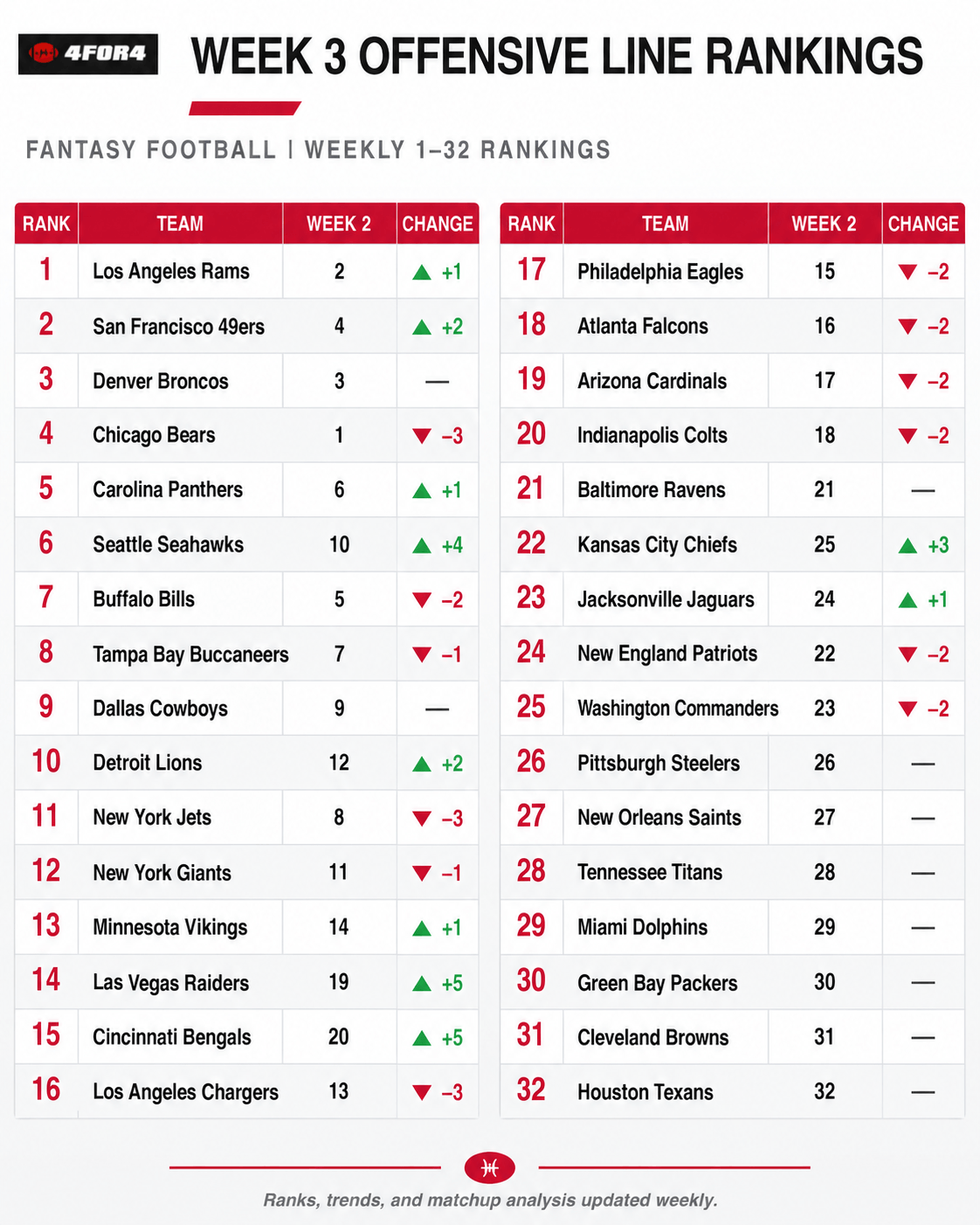
These rankings reflect overall offensive line performance, injuries, recent play, and how each unit is trending entering the week. The change column compares each team’s Week 3 ranking with its Week 2 ranking.
Biggest Offensive Line Risers and Fallers
Risers
Las Vegas Raiders (+5)
Las Vegas has produced one of the league’s most encouraging early pass-protection profiles, allowing pressure on only 17.5% of its dropbacks with a 3.3% adjusted sack rate through two games.
That improvement does not extend equally to the running game. Raiders running backs have averaged only 0.95 yards before contact, and while that’s actually quite a bit better than their 2025 mark, Ashton Jeanty has been hit at or behind the line of scrimmage on 61% of his attempts. The Raiders are not suddenly an elite all-around blocking unit, but their ability to keep the pocket clean warrants a five-spot climb to No. 14.
Cincinnati Bengals (+5)
Cincinnati’s five-spot rise is more about its complete two-week profile than an endorsement of what happened against Houston.
The Bengals have allowed pressure on only 27.4% of their dropbacks this season, but the individual Week 2 results were considerably less encouraging. Orlando Brown Jr. was charged with five pressures and two sacks, Dalton Risner allowed six pressures and one sack, and Dylan Fairchild surrendered another five pressures and one sack. Amarius Mims was the primary exception, as he continues to look incredible through two games.
Joe Burrow’s pocket management helped Cincinnati survive the difficult matchup, but the line will need to be more consistent against Pittsburgh.
Fallers
Los Angeles Chargers (-3)
The Chargers’ blocking problems extend well beyond one difficult matchup for Joe Alt against Maxx Crosby.
Los Angeles has allowed a 42.4% pressure rate and a 9.8% adjusted sack rate while creating only 1.11 running back yards before contact. The interior has also been hit by injuries, with Kayode Awosika expected to miss multiple games and Trey Pipkins already unavailable.
David Njoku and Charlie Kolar were both placed on injured reserve, further reducing the offense’s ability to use its tight ends to provide additional protection. With Trevor Penning expected to become the leading option at left guard, the Chargers fall three spots to No. 16.
Chicago Bears (-3)
Chicago remains one of the league’s best run-blocking units, but its early pass-protection performance no longer supports the No. 1 overall ranking.
The Bears allowed 17 pressures against Minnesota, while center Garrett Bradbury was responsible for four of the offense’s eight penalties. Chicago has now allowed a 38.8% pressure rate with a 10.3% adjusted sack rate through two games.
Some opponent context is warranted. Minnesota leads the league in early defensive “Havoc” rate (h/t Ian Hartitz), and Dallas Turner has been one of the NFL’s most productive pass rushers. Chicago’s underlying rushing metrics remain strong enough to keep the line inside the top five, but the protection concerns push the Bears from first to fourth.
Week 3 Fantasy Impact Players Helped by Their Offensive Line Matchup
A strong or weak offensive line matchup shouldn’t completely override volume, talent, or game environment, but it can help break ties between similarly ranked fantasy options.
Among the biggest Week 3 beneficiaries:
- Christian McCaffrey/Kaelon Black, 49ers: San Francisco’s second-ranked offensive line has produced 5.07 adjusted line yards, 2.35 running back yards before contact, and a 23.0% pressure rate through two games. McCaffrey now faces an Arizona defense ranked 31st in RB aFPA and projects for 17.5 fantasy points.
- Jahmyr Gibbs, Lions: Detroit’s offensive line has dealt with several lineup changes, but its underlying performance remains strong enough to support a top-10 ranking. Gibbs projects for a position-high 23.3 fantasy points against a Jets defense ranked 32nd in RB aFPA.
- Jaxon Smith-Njigba, Seahawks: Seattle has climbed to sixth after allowing pressure on only 29.6% of its dropbacks while continuing to create usable rushing lanes. Smith-Njigba carries the highest wide receiver projection of the week at 17.1 fantasy points and faces a Washington defense ranked 30th in QB aFPA.
- Ashton Jeanty, Raiders: Las Vegas has moved from 19th to 14th behind one of the league’s best early pass-protection profiles. The run blocking remains a concern, but a matchup with a New Orleans defense ranked 27th in RB aFPA gives Jeanty an opportunity to improve upon his inefficient start. He projects for 15.2 fantasy points.
- Chuba Hubbard, Panthers: Carolina’s fifth-ranked offensive line has produced an efficient two-week rushing profile and now faces a Cleveland defense ranked 21st in RB aFPA. Hubbard’s 15.1-point projection keeps him firmly in the RB1/2 conversation despite the Browns’ Week 2 victory.
Best Quarterback and Passing Game Matchups
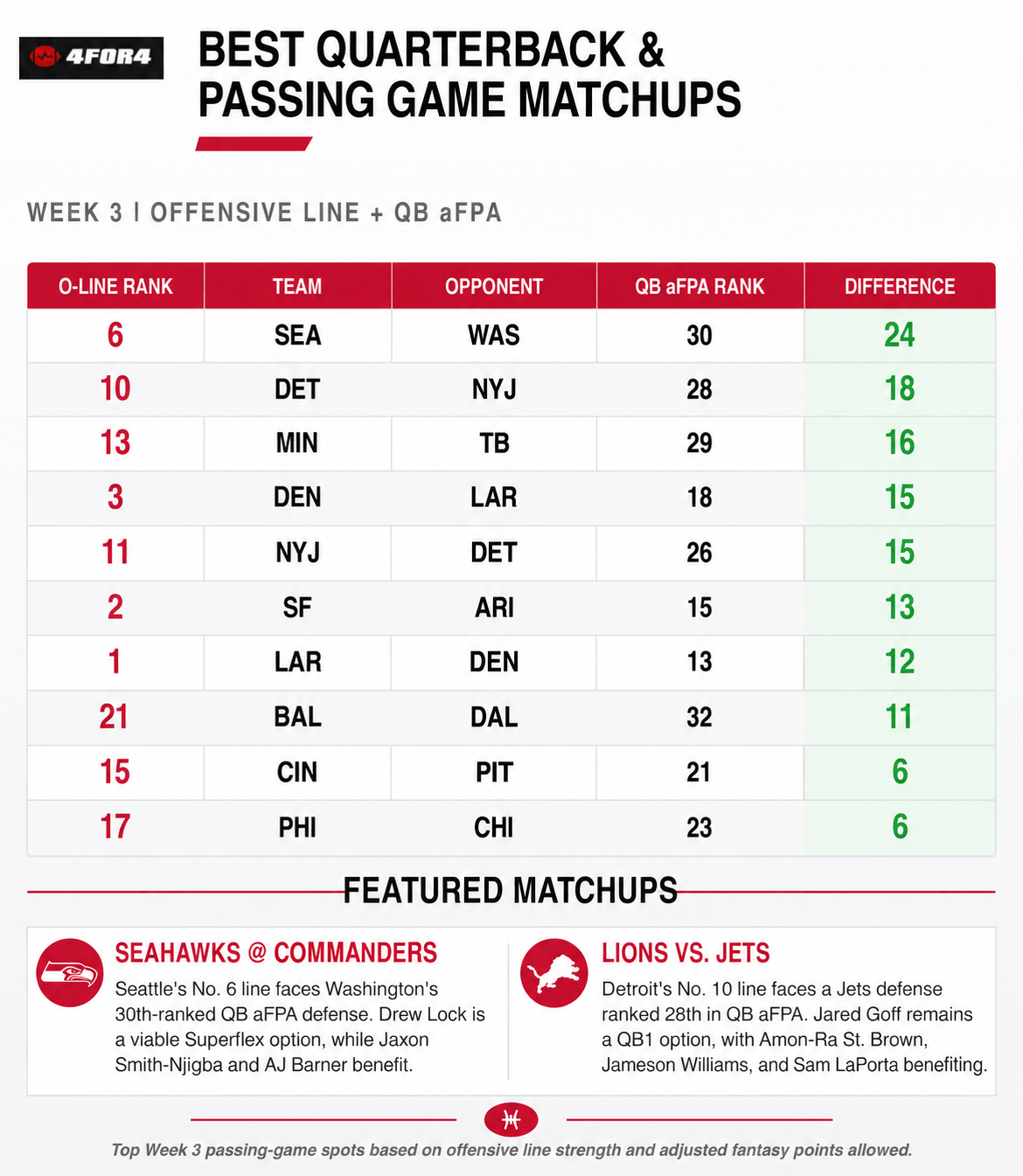
Seahawks at Commanders
Seattle enters Week 3 with the sixth-ranked offensive line after allowing pressure on only 29.6% of its dropbacks through two games. The unit has provided Drew Lock with a relatively stable pocket while also keeping the offense out of an excessive number of obvious passing situations.
Lock now faces a Washington defense ranked 30th in QB aFPA. His 14.7-point projection places him in the lower-end QB2 and Superflex conversation, but the matchup raises the ceiling of the entire Seattle passing attack. Jaxon Smith-Njigba carries a position-high 17.1-point projection, while AJ Barner offers a more matchup-dependent streaming option.
Barner has only three targets through two games despite running a route on 64.8% of Seattle’s passing plays. That 6% target share would typically keep him off the streaming radar, but Washington ranks 32nd in tight end aFPA. Dallas Goedert and Jake Ferguson have combined for eight catches, 120 yards, and four touchdowns against the Commanders, giving Barner enough matchup-driven upside to overlook some of his early usage concerns.
Lions vs. Jets
Detroit’s offensive line has climbed into the top 10 after producing a 31.8% pressure rate, 4.41 adjusted line yards, and a 1.01% blown-block rate through two games. The results have remained encouraging despite the Lions being forced to shuffle multiple positions in Week 2.
Jared Goff now faces a Jets defense ranked 28th in QB aFPA. New York has generated plenty of disruptive plays, and Aaron Glenn already appears to be getting much more out of the defense in 2026. However, that production has come against Cam Ward and a Packers offense that has vastly underperformed out of the gate.
Goff projects for 17.4 fantasy points and remains a strong QB1 candidate. Amon-Ra St. Brown carries a 15.3-point projection, Jameson Williams checks in at 10.5, and Sam LaPorta projects for 9.3. Jahmyr Gibbs should also remain heavily involved as a receiver against a defense ranked 32nd in RB aFPA.
Fantasy Football D/ST Matchups to Target
Panthers D/ST at Browns
Cleveland’s Week 2 victory did little to resolve the underlying problems along its offensive line. Deshaun Watson has faced pressure on 41.5% of his dropbacks, the fifth-highest rate in the league, while the Browns have produced only 2.40 adjusted line yards and 0.44 running back yards before contact.
Carolina enters the matchup after holding Atlanta to three points while producing five turnovers and two sacks. The Panthers are available in about 90% of leagues and face a Cleveland offense with a 19.0-point implied total, tied for the third-lowest mark on the slate.
Watson’s play style can contribute to an elevated sack rate, but Cleveland’s 3.15% blown-block rate shows that the protection problems extend beyond the quarterback. Carolina offers both sack and turnover upside against the 31st-ranked offensive line.
Seahawks D/ST at Commanders
Washington will be without Jayden Daniels and is expected to start Marcus Mariota against one of the league’s most disruptive early defenses.
The Commanders rank 25th in this week’s offensive line rankings after allowing pressure on 37.5% of their dropbacks with a 2.93% blown-block rate. Their rushing metrics have been considerably stronger, but injuries and the change at quarterback make this a difficult matchup against Seattle.
The Seahawks rank fourth in defensive Havoc rate, producing a pressure, tackle for loss, forced fumble, interception, or pass breakup on 43% of opposing plays. Seattle has also been the league’s best defense against downfield throws through two games, allowing a 25% completion rate, no touchdowns, and a 2.8 passer rating. Mariota’s mobility can help him avoid some negative plays, but the overall matchup gives the Seahawks one of the week’s most attractive D/ST ceilings.
Best Running Back Matchups
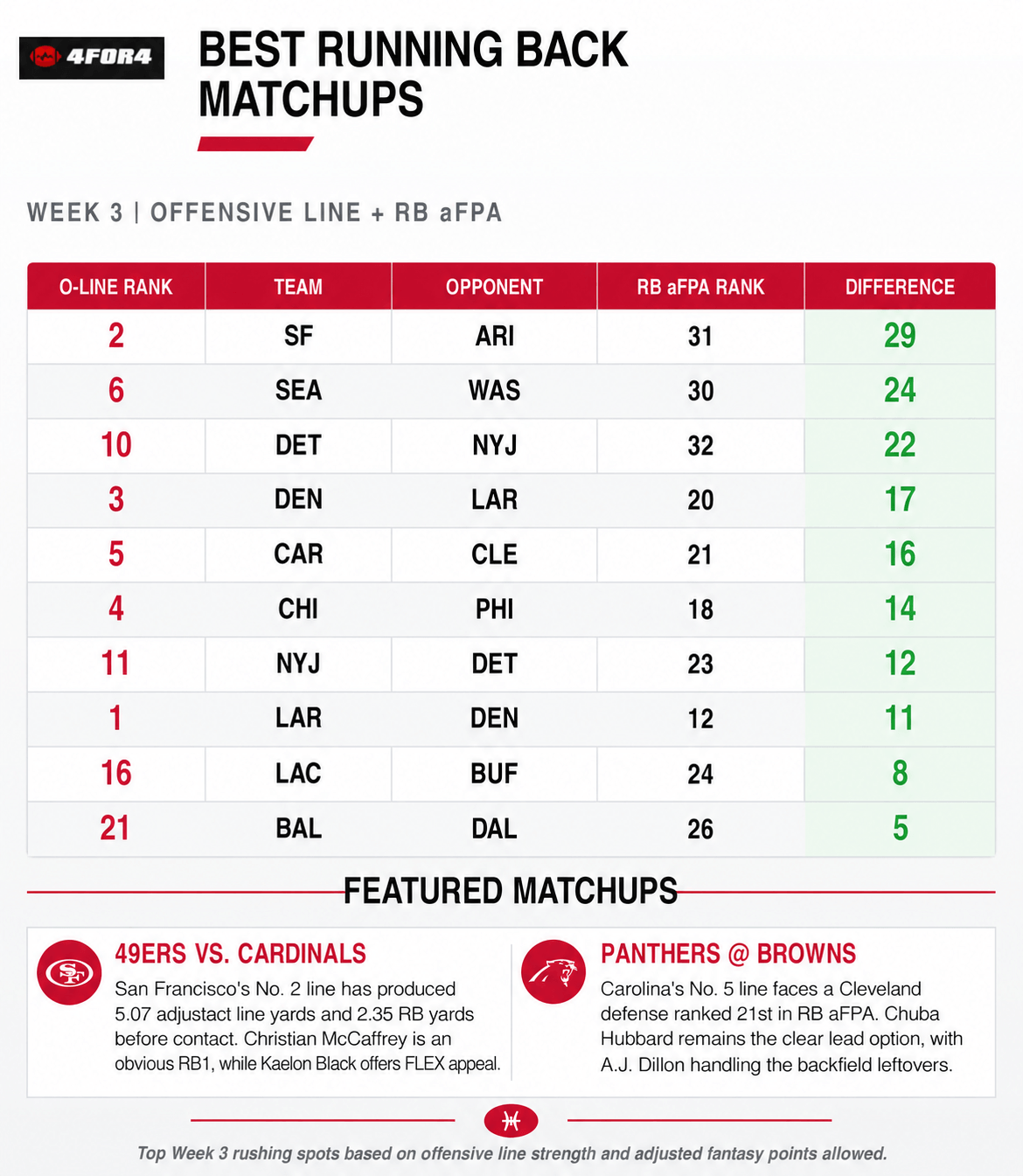
49ers vs. Cardinals
San Francisco has produced the league’s cleanest combination of run blocking and pass protection through two weeks. The 49ers have generated 5.07 adjusted line yards and 2.35 running back yards before contact while recording a 1.06% blown-block rate.
That second-ranked offensive line now faces an Arizona defense ranked 31st in RB aFPA. The Cardinals struggled to control Seattle’s rushing attack in Week 2 and have not shown enough resistance up front to make this anything other than one of the slate’s premier rushing environments.
You obviously don’t need any more reason to start Christian McCaffrey other than the fact that he’s on the field, but this matchup and the 8.5-point spread makes Kaelon Black interesting as well. Consider him a desperation FLEX in deeper leagues.
Panthers at Browns
Carolina’s offensive line has climbed into the top five behind an efficient two-week rushing profile. The Panthers have consistently created space before contact and should be able to keep their offense balanced against Cleveland.
The Browns rank 21st in RB aFPA, making this a less extreme defensive matchup than San Francisco’s, but the advantage at the line of scrimmage still favors Carolina. Cleveland’s offense also carries one of the week’s lowest implied totals, potentially providing the Panthers with a favorable rushing game script.
Chuba Hubbard projects for 15.1 fantasy points and remains the clear backfield option, with A.J. Dillon expected to pick up the scraps with Jonathon Brooks once again on IR.
Running Backs to Downgrade in Week 3
These players aren’t automatic sits, but their offensive line and defensive-front matchups lower their Week 3 ceilings:
- Rachaad White and Jacory Croskey-Merritt, Commanders: Washington’s backfield faces the largest negative discrepancy on the slate, pairing the 25th-ranked offensive line with a Seattle defense ranked third in RB aFPA. White and Croskey-Merritt project for only 8.1 and 7.1 fantasy points, respectively, and will now be without Jayden Daniels stressing defenses out of the backfield.
- David Montgomery and Woody Marks, Texans: Houston remains last in the offensive line rankings after its running backs produced only one successful run against Cincinnati. The Texans have been dramatically more effective with gap and man concepts than zone runs, but they have not adjusted enough to that personnel strength. Montgomery projects for 12.8 fantasy points and can remain in FLEX consideration, while Marks’ 7.0-point projection leaves him dependent on a touchdown or receiving work.
- De’Von Achane, Dolphins: Miami’s 29th-ranked offensive line faces a Kansas City defense ranked fourth in RB aFPA. Achane’s talent and receiving workload keep him in fantasy lineups, but his 14.7-point projection carries more downside than usual if Miami cannot prevent early penetration or sustain drives.
- Chase Brown, Bengals: Cincinnati’s offensive line has moved up to 15th, but most of its improvement has come in pass protection rather than consistent rushing efficiency. Brown now faces a Pittsburgh defense ranked second in RB aFPA. His workload and 15.1-point projection preserve his RB2 outlook, although the matchup lowers his efficiency and touchdown ceiling.

How These Offensive Line Rankings Work
These rankings are designed specifically for fantasy football rather than as a pure evaluation of NFL offensive line talent.
The weekly process incorporates injuries, projected starters, recent performance, and individual line play. Metrics such as pressure rate, blown-block rate, adjusted sack rate, adjusted line yards, and running back yards before contact help identify how each unit is performing in pass protection and the running game.
Pressure rate and blown-block rate receive particular consideration because they more directly reflect offensive line performance. Sack rate remains useful, but the quarterback’s decision-making, mobility, and time to throw can significantly affect the final result. Josh Allen and Lamar Jackson provide two early examples, as their low pressure-to-sack rates have helped conceal how frequently their offensive lines have allowed disruption.
The rankings are then compared with 4for4’s adjusted fantasy points allowed to quarterbacks and running backs. aFPA improves upon raw fantasy points allowed by accounting for the quality of each defense’s opponents, and that adjustment will become increasingly useful as the season progresses.
Week 3 represents the final slate before aFPA begins refreshing weekly. Until that update arrives, the matchup rankings should remain one part of the evaluation rather than outweighing offensive line strength, injuries, expected player usage, or the quality of the opposing defensive front.