NFL Offensive Line Rankings Week 6: Matchups to Exploit

 Make us preferred on Google
Evaluating offensive line play through a fantasy football lens can reveal matchup advantages that traditional rankings or defensive fantasy points allowed don't always show.
Each week, we’ll rank all 32 offensive lines, track the biggest movers, and compare those units against the opposing defense’s adjusted fantasy points allowed (aFPA) to identify the quarterback, running back, and D/ST matchups most affected by trench play.
For Week 6, the 49ers and Raiders offer two of the slate’s strongest passing-game combinations, while the Giants and Falcons draw favorable rushing matchups. The Jaguars and Jets also have chances to pressure two of the league’s lowest-ranked offensive lines.
With aFPA now updating weekly, those rankings provide a more current picture of each matchup. Five games still represent a relatively small sample, so opponent quality, game script, quarterback play, and injuries remain important alongside the defensive rankings.
Editor’s Note: Check out the complete set of Week 6 fantasy football rankings here.
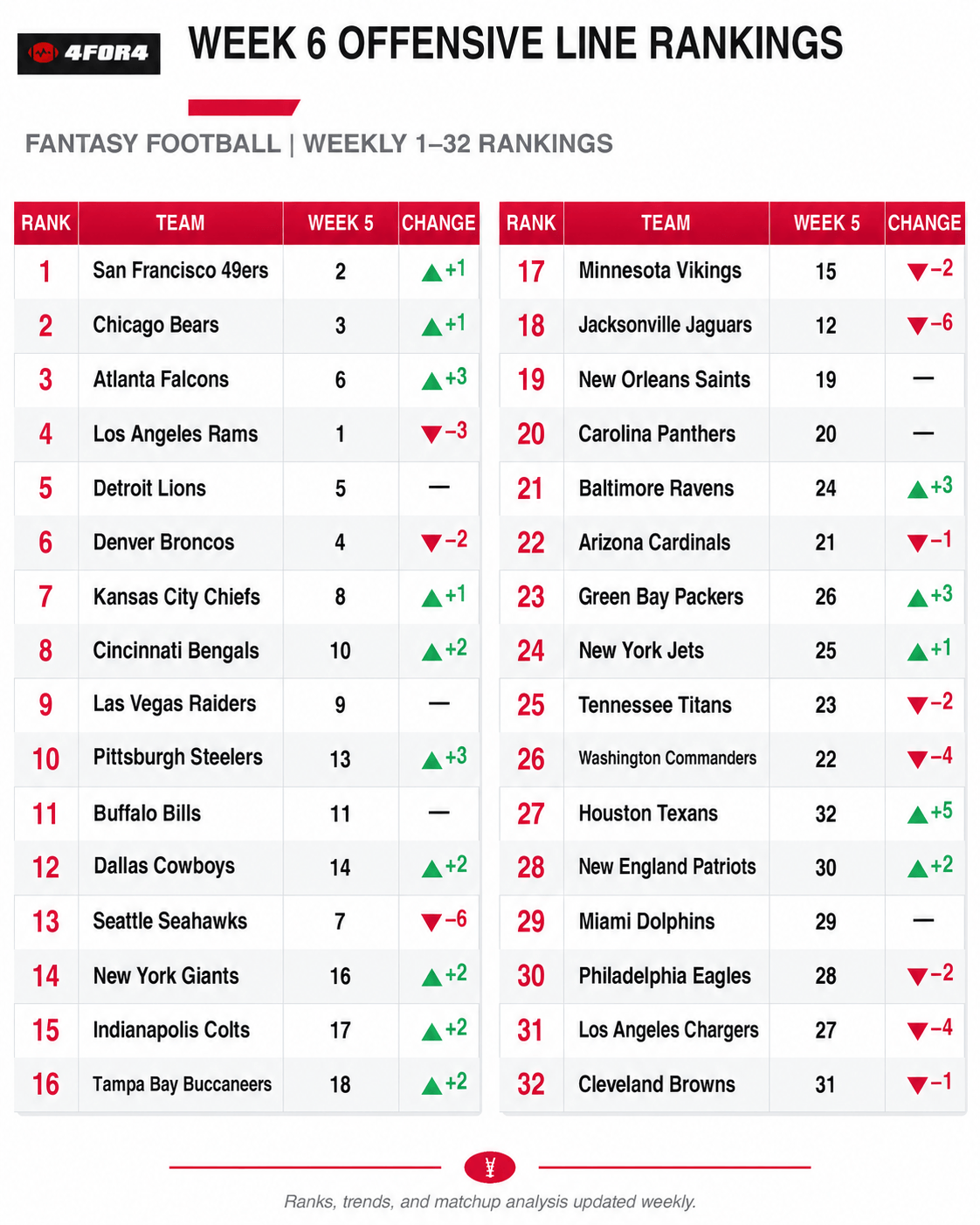 These rankings reflect overall offensive line performance, injuries, recent play, and how each unit is trending entering the week. The change column compares each team’s Week 6 ranking with its Week 5 ranking.
Biggest Offensive Line Risers and Fallers
Risers
Atlanta Falcons (+3)
Atlanta climbs to third after producing one of the league’s strongest all-around blocking profiles through five weeks.
The Falcons lead the NFL in pressure rate allowed (21.9%) while ranking fifth in Pressure Rate Over Expectation (-2.8%), sixth in adjusted line yards (4.75), and sixth in blown-block rate (2.25%). They have consistently kept disruption away from the quarterback while creating enough running-game movement to support one of the league’s most efficient offenses, now that Michael Penix Jr. is back under center.
Atlanta’s 8.4% adjusted sack rate initially seems out of place next to those numbers, but Penix has turned 28.6% of his pressured dropbacks into sacks, and Jack Strand/Cooper Rush were far worse. The pressure itself has been rare; the quarterback has simply struggled to avoid negative plays when it arrives.
Houston Texans (+5)
Houston’s five-spot rise moves the Texans out of the bottom five, but it should not be mistaken for a full endorsement of the offensive line.
The Texans remain 31st in adjusted line yards (3.41) and running back yards before contact (1.09), while their 3.44% blown-block rate ranks last. Those results help explain why the offense has struggled to establish consistent rushing production.
Pass protection has been more respectable. Houston ranks 17th in pressure rate and 13th in Pressure Rate Over Expectation, suggesting the line has performed closer to average on traditional dropbacks than its reputation or overall offensive production would imply. C.J. Stroud’s 18.9% pressure-to-sack rate has also kept the 7.9% adjusted sack rate from getting even worse.
Braden Smith’s activation provides another potential stabilizing piece. Houston still has considerable work to do, particularly in the running game, but its pass-protection results no longer support automatically placing the unit at the bottom of the league.
Fallers
Seattle Seahawks (-6)
Seattle falls six spots after its early-season protection results continued to move in the wrong direction.
The Seahawks rank 21st in both pressure rate and adjusted line yards, 23rd in adjusted sack rate, and last in running back yards before contact. Their 0.91 yards before contact per attempt is particularly concerning for an offense attempting to support its quarterbacks with a functional running game.
Seattle’s seventh-ranked blown-block rate offers some encouragement, and the line hasn't completely collapsed snap to snap. Still, the broader results no longer support a top-10 placement. The Seahawks slide to 13th ahead of a difficult matchup with a Denver defense generating a 37.9% pressure rate and a +7.4% Pressure Rate Over Expectation.
Jacksonville Jaguars (-6)
Jacksonville also drops six spots, although this move is driven as much by personnel as performance. The Jaguars rank fifth in pressure rate, seventh in Pressure Rate Over Expectation, and ninth in adjusted line yards. Those numbers describe a unit that has generally created usable pockets and rushing lanes. Jacksonville’s 30th-ranked blown-block rate and Trevor Lawrence’s 21.3% pressure-to-sack rate suggest more volatility than those broader efficiency numbers indicate.
The larger concern is the loss of Anton Harrison, who was placed on injured reserve and will miss at least four games following knee surgery. Walker Little is expected to replace him at left tackle, changing the protection around Lawrence’s blind side.
Week 6 Fantasy Impact Players Helped by Their Offensive Line Matchup
A strong or weak offensive line matchup shouldn’t completely override volume, talent, or game environment, but it can help break ties between similarly ranked fantasy options.
Among the biggest Week 6 beneficiaries:
- Brock Purdy, 49ers: San Francisco owns our top-ranked offensive line and faces a Washington defense ranked 32nd in QB aFPA. Purdy enters the week as the QB2, with Mike Evans projected as the WR4 and George Kittle as the TE2.
- Matthew Stafford, Rams: The loss of Alaric Jackson lowers the ceiling of Los Angeles’ top-ranked statistical profile, but Arizona ranks 28th in QB aFPA and has generated only a 31.4% pressure rate. Stafford projects as the QB3, while Puka Nacua and Davante Adams rank first and eighth at WR.
- Kirk Cousins and the Raiders’ pass catchers: Las Vegas ranks ninth overall and draws a Buffalo defense sitting 29th in QB aFPA. Cousins projects as the QB12, Brock Bowers as the TE1, and Tre Tucker as the WR36. Buffalo’s respectable pressure production keeps this from being a completely risk-free matchup, but the Raiders’ pass protection has been one of the league’s strongest units.
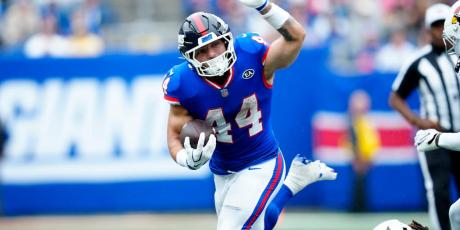
- Cam Skattebo, Giants: New York’s 14th-ranked line faces a Saints defense ranked 29th in RB aFPA. New Orleans has also allowed a 56.9% rushing success rate with one of the league’s lowest stuff rates. Skattebo projects as the RB14 after maintaining his early-down role and splitting the passing work with Tyrone Tracy.
- Bijan Robinson, Falcons: Atlanta has climbed to third in the offensive line rankings and now faces a Chicago defense ranked 22nd in RB aFPA. The Bears have allowed a 55.1% rushing success rate while stuffing only 36.5% of opposing runs. Robinson enters the week as the overall RB1 and should continue separating from Brian Robinson in the Atlanta backfield.
Best Quarterback and Passing Game Matchups
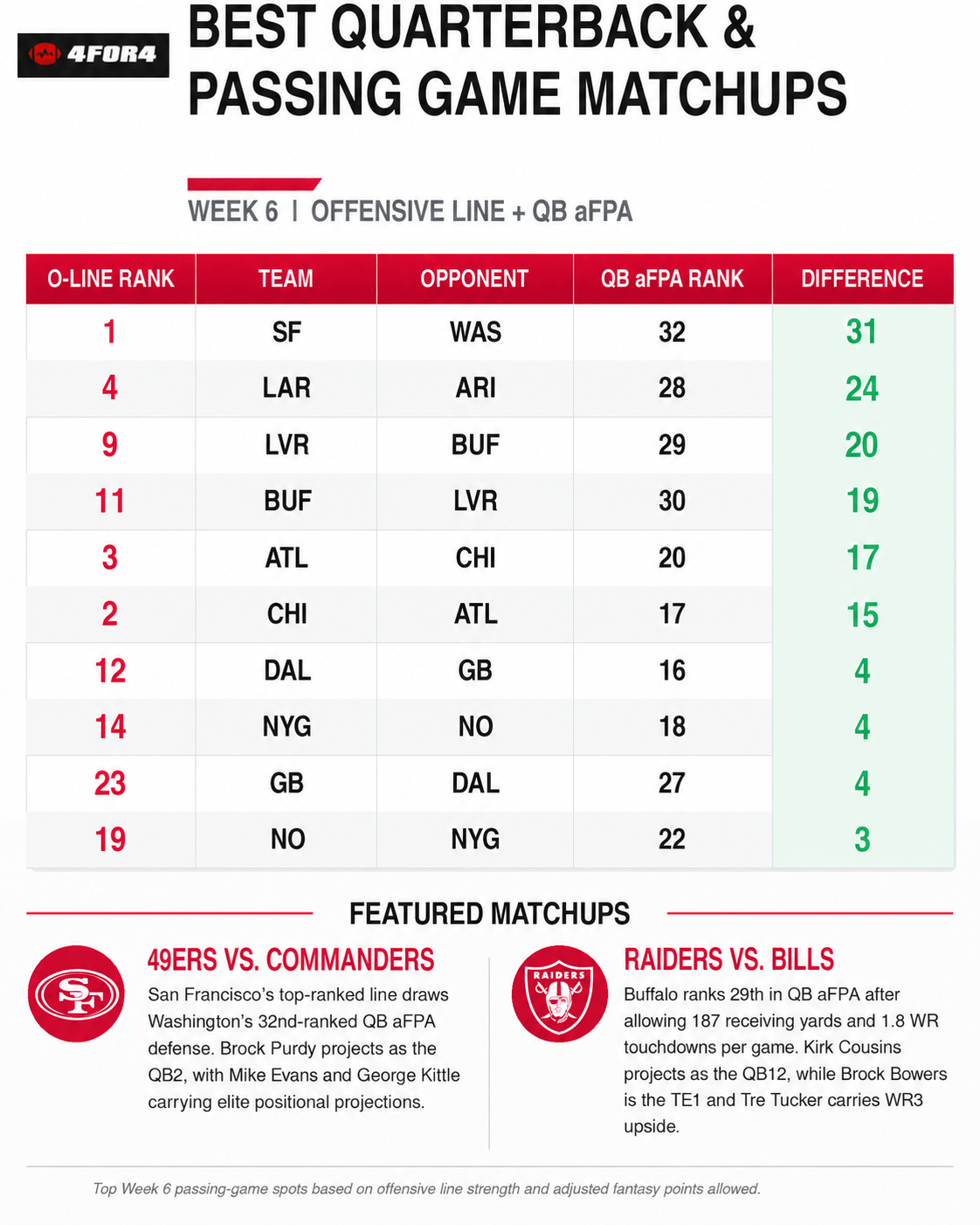
49ers vs. Commanders
San Francisco moves into the top spot after producing one of the league’s most complete blocking profiles through five weeks. The 49ers rank first in adjusted sack rate (3.9%) and blown-block rate (1.78%), third in adjusted line yards (4.82), and inside the top 10 in both pressure rate and Pressure Rate Over Expectation.
Brock Purdy has also converted only 5.8% of his pressured dropbacks into sacks, the lowest rate among the primary quarterbacks in our database. His pocket management has complemented a line that rarely loses blocks outright, giving San Francisco multiple ways to limit negative plays.
Washington ranks 32nd in QB aFPA while generating a 35.2% pressure rate with a +3.9% defensive Pressure Rate Over Expectation. Those disruption numbers are close enough to league average that the matchup should not prevent San Francisco from attacking downfield.
Purdy projects as a top-5 QB, while Mike Evans and George Kittle are obvious must-starts outside of Christian McCaffrey. The rest of the team is a bit of a grab-bag. Brandin Cooks could certainly find himself free for a big gain or two, but at 33 years old, you would need to be in a pretty desperate situation to depend on his speed, even in a great matchup.
Raiders vs. Bills
Las Vegas’ ninth-place ranking is driven almost entirely by its pass protection.
The Raiders rank third in pressure rate allowed (25.5%) and first in Pressure Rate Over Expectation (-7.0%), while their 5.2% adjusted sack rate ranks eighth. Those results have allowed Kirk Cousins to operate from clean pockets despite an offensive line that ranks near the bottom of the league in adjusted line yards and RB yards before contact.
Buffalo ranks 29th in QB aFPA and has been a gold mine for opposing receivers, allowing an average of 15.2 receptions, 187 yards, and 1.8 touchdowns per game to the position. Puka Nacua posted a 17-138-1 line against the Bills last week, while Amon-Ra St. Brown produced 9-142-2 in Week 2.
The Bills have still created pressure at a respectable rate, disrupting 37.6% of opposing dropbacks with a +4.7% Pressure Rate Over Expectation. Las Vegas’ protection gives Cousins a better chance of handling that pressure than most of Buffalo’s previous opponents.
Cousins finds himself in a great QB streaming situation, while Brock Bowers is making a run at becoming 2026’s overall TE1 in points per game. Tre Tucker is really the only other interesting piece here, but he could absolutely weasel his way into a WR3 finish; he has at least four catches in four consecutive games.
Best D/ST Matchups
Jaguars vs. Texans
The Jaguars have generated a 38.9% pressure rate (6th) with a +6.3% defensive Pressure Rate Over Expectation (8th), while their run defense has been even more impressive, limiting opponents to a 42.2% rushing success rate (5th) while stuffing 50.9% of designed runs (2nd).
That doesn’t bode well for the Woody Marks-led Texans, who currently rank 31st in both adjusted line yards (3.41) and RB yards before contact (1.09).
Braden Smith’s activation is a positive development and could stabilize the Texans’ interior, but one returning lineman does not erase a unit’s broader issues, particularly in a matchup this lopsided.
Jets at Patriots
The Patriots have allowed the fifth-highest pressure rate in the league and will now be operating without Will Campbell, who is considered week-to-week with a knee injury, putting Caleb Lomu in position to make his first start at left tackle. Lomu allowed only one hurry across 49 relief snaps last week, which offers some reason for optimism, but facing a full game plan from the Jets will be a tougher assignment.
New York has generated a 36.9% defensive pressure rate with a +6.0% Pressure Rate Over Expectation. Those results are not quite elite, but they are strong enough to take advantage of a Patriots line that has struggled throughout the season.
Maye has converted only 14.3% of his pressures into sacks and remains capable of creating production with his legs. His pocket management lowers the Jets’ floor, but the expected volume of pressure keeps New York firmly in the D/ST streaming conversation.
Best Running Back Matchups
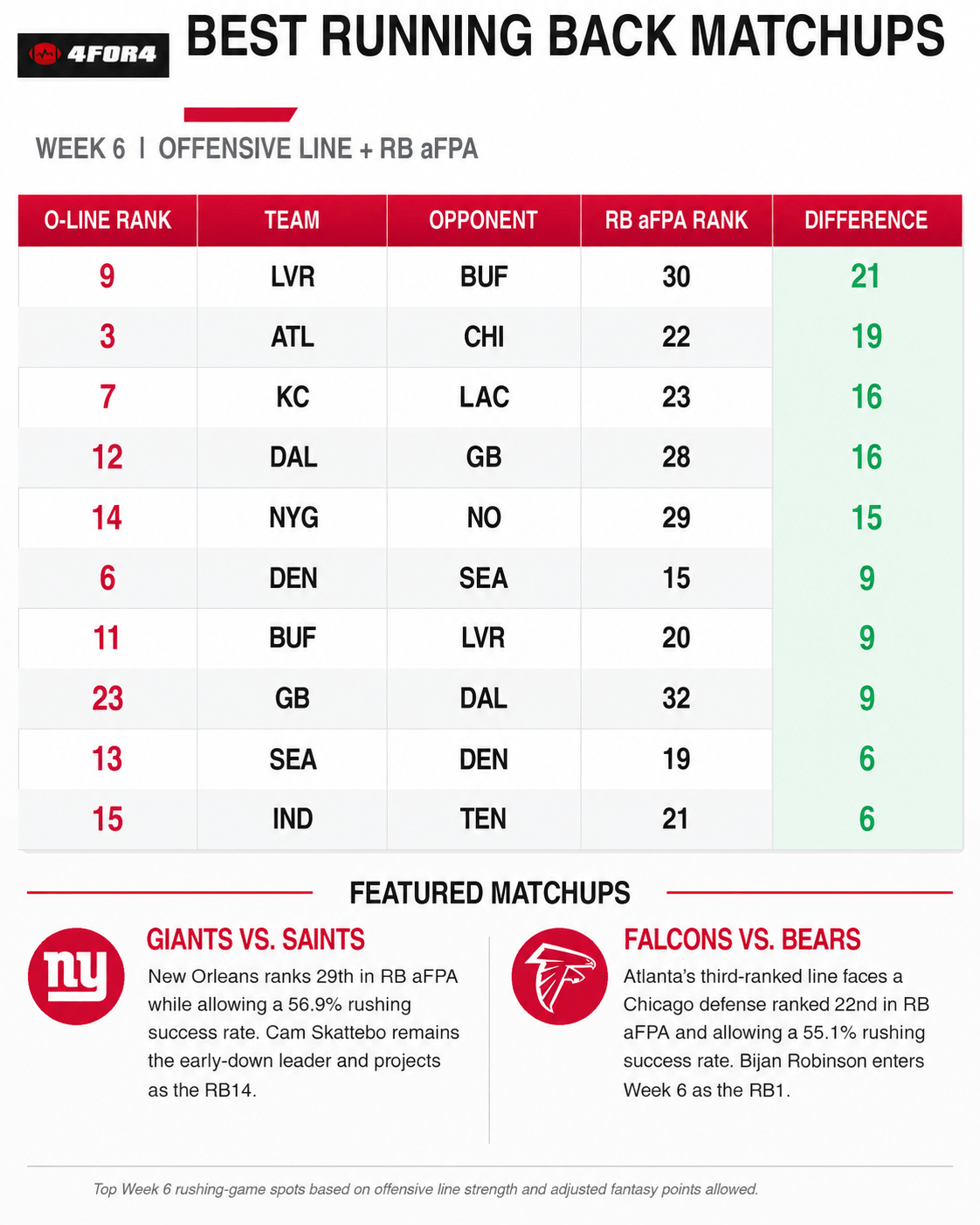
Giants vs. Saints
New York’s offensive line has settled into the middle of the rankings after producing mixed results through five weeks. The Giants rank 15th in adjusted line yards (4.10) and fifth in blown-block rate (2.18%), but only 25th in running back yards before contact (1.19).
The matchup provides an opportunity for those rushing numbers to tick up. New Orleans ranks 29th in RB aFPA and has struggled across nearly every underlying run-defense metric. The Saints are allowing a 56.9% rushing success rate (31st) and a 5.2% explosive-run rate (21st) while stuffing only 34.3% of opposing attempts (32nd).
Cam Skattebo’s role did not change in Week 5. He continued to handle most early-down snaps, ran a route on about half of the Giants’ passing plays, and out-carried Najee Harris and Tyrone Tracy by a combined 13–8 margin. Skattebo projects as an RB2 in a matchup that should keep New York committed to the run. Harris and Tracy continue to limit his passing-game ceiling, but neither has taken enough early-down work to threaten his status as the backfield’s primary runner.
Falcons vs. Bears
Atlanta’s climb to third in the offensive line rankings has been supported by strong results in both phases. The Falcons rank sixth in adjusted line yards (4.75) and 10th in RB yards before contact (1.78), while their league-low pressure rate gives the offense flexibility to remain balanced.
Chicago ranks 22nd in RB aFPA and has allowed a 55.1% rushing success rate (30th) with a 5.5% explosive-run rate (24th). The Bears have also stuffed only 36.5% of opposing attempts (29th), giving Atlanta one of the week’s clearest combinations of blocking advantage and defensive vulnerability.
Bijan Robinson enters Week 6 as the overall RB1 and should remain the offense's centerpiece. The gap between Robinson and Brian Robinson widened last week, as the latter saw fewer routes and rushing opportunities. Brian projects as an RB4 and remains a touchdown-dependent desperation play. Bijan has the chance to deliver another ceiling performance against a defense that has struggled to stop efficient gains before runners reach the second level.
Fantasy Players to Downgrade in Week 6
These players aren’t automatic sits, but their offensive line and defensive-front matchups lower their Week 6 ceilings:
- Bo Nix, Broncos: Denver’s sixth-ranked line faces a Seattle defense ranked second in QB aFPA. The Seahawks have generated a 38.3% pressure rate and a league-high +10.5% defensive Pressure Rate Over Expectation.
- Jaxon Smith-Njigba, Seahawks: Smith-Njigba remains a must-start option and carries a WR2 projection, but Seattle’s line has fallen to 13th after ranking 21st in pressure rate and last in running back yards before contact. Denver ranks second in WR aFPA while generating a 37.9% pressure rate with a +7.4% Pressure Rate Over Expectation.
- Bhayshul Tuten, Jaguars: Jacksonville has fallen to 18th following Anton Harrison’s placement on injured reserve. Tuten projects as an RB2 but faces a Houston defense ranked fourth in RB aFPA. The Texans have allowed an explosive run on only 0.9% of attempts, leaving Tuten dependent on volume and scoring opportunities.
- C.J. Stroud, Texans: Houston ranks 27th and now faces a Jacksonville defense ranked seventh in QB aFPA. The Jaguars have generated a 38.9% pressure rate with a +6.3% Pressure Rate Over Expectation, while Houston continues to rank last in blown-block rate.
- Drake Maye, Patriots: Maye still projects as a QB1 because of his passing efficiency and rushing production, so fantasy managers are unlikely to sit him. His offensive line has allowed the league’s second-highest pressure rate, however, and now faces a Jets defense ranked fourth in QB aFPA. Will Campbell’s expected absence adds another source of volatility.

How These Offensive Line Rankings Work
These rankings are designed specifically for fantasy football and are not intended to function as a pure evaluation of NFL offensive line talent.
The weekly process incorporates injuries, projected starters, recent performance, individual line play, and opponent context. Metrics such as pressure rate, blown-block rate, adjusted sack rate, adjusted line yards, and running back yards before contact help identify how each unit is performing in pass protection and the running game.
Pressure Rate Over Expectation provides additional context by comparing a team’s actual pressure rate with the rate expected based on its quarterback’s time to throw. That helps identify whether a quarterback is creating additional pressure by holding the ball or whether the offensive line is allowing disruption more quickly than expected.
Pressure rate and blown-block rate receive particular consideration because they more directly reflect offensive line performance. Sack rate remains useful for fantasy purposes, but quarterback decision-making, mobility, and pocket management can significantly affect the final result. Pressure-to-sack rate helps separate those quarterback effects from the protection itself.
Penalties receive very little weight and are generally referenced only when they become an extreme or repeated part of a unit’s performance.
The offensive line rankings are then compared with 4for4’s adjusted fantasy points allowed to quarterbacks and running backs. aFPA improves upon raw fantasy points allowed by accounting for the quality of each defense’s opponents and now updates weekly throughout the season.
Even with those adjustments, four games remain a relatively small sample. Matchup rankings should complement offensive line strength, injuries, expected player usage, and the quality of the opposing defensive front instead of replacing those evaluations.