NFL Offensive Line Rankings Week 5: Matchups to Exploit

 Make us preferred on Google
Evaluating offensive line play through a fantasy football lens can uncover matchup advantages that aren’t always obvious from traditional rankings or defensive fantasy points allowed.
Each week, we’ll rank all 32 offensive lines, track the biggest movers, and compare those units against the opposing defense’s adjusted fantasy points allowed (aFPA) to identify the quarterback, running back, and D/ST matchups most affected by play in the trenches.
For Week 5, the Rams, Bears, and Lions stand out among the strongest offensive line and matchup combinations on the slate. The Saints, Chargers, and Texans provide several attractive D/ST and downgrade opportunities, while Pittsburgh and Jacksonville make sizable climbs behind underlying results that have been stronger than their sack totals suggest.
With aFPA now updating weekly, those rankings provide a more current picture of each matchup. Four games still represent a relatively small sample, so opponent quality, game script, quarterback play, and injuries remain important alongside the defensive rankings.
Editor’s Note: Check out the complete set of Week 5 fantasy football rankings here.
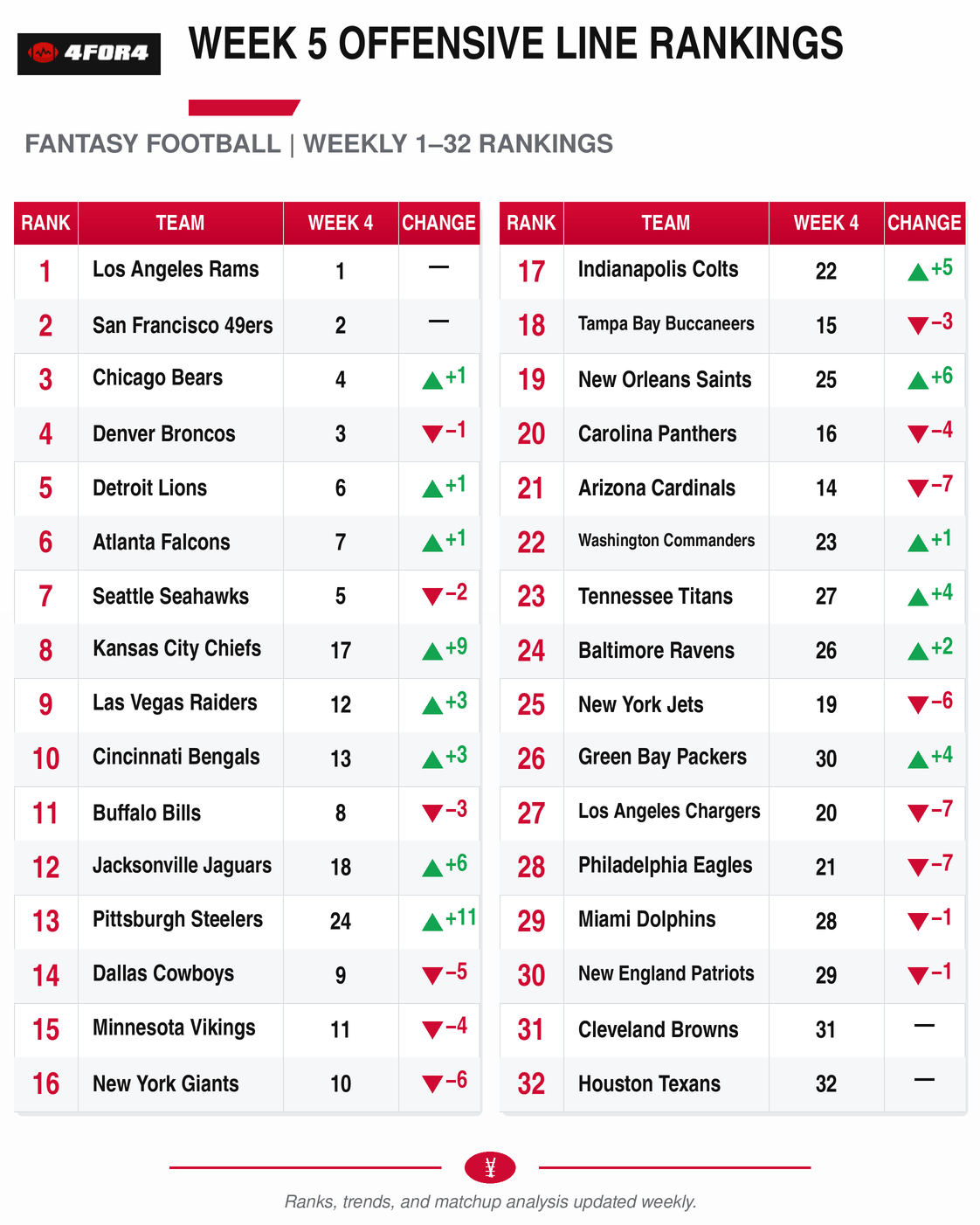
These rankings reflect overall offensive line performance, injuries, recent play, and how each unit is trending entering the week. The change column compares each team’s Week 5 ranking with its Week 4 ranking.
Biggest Offensive Line Risers and Fallers
Risers
Pittsburgh Steelers (+11)
Pittsburgh makes the largest jump of the week after its broader blocking profile proved considerably stronger than the five sacks allowed against Cleveland would suggest.
The Steelers rank fourth in running back yards before contact, 11th in adjusted line yards, and inside the top half of the league in both pressure rate and Pressure Rate Over Expectation. ESPN’s pass-block win rate also places Pittsburgh eighth through four games, giving us another reason not to treat the sack total as a clean reflection of the line.
Aaron Rodgers has converted 22.0% of his pressured dropbacks into sacks, making a 7.9% adjusted sack rate look worse than the protection around him. The line still has room to improve in pass protection, but Pittsburgh’s productive rushing profile and generally average pressure results no longer support a bottom-quarter ranking. The Steelers move from 24th to 13th.
Jacksonville Jaguars (+6)
Jacksonville’s six-spot rise is driven by one of the league’s more difficult early-season profiles to reconcile.
The Jaguars rank fourth in both pressure rate and Pressure Rate Over Expectation while sitting sixth in adjusted line yards. Those results suggest an offense that has kept the pocket relatively clean and created usable rushing lanes, even if the execution hasn't always looked as encouraging: Jacksonville ranks 28th in blown-block rate and 29th in ESPN’s pass-block win rate, keeping the climb more modest. Trevor Lawrence has also converted 25.8% of his pressures into sacks, making the line’s 6.8% adjusted sack rate look less impressive than the disruption allowed around him.
Fallers
Los Angeles Chargers (-7)
The Chargers continue to drop precipitously.
Los Angeles ranks 29th in pressure rate and last in Pressure Rate Over Expectation (+14.9%), allowing pressure far more frequently than expected based on Justin Herbert’s time to throw. The Chargers also rank 25th in running back yards before contact, leaving few areas in which the line has consistently created an advantage.
Rashawn Slater is now expected to miss several weeks with a high-ankle sprain. Joe Alt also left Week 4 with a neck injury, while Trevor Penning was evaluated for a concussion. Those issues compound the fact that center Tyler Biadasz won’t play a snap this season.
Herbert’s mobility can help him survive some protection losses, but the combination of poor performance and mounting injuries leaves Los Angeles with one of the NFL’s most uncertain blocking units.
Philadelphia Eagles (-7)
Lane Johnson’s sudden retirement turns Philadelphia’s recent lineup issues into a much larger season-long concern. The Eagles were already dealing with injuries to Landon Dickerson, Cam Jurgens, and Fred Johnson before losing one of the most impactful right tackles of this century. Third-round rookie Markel Bell is expected to receive the first opportunity to start at RT, but his six-pressure, three-sack performance last week means he’s already on shaky ground.
The underlying results have also continued to trend downward. Philadelphia ranks 30th in adjusted sack rate, 25th in adjusted line yards, and 29th in ESPN’s run-block win rate. Jalen Hurts’ 23.1% pressure-to-sack rate has contributed to the sack production, but that alone can’t explain away all of the shortcomings.
(Update: the Eagles have now traded away Cam Jurgens to the Baltimore Ravens. It's hard to see this helping Philadelphia in the 2026 season.)
Week 5 Fantasy Impact Players Helped by Their Offensive Line Matchup
A strong or weak offensive line matchup shouldn’t completely override volume, talent, or game environment, but it can help break ties between similarly ranked fantasy options.
Among the biggest Week 5 beneficiaries:
- Matthew Stafford, Rams: Los Angeles owns our top-ranked offensive line and draws a Buffalo defense ranked 30th in QB aFPA. Stafford enters the week as a top-8 QB, while Puka Nacua and Davante Adams should have ample time to work against a Bills secondary allowing 186.0 YPG to wide receivers (fifth-most).
- Jared Goff, Lions: Detroit ranks fifth up front and faces an Arizona defense sitting 28th in QB aFPA but first against running backs. That split should encourage the Lions to attack through Goff, Amon-Ra St. Brown, Jameson Williams, and Sam LaPorta.
- D’Andre Swift and Kyle Monangai, Bears: Chicago’s third-ranked offensive line gets the friendliest rushing matchup on the board, with Green Bay checking in 32nd in RB aFPA. Swift and Monangai both carry top-20 projections at the position in a game where Chicago should be able to remain committed to the ground.
- Chase Brown, Bengals: Cincinnati has climbed into the top 10 of our offensive line rankings and now faces a Miami defense ranked 30th in RB aFPA. Brown is already a volume-based option, and the combination of line play and the matchup gives him one of the week's strongest rushing setups.
- RJ Harvey and J.K. Dobbins, Broncos: Denver’s fourth-ranked line faces a Chargers defense ranked 27th in RB aFPA but fourth against quarterbacks. A nice run-funnel setup that could see both backs get there in different ways.
Best Quarterback and Passing Game Matchups
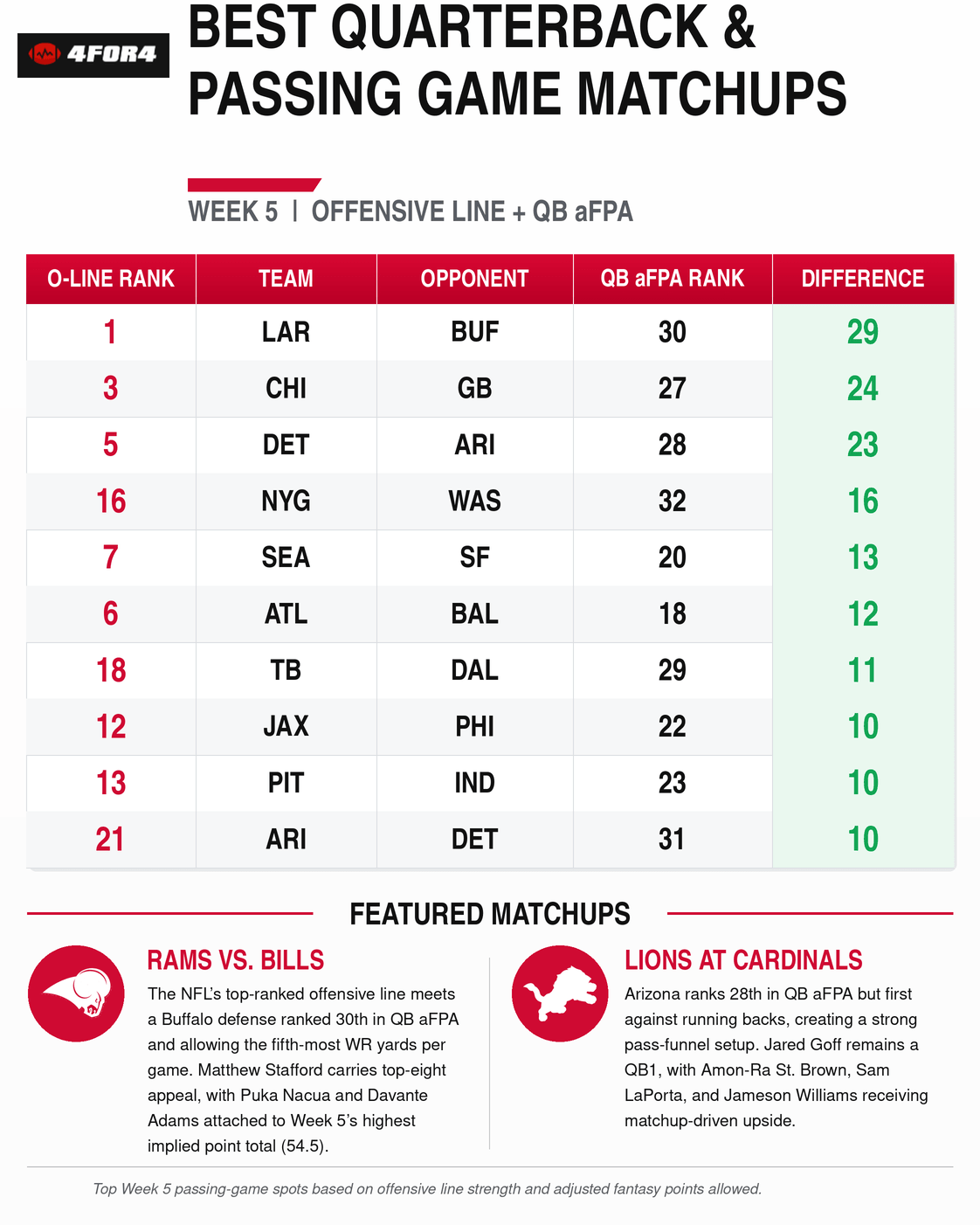
Rams vs. Bills
Los Angeles enters Week 5 with the top-ranked offensive line after producing one of the league’s cleanest all-around blocking profiles. The Rams rank second in both adjusted line yards (5.14) and RB yards before contact (2.77) while allowing a 29.5% pressure rate (sixth). Their -3.6% Pressure Rate Over Expectation (fifth) also indicates that the protection has performed better than expected based on Matthew Stafford’s time to throw.
Stafford now faces a Buffalo defense ranked 30th in QB aFPA. The Bills have also allowed 186.0 receiving yards per game to wide receivers, the fifth-most in the league, giving Stafford one of the week’s strongest combinations of protection and opponent quality.
Stafford enters the week as a top-eight quarterback, with Puka Nacua projected as a top-three WR and Davante Adams remaining firmly on the WR1/2 fringe. Buffalo also ranks 29th in RB aFPA, so the Rams should have access to their entire offense in a game with Week 5’s largest implied point total (54.5)
Lions at Cardinals
Detroit’s offensive line has stabilized inside the top five after generating 4.62 adjusted line yards (seventh) and 1.96 running back yards before contact (seventh), while keeping its pressure results better than expected. The Lions have allowed a 32.8% pressure rate (12th) with a -1.0% Pressure Rate Over Expectation (seventh) despite cycling through seven different starters on the young season.
Arizona presents a particularly juicy passing-game split; the Cardinals rank 28th in QB aFPA but first against running backs, creating an obvious incentive for Detroit to lean on Jared Goff and its receiving weapons instead of repeatedly attacking the defense's strength.
Jahmyr Gibbs will obviously still get his through the air and ground, but Goff looks prone to deliver another solid QB1 performance, with Amon-Ra St. Brown and Sam LaPorta easy clicks as well. Jameson Williams will always remain a volatile upside play, but this is a fantastic spot to bet on another WR2 day.
Fantasy Football D/ST Matchups to Target
Vikings D/ST at Saints
New Orleans’ offensive line has avoided a complete collapse, but the Asim Richards experience has been a little rough. With sophomore LT Kelvin Banks going down in Week 2, Richards has stepped in and allowed 16 pressures on 118 pass-blocking snaps, earning a 92.3 pass-blocking efficiency grade according to PFF and ranking 67th out of 67 tackles. The Saints as a whole rank 22nd in adjusted line yards (3.85), 17th in pressure rate allowed (35.9%), and 19th in PROE (+4.3%).
Minnesota ranked second in defensive Havoc rate through four weeks, generating a pressure, tackle for loss, forced fumble, interception, or pass breakup on 45.8% of opposing plays. The Vikings also rank third in QB aFPA and second against running backs, leaving New Orleans without an obvious area to attack.
Tyler Shough has converted only 16.9% of his pressured dropbacks into sacks, but Minnesota’s ability to create disruption across every level of the defense provides paths to turnovers and negative plays even when the pressure does not result in a sack.
Jets D/ST vs. Browns
Cleveland remains one of the league’s clearest offensive lines to target. The Browns are currently 23rd in pressure rate allowed (38.1%), with a +9.0% PROE (29th), and a 9.1% adjusted sack rate (28th). Their 3.58 adjusted line yards (29th) and 1.18 RB yards before contact (27th) also rank near the bottom of the league.
Deshaun Watson has converted 20.8% of his pressures into sacks, further increasing the downside of an offense already allowing disruption more frequently than expected based on his time to throw. The Jets rank second in QB aFPA, giving New York a strong opportunity to turn those protection issues into sacks and turnovers, the crown jewel of D/STs.
The biggest concern is a Jets defense ranked 31st in RB aFPA, which gives Quinshon Judkins a path to more opportunities. If New York can control the early downs and force Watson to carry the offense, the matchup provides one of the week’s better D/ST ceilings. If you’d rather target the Jets offense, the Browns D/ST is also viable here in what should be a slog of a game.
Best Running Back Matchups
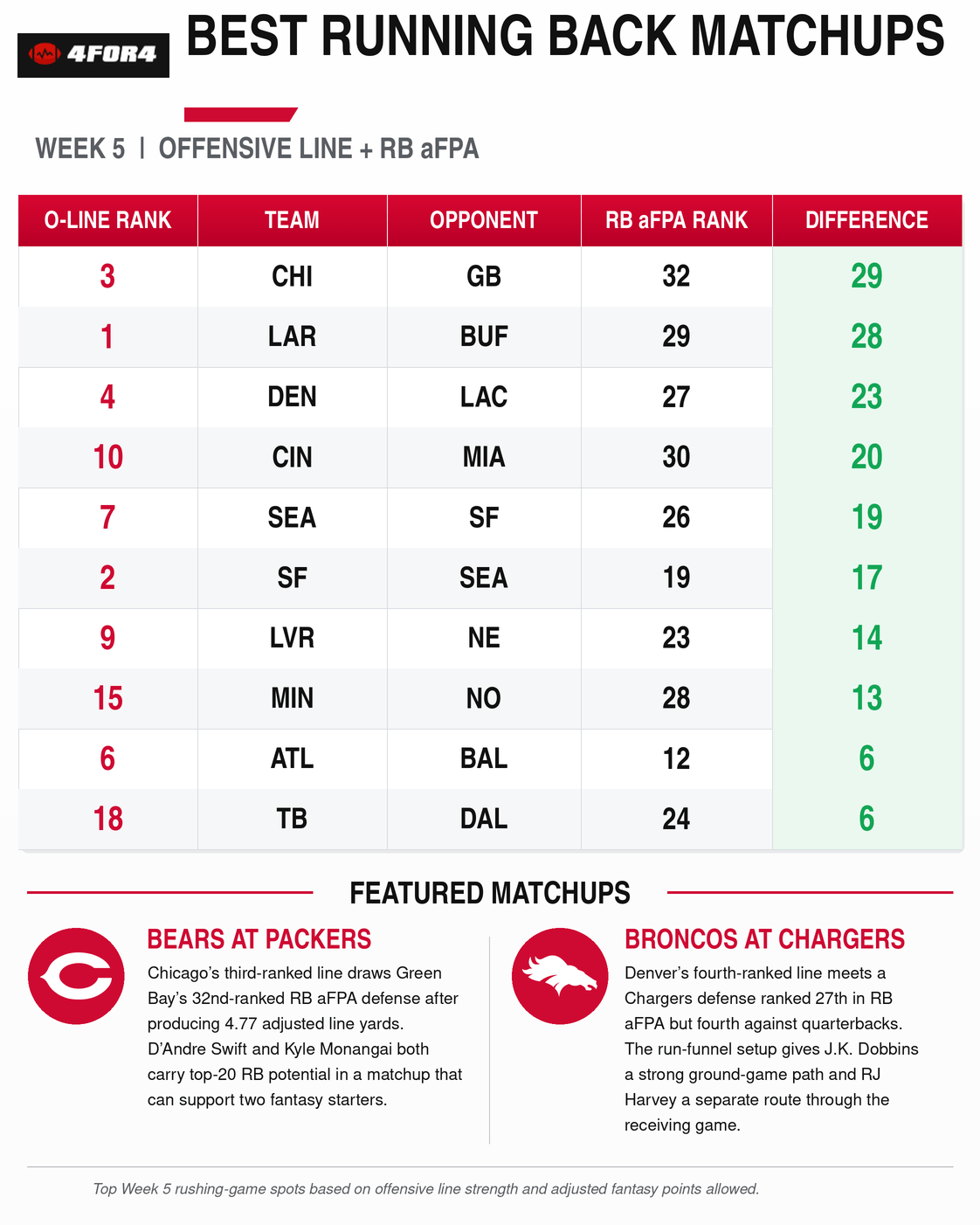
Bears at Packers
Chicago’s third-ranked offensive line has produced 4.77 adjusted line yards, the fourth-best mark in the league, while creating 1.79 running back yards before contact (tenth). The Bears have also protected the pocket effectively, regardless of quarterback, giving the offense the flexibility to stay balanced instead of abandoning the run after negative plays.
Green Bay enters Week 5 ranked dead last in RB aFPA and 27th in QB aFPA, so Chicago should be able to move the ball after ranking seventh in the league in EPA/dropback (0.303) against the Jets with Tyson Bagent at the helm.
D’Andre Swift and Kyle Monangai both carry top-20 RB potential here. Their shared workload lowers each back's individual ceiling, but this is a matchup in which Chicago can support both as fantasy starters.
Broncos at Chargers
Denver’s fourth-ranked offensive line has been more dominant in pass protection than in the running game, ranking 17th in both adjusted line yards and running back yards before contact. Even so, the unit has remained stable enough to take advantage of a favorable matchup with the Chargers.
Los Angeles ranks fourth in QB aFPA but 27th against running backs, creating one of the week’s clearest run-funnel setups. Denver has little incentive to challenge the strongest area of the Chargers’ defense, and if the -3.5-point spread stays true, they can involve both RJ Harvey and J.K. Dobbins.
The projected workload gives Dobbins the stronger path to production on the ground, while Harvey’s receiving involvement provides a separate route to fantasy value. Neither back projects as a must-start option, but each of them can flirt with fringe RB2/3 outputs as a solid FLEX option(s).
Fantasy Players to Downgrade in Week 5
These players aren’t automatic sits, but their offensive line and defensive-front matchups lower their Week 5 ceilings:
- Alvin Kamara, Saints: New Orleans ranks 19th and now faces a Minnesota defense ranked second in RB aFPA. The Saints have produced only 3.85 adjusted line yards, while Kamara’s declining efficiency and shared workload with Kendre Miller and CJ Donaldson leave him with fewer paths to overcoming a difficult matchup.
- Justin Herbert, Chargers: Los Angeles’ offensive line has fallen to 27th after allowing a 41.4% pressure rate and a league-worst +14.9% Pressure Rate Over Expectation. Herbert has converted 20.0% of his pressured dropbacks into sacks and now faces a Denver defense ranked seventh in QB aFPA.
- Jalen Hurts, Eagles: Philadelphia ranks 28th following Lane Johnson’s retirement and continued instability across the rest of the line. The Eagles have produced a 10.0% adjusted sack rate and only 3.79 adjusted line yards, while Hurts has converted 23.1% of his pressured dropbacks into sacks.
- C.J. Stroud, Texans: Houston remains last in the rankings after producing 3.24 adjusted line yards and 0.92 running back yards before contact while allowing a 39.2% pressure rate. The Texans now face a Tennessee defense ranked sixth in QB aFPA.
- Braelon Allen, Jets: New York ranks 25th after generating only 3.84 adjusted line yards and 1.27 running back yards before contact. Allen projects for enough volume to remain usable, but Cleveland ranks fourth in RB aFPA and has consistently created penetration against stronger offensive lines.

How These Offensive Line Rankings Work
These rankings are designed specifically for fantasy football and are not intended to function as a pure evaluation of NFL offensive line talent.
The weekly process incorporates injuries, projected starters, recent performance, individual line play, and opponent context. Metrics such as pressure rate, blown-block rate, adjusted sack rate, adjusted line yards, and running back yards before contact help identify how each unit is performing in pass protection and the running game.
Pressure Rate Over Expectation provides additional context by comparing a team’s actual pressure rate with the rate expected based on its quarterback’s time to throw. That helps identify whether a quarterback is creating additional pressure by holding the ball or whether the offensive line is allowing disruption more quickly than expected.
Pressure rate and blown-block rate receive particular consideration because they more directly reflect offensive line performance. Sack rate remains useful for fantasy purposes, but quarterback decision-making, mobility, and pocket management can significantly affect the final result. Pressure-to-sack rate helps separate those quarterback effects from the protection itself.
Penalties receive very little weight and are generally referenced only when they become an extreme or repeated part of a unit’s performance.
The offensive line rankings are then compared with 4for4’s adjusted fantasy points allowed to quarterbacks and running backs. aFPA improves upon raw fantasy points allowed by accounting for the quality of each defense’s opponents and now updates weekly throughout the season.
Even with those adjustments, four games remain a relatively small sample. Matchup rankings should complement offensive line strength, injuries, expected player usage, and the quality of the opposing defensive front instead of replacing those evaluations.