Who Should I Draft with the 4th Pick in Fantasy Football

 Make us preferred on Google
The fourth pick in your fantasy drafts once again represents a pretty clear tier break across most platforms. According to our current ADP, Jahmyr Gibbs, Bijan Robinson, and Ja'Marr Chase are coming off the board as the first three selections, leaving us to choose between a group of players with wildly different paths toward an overall RB1 or WR1 finish.
Below, we are going to take a look at the four best options still available to us and whittle them down to decide on our optimal pick in each scoring format.
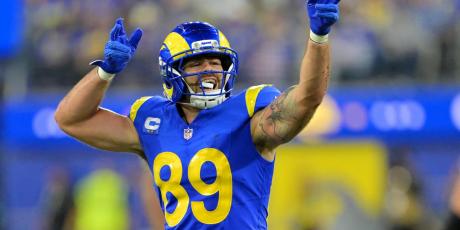
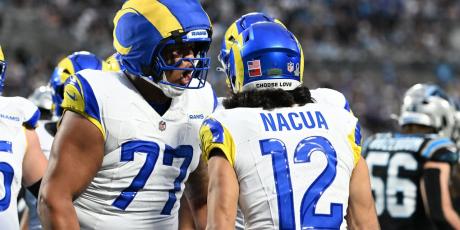
WR Puka Nacua, Rams
Coming off the board as the fourth-overall selection in current ADP, Puka Nacua has a pretty straightforward case to simply stay right where the market has him.
Nacua was absolutely dominant last season, averaging 19.4 half-PPR points per game and finishing as the overall WR1 despite missing one contest. His 310.5 fantasy points outpaced Amon-Ra St. Brown by 45 points and Ja’Marr Chase by nearly 60, while his 10 touchdowns finally gave us the scoring ceiling that had been missing from his first two NFL seasons.
The efficiency was phenomenal. Nacua averaged 3.8 yards per route run, the second-highest single-season mark by a wide receiver with at least 50 targets since Next Gen Stats began tracking the data. His 2024 mark of 3.6 also sits fourth on that same list, so we’re well past treating this as some sort of fluke.
And the environment hasn’t changed in the slightest. Matthew Stafford is coming off an MVP season, Sean McVay remains one of the best offensive play-callers in football, and Davante Adams will turn 34 years old during the season. Nacua is heading into his age-25 campaign and fourth year in the league, a point at which some of the best fantasy wide receiver seasons in NFL history have occurred.
There’s some durability risk baked into the profile —Nacua’s physical playing style helped cost him six games in 2024 and another last season— but there’s very little else to poke at. He has the target volume, efficiency, quarterback, and offensive environment to repeat as fantasy’s WR1.
RB Christian McCaffrey, 49ers
Well, we apparently didn’t learn our lesson about Christian McCaffrey last season.
After an injury-ruined 2024 made him one of the toughest 2025 picks, McCaffrey responded by scoring 365.6 half-PPR points, easily the most among any non-quarterback and nearly 30 more than the next-closest player, Jonathan Taylor.
The volume was, unsurprisingly, enormous. McCaffrey led the league with 413 total touches, turning them into 1,200 rushing yards and more than 900 receiving yards while catching 102 passes. He has now led the NFL in touches LaDainian Tomlinson-esque three times in his career, once again proving that when he is healthy, there still might not be a more valuable fantasy role in football.
Of course, the workload is also the reason he’s available to us at the 1.04.
McCaffrey is now 30 years old and has surpassed 2,000 career touches. Historically, running backs coming off that sort of volume are much more likely to lose touches, miss games, or both the following season. That concern carries a little extra weight for someone with McCaffrey’s injury history.
There are reasons not to panic, though. A massive chunk of McCaffrey’s workload comes through the air rather than repeated collisions between the tackles, and his 69 projected receptions provide a fantasy-point cushion very few running backs can replicate. San Francisco also continues to have questions among its pass-catching depth, giving Brock Purdy every reason to keep funneling high-percentage opportunities toward his running back.
There’s unquestionably more risk here than with Nacua, but McCaffrey just showed us what the healthy version still looks like. Another 400-touch season probably shouldn’t be the expectation, but he doesn’t need one to finish as the RB1 again.
WR Amon-Ra St. Brown, Lions
If the first round is about minimizing the odds of completely whiffing, there might not be a safer wide receiver pick than Amon-Ra St. Brown.
St. Brown has finished as the WR3 in half-PPR scoring in each of the last three seasons, and since entering the league in 2021, he leads all wide receivers with 547 receptions while ranking fourth with 6,252 receiving yards. That consistency comes from one of fantasy’s most bankable weekly roles, with his target share remaining firmly in the mid-to-upper-20% range throughout the last four seasons.
Jared Goff helps make that possible. He hasn’t finished lower than sixth in raw dropbacks over the last three seasons, while Detroit has remained one of the league’s highest-scoring offensive environments even through coordinator turnover.
Jahmyr Gibbs is now positioned for an even larger piece of the offense following David Montgomery’s departure, while Jameson Williams is coming off a 65-1,117-7 season and remains one of the league’s most explosive vertical threats. Sam LaPorta and Isaac TeSlaa provide additional competition for targets (assuming LaPorta’s health), and Detroit is good enough that it won’t always need Goff to throw the ball 40 times to win games.
None of that is particularly frightening for St. Brown’s weekly fantasy floor. It just makes his path to an overall WR1 finish a little tougher to imagine than Nacua’s, particularly when we’re talking about spending the fourth pick rather than the seventh or eighth.
WR Jaxon Smith-Njigba, Seahawks
If Puka Nacua was incredible in 2025, Jaxon Smith-Njigba wasn’t very far behind.
JSN exploded for 119 receptions on 163 targets, a league-high 1,793 receiving yards, and 10 touchdowns, earning Offensive Player of the Year honors while playing a starring role in Seattle’s Super Bowl run.
Smith-Njigba accounted for a ridiculous 32.6% of Seattle’s targets, 36.6% of its receptions, 49.1% of its air yards share, and 40.0% of its receiving touchdowns. The efficiency was equally ridiculous. His 3.7 yards per route run trailed only Nacua and Tyreek Hill’s 2023 season among the best marks of the Next Gen Stats era.
Regression is the easy counterargument. Asking any receiver to repeat nearly 1,800 yards and basically one-third of his team’s targets is a tall order, and Seattle did lose offensive coordinator Klint Kubiak to Las Vegas. Brian Fleury takes over the offense after serving as San Francisco’s tight ends coach, introducing at least some uncertainty about exactly how the passing game will look.
But the personnel doesn’t give us much reason to believe Smith-Njigba is suddenly going to stop being featured. Kenneth Walker is gone, Sam Darnold remains under center, and Seattle hasn’t added anyone who should realistically threaten JSN’s status as the clear No. 1 option.
Nacua has the slightly stronger combination of proven efficiency and offensive continuity, but Smith-Njigba belongs firmly in this conversation after what he did last year.
Who Should You Draft?
Puka Nacua, Christian McCaffrey, Amon-Ra St. Brown, and Jaxon Smith-Njigba all have legitimate cases to be selected at the 1.04, and I wouldn’t consider any of them a significant reach. My choice would be Puka Nacua in PPR and half-PPR, while Christian McCaffrey gets the nod in standard formats.
Nacua led the league with 129 receptions and 107.2 receiving yards per game last season, giving him the combination of volume and efficiency we want when receptions are worth a full point. McCaffrey’s own 102 catches certainly keep him viable in PPR, but his enormous rushing workload and touchdown access give him a slightly larger advantage over the field as receptions become less valuable.
Smith-Njigba would be my second choice in PPR after commanding 163 targets and nearly 33% of Seattle’s passing volume, while St. Brown represents arguably the safest selection of the four but doesn’t quite offer the same obvious path toward finishing first overall at his position.
My pick at the 1.04 in each format:
- PPR: Puka Nacua
- Half-PPR: Puka Nacua
- Standard: Christian McCaffrey
Nacua’s massive reception volume and historically efficient per-route production give him the edge in full-PPR scoring, while McCaffrey’s combination of rushing volume, receiving involvement, and touchdown upside provides the best chance to create a positional advantage as receptions are de-emphasized.