How Winners Draft Quarterbacks in Underdog Best Ball Mania

 Make us preferred on Google
The QB landscape in best ball this year is very different than in past years. We only have one QB (Josh Allen) with an ADP in the first four rounds. Let’s dig into Best Ball Mania VI (BBMVI) data from last year to see what worked, what’s driving QB ADPs this year, and how to attack the current landscape.
Two or Three QBs?
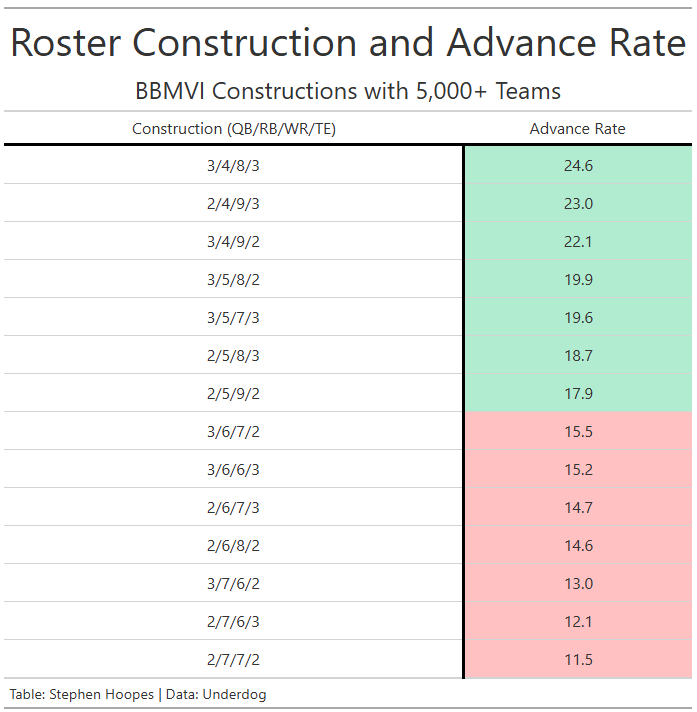
Deciding between two or three QBs is the biggest choice from a roster-construction perspective. Data from recent years continues to guide us toward three-QB builds. The table below shows playoff advance rates by every roster construction drafted at least 5,000 times last year. Four of the five best-performing options had three QBs. And three-QB builds have now outperformed two-QB builds in four of the six years of BBM. That’s definitely the way I’m leaning in early drafts.
When Should I Draft These QBs?
Alright, so we want three QBs in most cases. Perhaps the more interesting question is when should we target these QBs? The answer last year was as late as possible. Let’s start by looking at trends in QB scoring. The table below shows fantasy points per game scored by QBs in each of the last five seasons. The formatting is based on the row, not the column. That just means if a cell is dark blue, it’s the highest a QB of that rank scored over the last five seasons. And white/light blue means it was the lowest. For example, the 24.9 fantasy points per game scored by the QB1 in 2025 was the lowest a QB1 scored over the last five seasons (minimum of eight games played). And that’s true for QB2, QB3, and QB4.
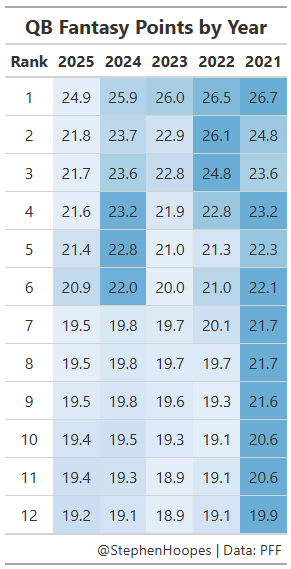
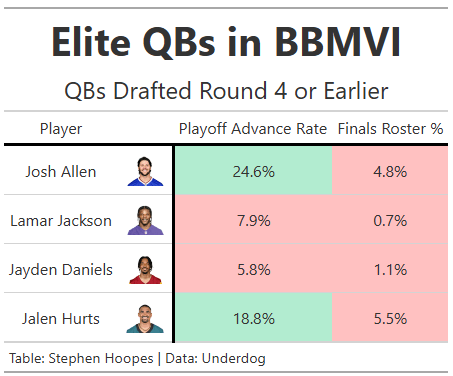
At the same time, QBs seven through 12 have been stable over the last four seasons. I detail possible reasons for why this is happening in my Trends from 2025 That Matter article, but let’s take these changes as a given for now. This is all bad news for the elite QBs because they’re separating less from QBs you can take later in the draft. And we saw the impact of this on BBMVI results. The table below shows the four QBs who had ADPs in the first four rounds last year. That’s my definition of an “elite” QB. Taken together, they had a 14.3% playoff advance rate, or 2.4% below average. And their average finals roster rate of 3.0% is even worse compared to its baseline.
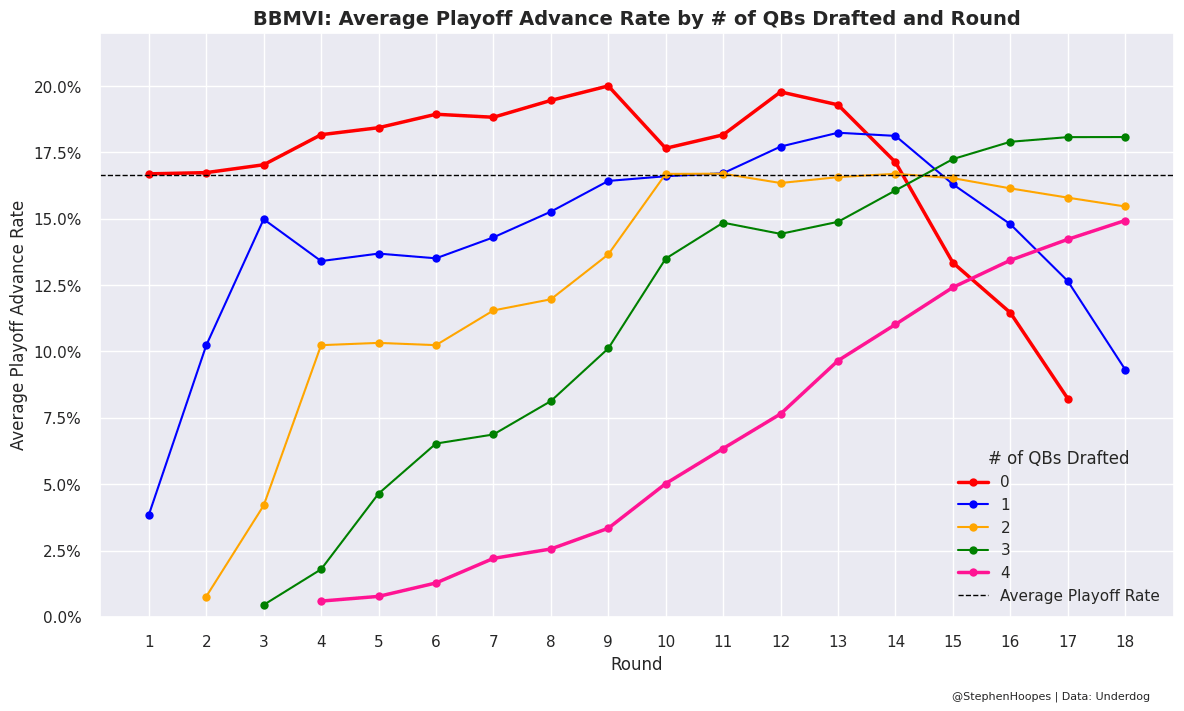
One more graph to finish off the discussion of what worked last year. The graph below has draft round on the x-axis and playoff advance rate on the y-axis. And each line represents how many QBs you had on your team at the end of that round. It was actually optimal to have zero QBs drafted through round 13 last year, which was about three rounds later than the typical year in BBM.
But What About This Year?
The big issue this year is that best ball drafters have taken notice of the trends above. As I mentioned at the top, we only have one “elite” QB this year in Josh Allen. This is the cheapest the second tier of QBs has ever been, with players like Lamar Jackson and Jalen Hurts going well past previous-year ADPs. Simultaneously, this is the most expensive later-round QBs have ever been. I’d argue C.J. Stroud at QB24 is the last QB you can be reasonably confident starts the entire year. And he’s being drafted in the 12th round. Well, I said above that it was optimal to have zero QBs through 13 rounds last year. If you did that this year, your QB room might look like Fernando Mendoza, Aaron Rodgers, and Tua Tagovailoa? Yikes!
So, how should we actually play QB this year? Well, here’s what I’ve gravitated to so far. I don’t have a lot of Josh Allen. We’ll get to this in the RB article of this series, but RB bets fall off a cliff after Round 5. To be honest, the RBs that I actually feel confident about are gone after Round 3. That makes the opportunity cost of taking Josh Allen at pick 29 very expensive because you’re passing up on Breece Hall or Travis Etienne. But the RBs going around Jalen Hurts and Jayden Daniels are Chuba Hubbard and Tony Pollard. I’m a lot more comfortable missing out on those guys.
So, I really like a lot of the guys in the Round 6 range. These are “elite” QB profiles that we’re getting a discount relative to prior years. And then, especially if you’re trying to get to three QBs like I am, you need to aggressively target QBs from rounds eight to 10. Nearly 40% of the players with an ADP from 85 to 116 are QBs at the moment. This is not optimal at all, just looking at last year’s data, but as I said, the landscape has shifted. And if you completely miss on this window, you’re going to hate your QB room. Trust me.
Team- and Game-Stacking
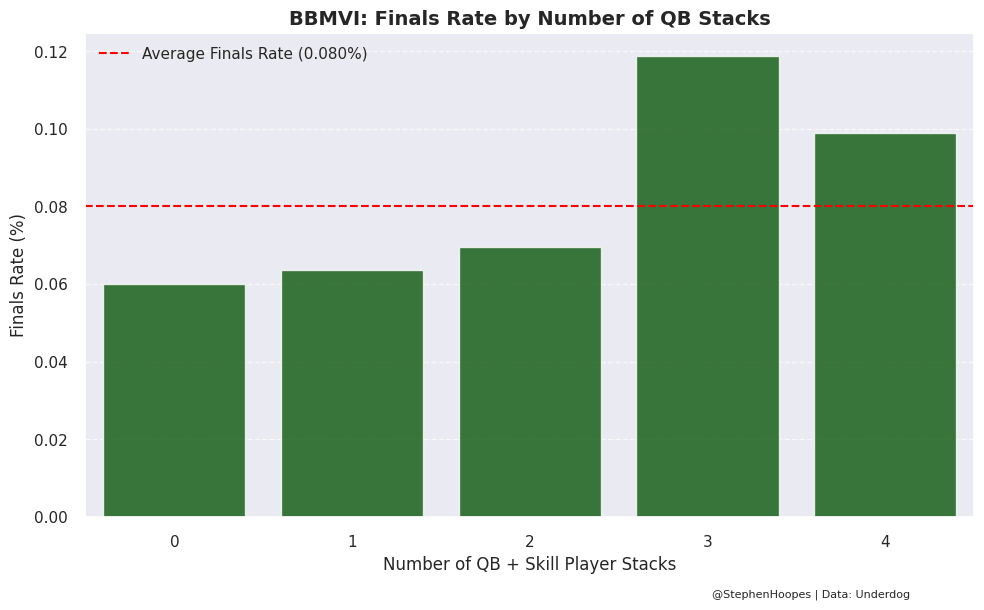
Stacking is table stakes in best ball. It requires you to get fewer things right and boosts your ceiling if you hit on the right offenses. You should take any data point that only focuses on BBM finals rate with a grain of salt, because it’s such a tiny sample of all entries. But the graph below fits my narrative, so I’m sharing it anyway. The x-axis is the number of team stacks an entry had, while the y-axis is the rate those teams made the finals. I’m defining a team stack as rostering a team’s QB and at least one of that team’s skill players. You were twice as likely to make the finals last year if you had three team stacks compared to zero.
I would cap the number of players you draft on the same team at four or five. Advance rates really start to plummet after that point, either because your players are cannibalizing each other or you’re pulling players up from their ADPs in order to increase your team stack. But let’s turn to game stacking Week 17, when all of the money is won. The graph below shows the number of game stacks that a finals team had on the x-axis, along with their points in the finals on the y-axis.
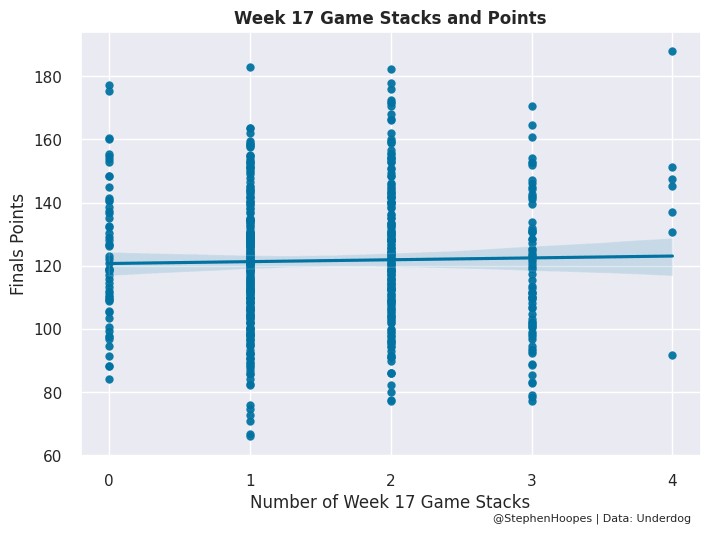
I’m defining a game stack as having at least one player on both teams of a Week 17 matchup. The number of active, healthy players you have is going to dictate a lot in a one-week sample. But just like in past years, you generally want more game stacks than fewer. It lowers your floor relative to the teams that do not game stack, because if the game you’re heavily stacking duds, your score is going to suffer. But all of the money is at the top, and this strategy increases your ceiling. For example, the winner last year game stacked four different Week 17 matchups.
Bye Weeks and Advanced Stats
One easy but important thing to avoid is drafting a QB room with the same bye weeks. The NFL schedule was released on May 14th, so get to know those bye weeks. Guaranteeing zero points in a week from the position that scores the most fantasy points is a bad idea. Teams with QB rooms where every QB had the same bye week advanced only 14.5% of the time last season, compared to the 16.7% benchmark. That includes the teams that only drafted one QB, with these teams advancing less than 10% of the time. The extra skill player just isn’t worth that massive hit on advance rate.
I tested a lot of different QB stats to see if any of them correlated with a higher advance, but came up empty. For some examples, I looked at the average of the following variables for the QBs in each entry: big-time throw rate, accuracy rate, EPA per play, scramble rate, first down rate, and PFF passing grade. All six of those had a correlation between -0.01 and -0.10. So, basically, no correlation at all and slightly counter-intuitive because you’d expect higher numbers for these to boost your advance rate, not hurt it.
But we know there are hundreds more variables that affect an entry’s ability to make the playoffs. And we also know that the QBs with high values for these variables prior to last season were probably drafted early. But teams that took early-round QBs last year had a tough year.

Bottom Line
- I’m prioritizing three-QB builds as four of the five best-performing roster constructions in BBMVI had three QBs. And three-QB builds have now outperformed two-QB builds in four of the six years of BBM.
- Waiting on QB crushed last year to such an extent that it was optimal to have zero QBs drafted through Round 13.
- The problem is that the profiles of those late-round QBs last year have been pushed up in drafts. Meanwhile, we only have one “elite” QB this year in Josh Allen, with the second-tier of players like Jalen Hurts and Jayden Daniels available in Round 6.
- How I’m playing QB so far is avoiding Josh Allen in Round 3 in exchange for the Round 6 options or aggressively targeting the “QB window” where nearly 40% of the players with an ADP from 85 to 116 are QBs.
- Team-stacking is table stakes in best ball; you were twice as likely to make the finals last year if you had three team stacks compared to zero.
- But so is game stacking Week 17, with the winner last year game stacking four different Week 17 matchups.
- Finally, avoid drafting just one QB or a QB room with the same bye weeks, as you’re harming your advance rate for no reason.