Best Ball: Using the Schedule to Your Advantage

 Make us preferred on Google
The NFL’s extended schedule release: a true “this could’ve been an email” moment on the offseason calendar. But the schedule is crucial for best ball for both playoff game stacking and bye week strategy. Let’s dig into both, starting off with some motivation for why we should care about each.
Playoff Game Stacking
The motivation is clear for playoff game stacking: nearly all of the money is won in Week 17. In Best Ball Mania VII (BBMVII), about 84% of the total prize pool is doled out in Week 17. You have to make it there to earn anything above $1,000. And then in Week 17 itself, first place earns 533 times what the worst-performing team takes home. You both have to get there and maximize your ceiling for that single week slate.
Well, one way to maximize your Week 17 ceiling is to focus on game stacking your early-round bets. The graph below shows the number of game stacks that a BBMVI finals team had on the x-axis, along with their points in the finals on the y-axis. I’m defining a game stack as having at least one player on both teams of a Week 17 matchup. The number of active, healthy players you have is going to dictate a lot in a one-week sample.
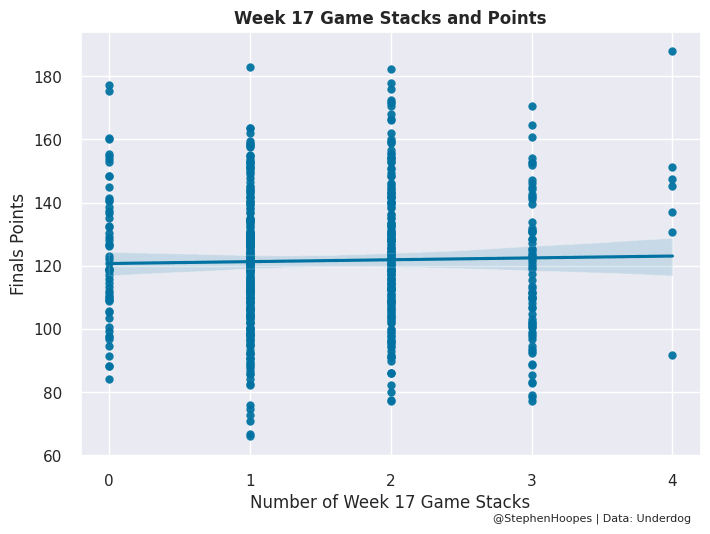
But just like in past years, you generally want more game stacks than fewer. It lowers your floor relative to the teams that do not game stack, because if the game you’re heavily stacking duds, your score is going to suffer. But all of the money is at the top, and this strategy increases your ceiling. For example, the winner last year game stacked four different Week 17 matchups.
So, what Week 17 matchups should we target this season? The table below shows each team’s schedule during the BBMVII playoffs. And the colors are sourced from DraftKings’ projected game totals for each matchup. Darker green means the game total is expected to be high, while light-green/white means the game total is expected to stink.
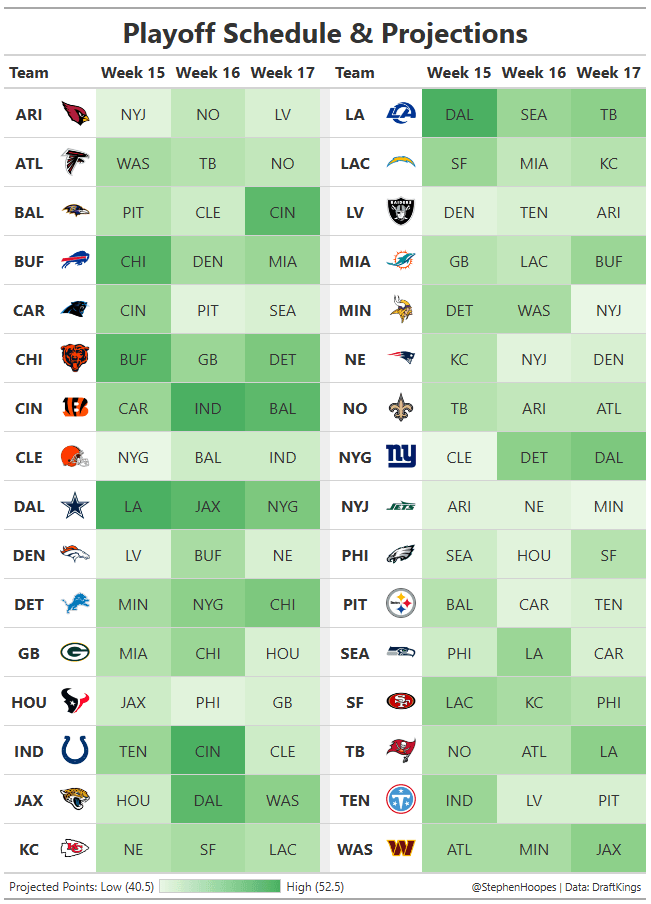
You’re obviously welcome to use this anyway you’d like, but here’s how I use the table. I don’t go into a draft saying “I’m only going to draft Bengals and Ravens players because of the Week 17 projected game total”. We’re generally bad at knowing which games will shoot out 6 months from now. For example, last year’s Patriots/Jets game had one of the lowest projected game totals going into the season. Well, the game hit 52 total points with the Patriots putting up 42 themselves in some sort of revenge act.
What I actually do is mostly ignore this table through the first few rounds. I make my bets based on who I think will score the most points throughout the entirety of the season. For example, let’s say I took Ladd McConkey in Round 4. That makes me more interested in a player like Xavier Worthy in Round 10 than in other drafts. So, to me, it’s more of a tiebreaker and a reason to take a player like Worthy on this team, especially since he’s not someone I’m targeting in a ton of drafts. I already made a bet on the Chargers’ game scoring a lot of points in Week 17, so let’s lean into that bet with Worthy.
Bye Weeks
Let’s start with the motivation for why we should care about bye weeks. The graph below is a bit hypnotic but stick with me. Each colorful line shows the distribution of points by your standing in a 12-person draft. For example, the black line all the way on the right represents the scores of teams that finished first among the 12 teams in their draft.
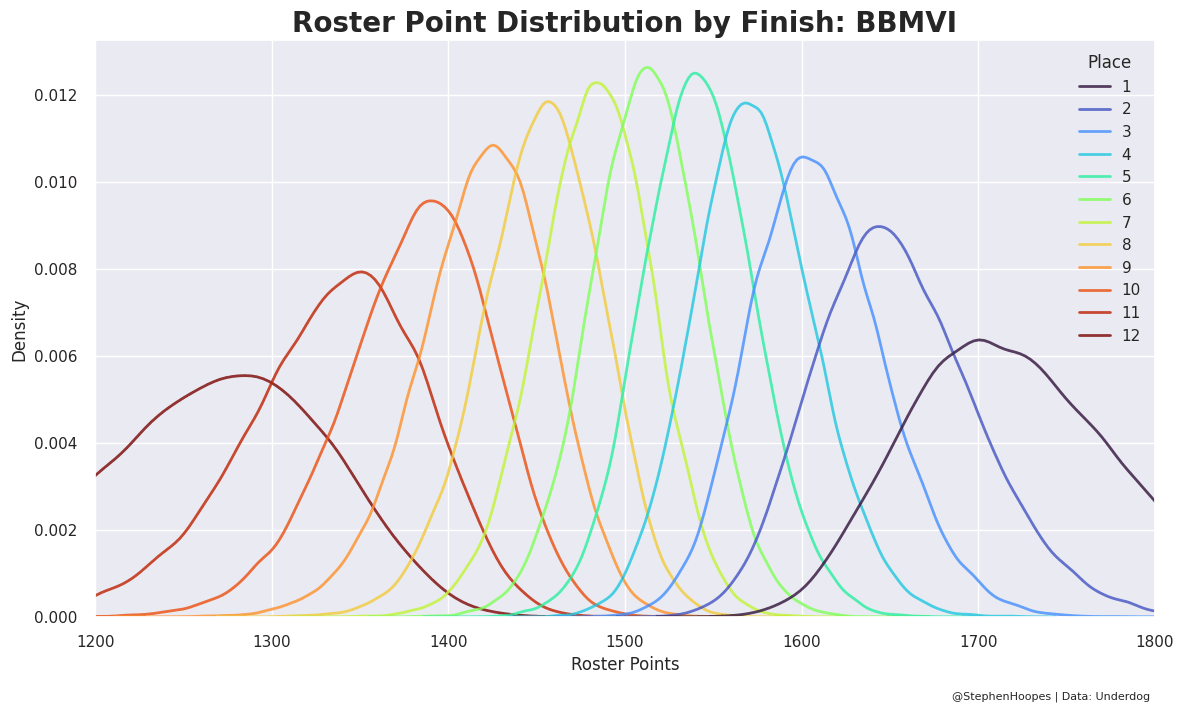
What I want you to focus on are the two blue lines directly to the left of that black line. Those two blue lines represent the second and third-place finishers. On average, second-place teams scored 45 more points than third-place teams’ last season. Now, 45 points is more than any individual QB or TE will typically score in a week. But what you’ll notice on the graph is that the third-place line overlaps a lot with the second-place line. And that’s because the standard deviation of scores in this range is also about 45 points. There is a very reasonable chance that one additional week of QB or TE scoring is the difference between you advancing to the playoffs or just missing out.
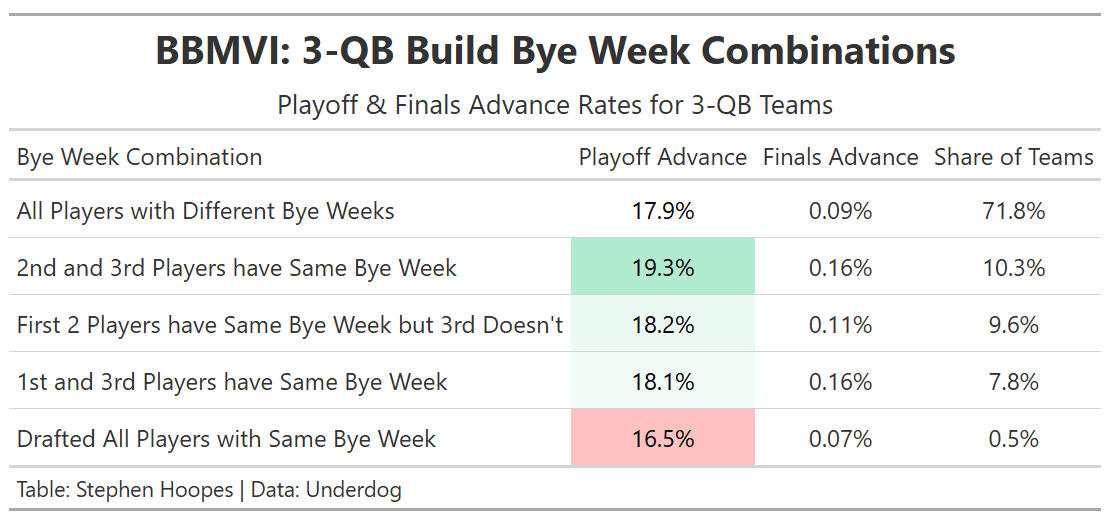
With that in mind, the table below focuses on teams that took three QBs last year. It shows all five possible scenarios for the bye weeks of those QBs. As I mentioned in How Winners Draft QBs, it was a good year for 3-QB builds. Four of the five best-performing roster constructions had three QBs. And three-QB builds have now outperformed two-QB builds in four of the six years of BBM. But even with that advantage, if you took three QBs with identical bye weeks, you advanced to the playoffs and finals at below-average rates.
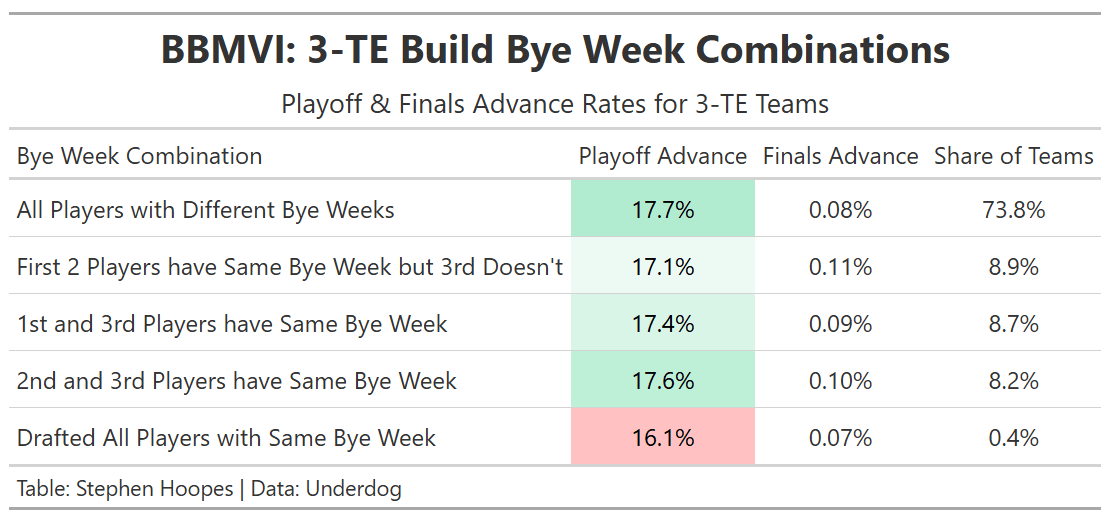
It’s a similar story at TE. BBMVI was the sixth consecutive year that three-TE builds outscored two-TE builds in regular-season points. And last year was the second consecutive year where drafting three TEs with distinct bye weeks gave you an advance rate edge on the field.
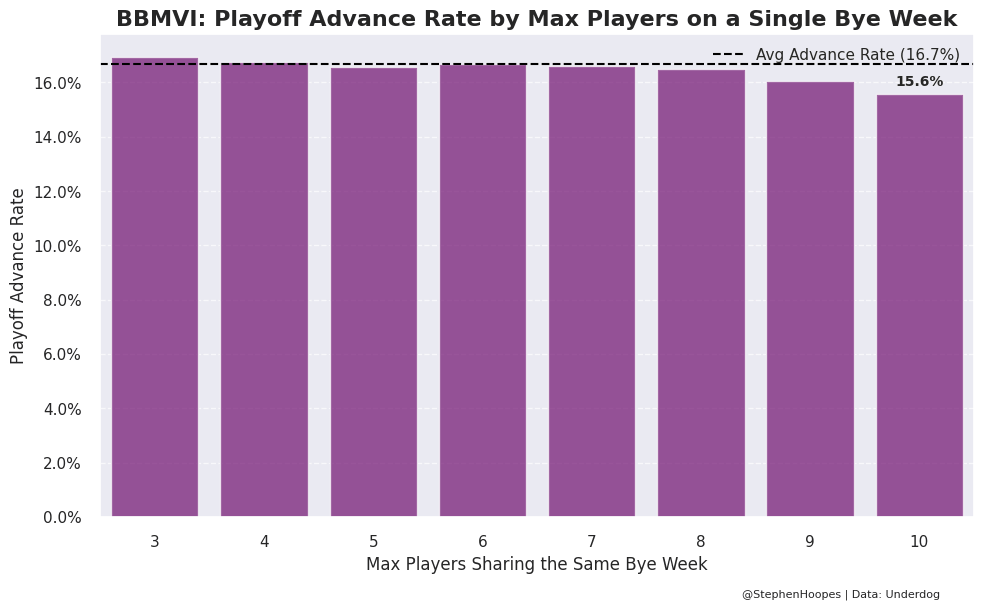
To finish off the bye week discussion, just don’t go insane drafting all of your players with the same bye week. The graph below shows the maximum number of players each team drafted that shared a bye week. There’s basically no impact on advance rate through seven players. But after that point, you start to see advance rates dip, all the way to 15.6% or 1.1% below average with 10 shared bye week players.

Bottom Line
- We care about playoff game stacking because first place in BBMVII earns 533 times what the worst-performing Week 17 team takes home.
- And game stacking your early round bets increases your ceiling when the tournament switches to single-week elimination games.
- For example, the winner last year game stacked four different Week 17 matchups.
- We care about bye weeks because there is a good chance that one additional week of QB or TE scoring is the difference between you advancing to the playoffs or just missing out.
- Last year was the second consecutive year that drafting three TEs with distinct bye weeks gave you an advance rate edge on the field.