How Winners Draft Tight Ends in Underdog Best Ball Mania

 Make us preferred on Google
The analysis of elite TEs in best ball has been tough. There are just so few of them that the performance of a very small number of players dictates the entire position. In the past, the main question was “did Travis Kelce stay healthy and go nuclear”? If so, then you wanted an early-round TE. If not, then early-round TE didn’t work. But one thing has been very consistent since Underdog launched Best Ball Mania (BBM).
Roster Construction and What Worked Last Year
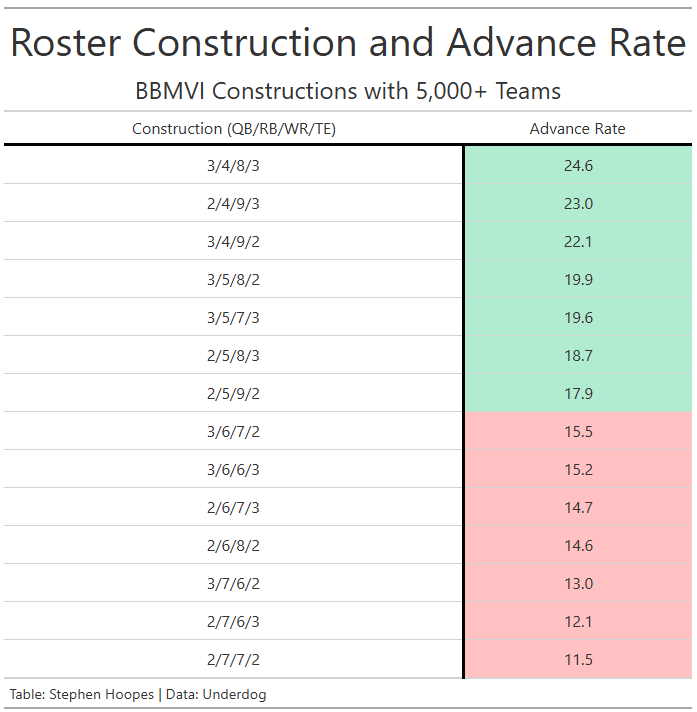
BBMVI was the sixth consecutive year that three-TE builds outscored two-TE builds in regular-season points. In fairness, that overstates the argument a bit because it’s generally been close. But below were the most successful roster constructions from last year. The two best performing options each had three TEs. However, that remains highly correlated with how you played the elite TE options.
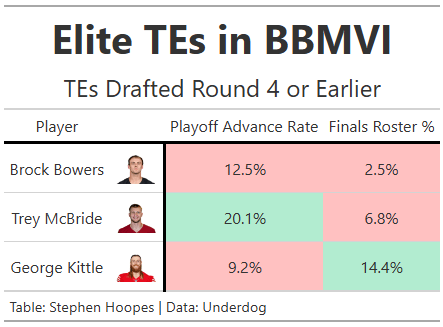
And unfortunately, it was another year where selecting an elite TE did not pay off. The table below shows how the three players taken in Round 4 or earlier performed last year. Trey McBride was the only one with an above-average advance rate. But after a massive 12/134/2 line in Week 15, he duded out with a 4/27/0 line in Week 16, eliminating a lot of teams right before the finals. And then Brock Bowers was forced to deal with the Raiders’ incompetent offense, while George Kittle only played in 11 regular-season games due to injuries. As a group, teams that drafted elite TEs advanced 13.9% of the time or about 3% below average. And they advanced to the finals 7.9% of the time, or just slightly below average.
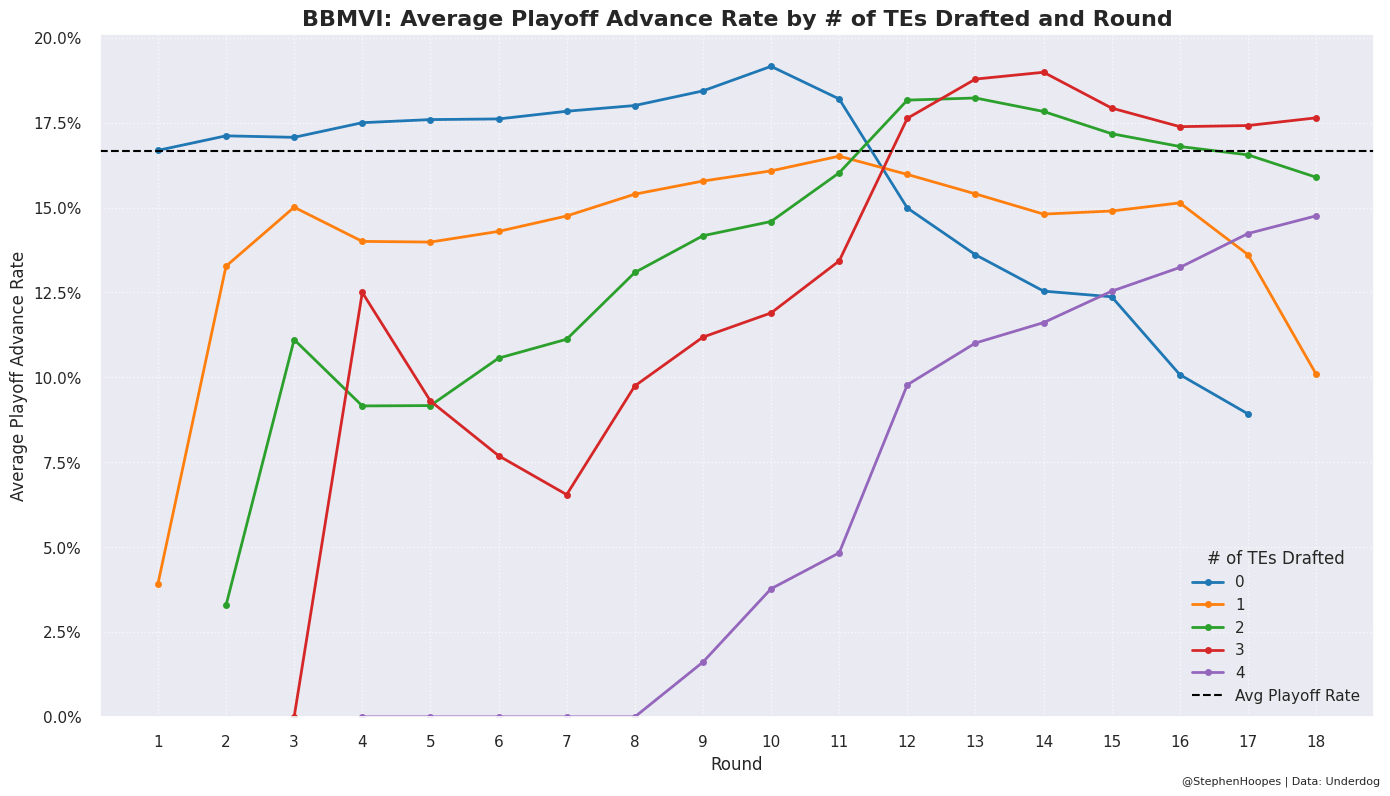
With that context in mind, the graph below shows rounds on the x-axis and playoff advance rate on the y-axis. Each line on the graph shows how many TEs a team drafted by the end of each round. If you follow the blue line at the top, you’ll see it was optimal to have zero TEs through Round 11 last year. But then it rapidly jumps to three TEs (the red line) in the span of a few rounds. We’ll get into this more later, but that’s the exact window where a lot of TEs are going off the board in early drafts this year. One-third of the players taken in Rounds 11 through 13 right now are TEs.
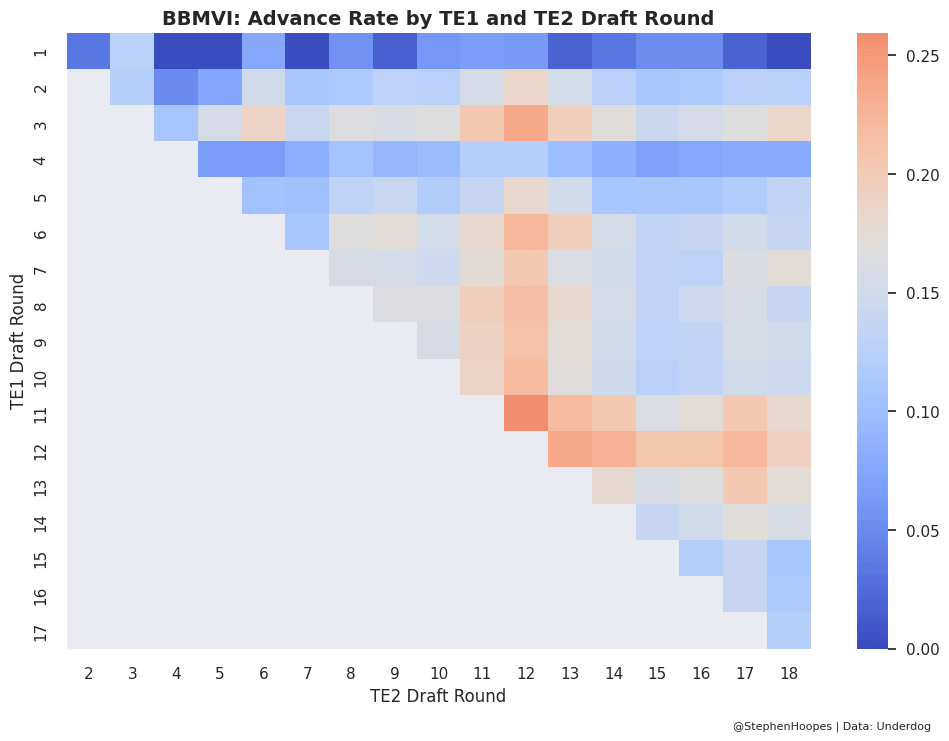
To finish off what worked last year, below is a heatmap where red shows higher advance rates and blue shows lower advance rates. The y-axis shows what round you drafted your first TE in, while the x-axis shows the round of your second TE. The darkest red cluster starts with a TE in Round 11 and then immediately taking your second TE in Round 12. And there were similarly good options right around that range.
What’s Going on with Late-Round TEs?
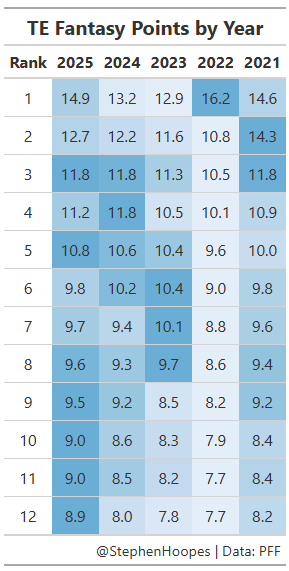
We’re seeing later-round TEs deliver more points than ever. The table below shows the fantasy points per game scored by QBs in each of the last five seasons. The formatting is based on the row, not the column. That just means if a cell is dark blue, it’s the highest a TE of that rank scored over the last five seasons. And white/light blue means it was the lowest. One of the things that stands out to me is that TEs seven through 12 either set or nearly set recent highs in half-PPR points per game last year.
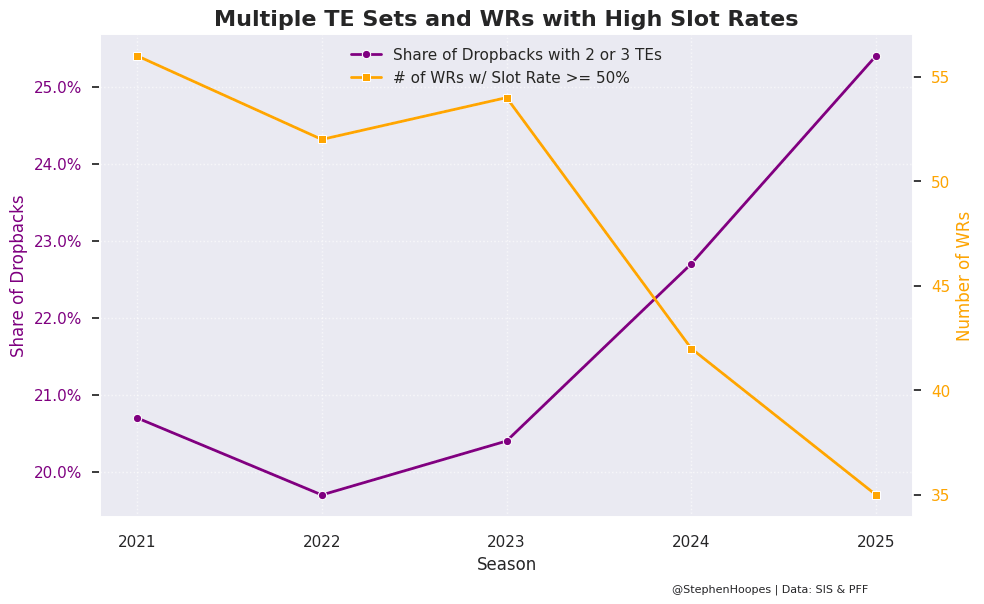
Part of the reason is they’re simply on the field more often in passing situations, largely at the expense of slot WRs. The graph below is from my Trends article. It shows the share of dropbacks with two or three TEs on the field in purple. And then the orange line is the number of WRs with at least a 50% slot rate. Multi-TE sets have increased by about five percentage points since 2022. A fun team to look at here is the Rams. Here are the Rams’ number of dropbacks with three TEs on the field over the last five years: two, zero, one, one…and then 132 last year. Meanwhile, we’ve lost 20 WRs with high slot rates across the league in only two seasons.
How to Play TE This Year?
I don’t think there is a systemic reason why the elite TEs need to continue disappointing. Last year, Brock Bowers was stuck on a Raiders offense that was incapable of protecting Geno Smith for more than a second. There’s hope that he could truly ascend if the offense is simply functional this year. Meanwhile, Colston Loveland broke out in a big way at the very end of last season. The top end of the position is capable of putting up stronger numbers in 2026 compared to 2025.
But with the later-round options scoring more than ever, we’re really going to need the Bowers’ of the world to melt faces in order to justify the opportunity cost. And that opportunity cost, to me, is higher than ever this year. What I said in this series so far is the very elite WRs are separating from the WRs you can select even in Round 3. Meanwhile, there are very few high-upside RB options after the third round, especially with a weak rookie RB class. Both Bowers and McBride are going at the end of Round 2.
And so, I’m finding myself waiting on TE at least until Loveland in most cases. And regardless if I miss or pass on Loveland, I’m trying to attack the TE window that starts in Round 11. I think a lot of guys in this range are undervalued. Guys like Jake Ferguson, Dallas Goedert, and Brenton Strange. And then you have some higher upside plays like Oronde Gadsden, especially with his price falling after the David Njoku signing. My ultimate goal is to hit three TEs in most of my drafts, with as many of them stacked with my QBs as possible.
Bottom Line
- BBMVI was the sixth consecutive year that three-TE builds outscored two-TE builds in regular-season points.
- It was another tough year for elite TE as teams that drafted this cohort advanced to the playoffs and finals at a below-average rate.
- With that in mind, it was optimal to have zero TEs through Round 11 last year.
- The Raiders’ incompetent offense and George Kittle’s injuries have a lot to do with the struggles of the elite TE last year.
- But we’re also seeing later-round TEs deliver more points than ever, partially because they’re on the field more often in passing situations at the expense of slot WRs.
- And so, I’m struggling with the cost of Bowers and McBride in early drafts, especially because RB falls off a cliff after Round 3.
- Instead, I find myself drawn to the TE window that starts in Round 11, with the ultimate goal of hitting three TEs in most of my drafts.