How Winners Draft Running Backs in Underdog Best Ball Mania

 Make us preferred on Google
The RB landscape has fully shifted after two consecutive seasons of early-round RBs staying incredibly healthy and defining fantasy football seasons. Let’s dig into Underdog’s Best Ball Mania VI (BBMVI) data to see what worked at RB last year, how that’s impacted ADPs this year, and how to deal with the current landscape.
What Worked in BBMVI?
The graph below shows rounds on the x-axis and playoff advance rate on the y-axis. Each line on the graph shows how many RBs a team drafted by the end of each round. For example, the blue line shows the average playoff rate was about 12% for teams that didn’t take an RB in Round 1. And the orange line shows the average playoff rate was about 24% for teams that did take an RB in Round 1. Ouch!
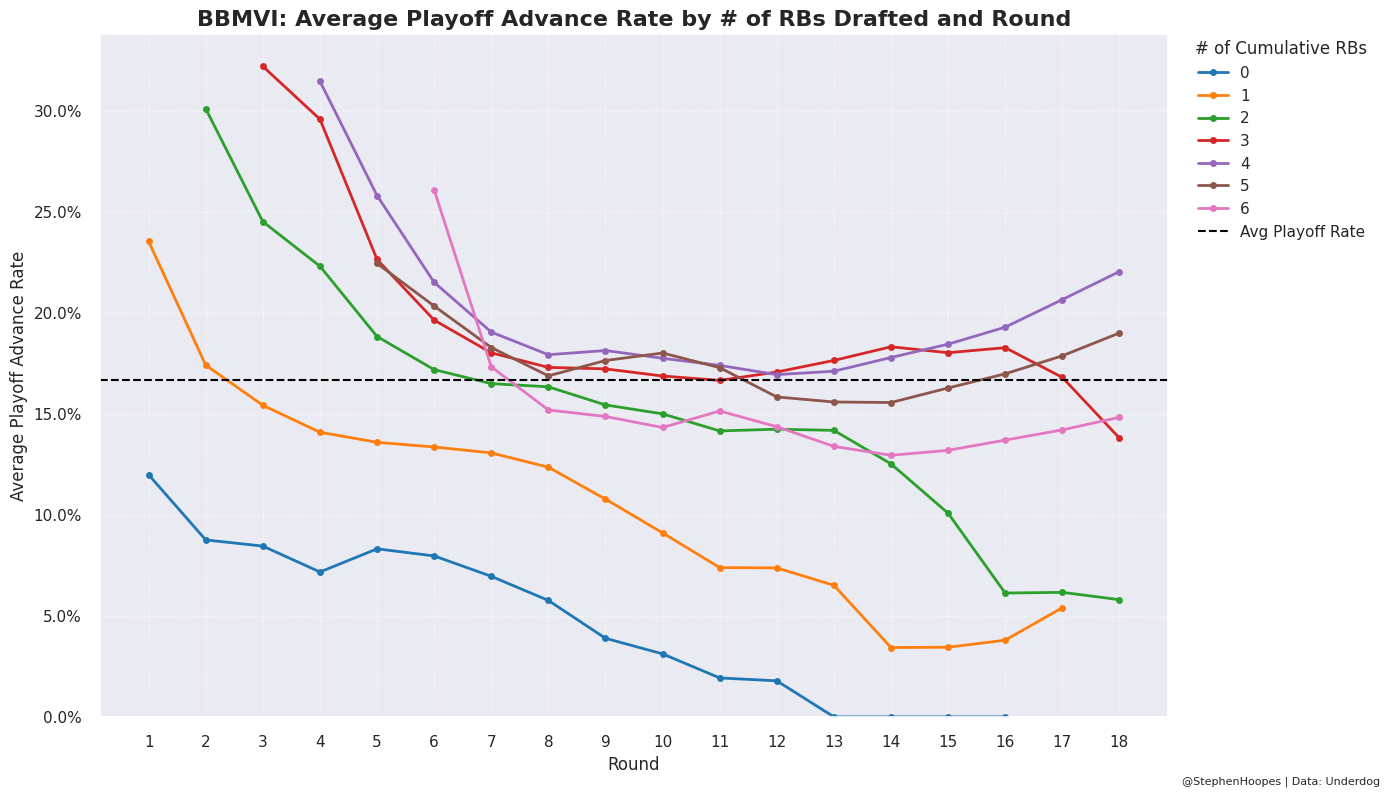
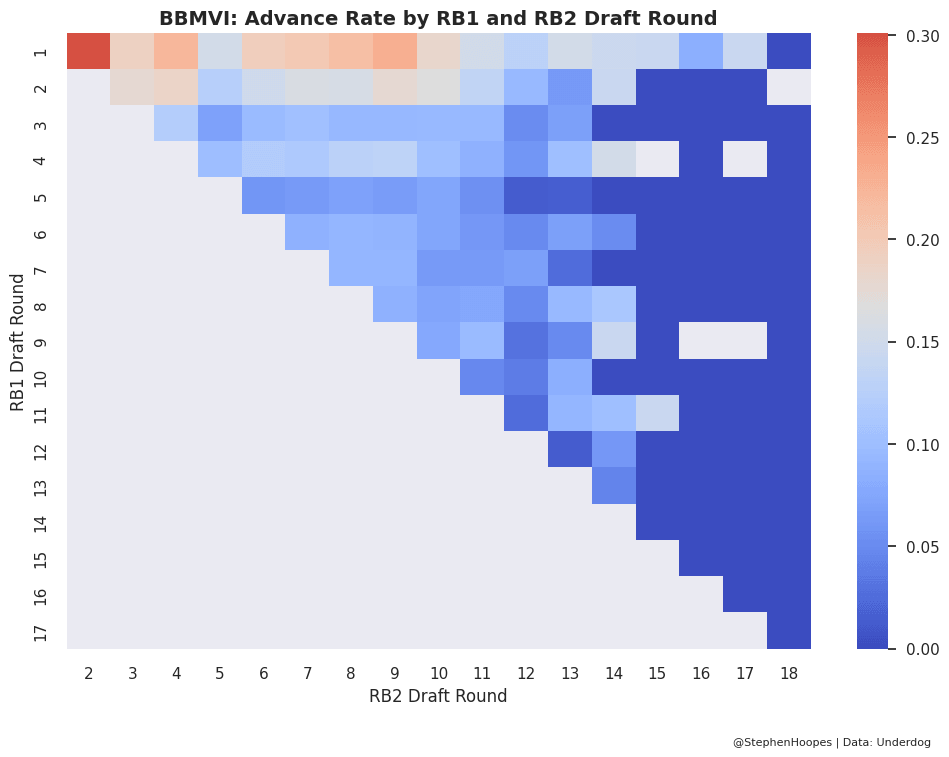
And that gap continues to increase as you go along the graph. The green line shows drafters that started with two consecutive RBs advanced about 30% of the time, compared to about 8% for those without an RB in either Round 1 or 2. It was another rough year for the zero-RB drafter. To show this in a different way, below is a heatmap where red shows higher advance rates and blue shows lower advance rates. The y-axis shows what round you drafted your first RB in, while the x-axis shows the round of your second RB. You’re only going to see red with an RB1 in the first or second rounds.
Why Did Early-Round RB Work Last Year?
Here’s what we’ve seen in recent seasons from RBs. They’ve stayed healthier than ever, especially those we’ve drafted early. They’ve seen their share of carries increase relative to expectation. And the NFL’s run rate within an opponent’s 5-yard line has increased from 48.8% in 2021 to 51.5% in 2025. That’s great news for elite RBs.
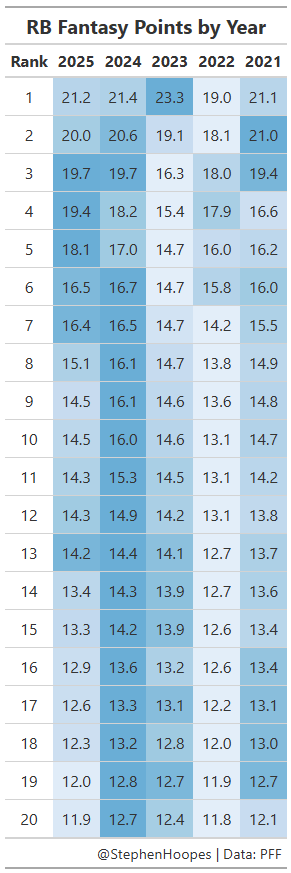
The table below shows the fantasy points per game scored by RBs in each of the last five seasons. The formatting is based on the row, not the column. That just means if a cell is dark blue, it’s the highest an RB of that rank scored over the last five seasons. And white/light blue means it was the lowest. RBs three through seven either set or nearly set new highs in 2025 relative to the previous four seasons.
And it’s not just that top RBs are scoring more. It’s crucial to take into account where in the drafts you got those players. Every single one of these players was drafted in the first three rounds last year. The difference-making RBs that are separating from RB2s are both identifiable and costly in drafts. With that in mind, the table below shows how the RBs drafted in the first three rounds performed last year in BBMVI.
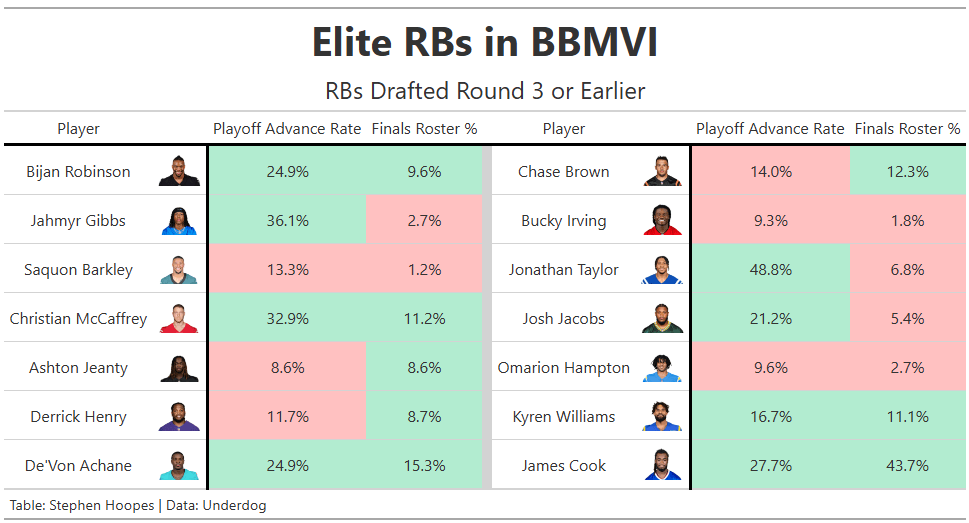
Some guys were massive hits like Christian McCaffrey and James Cook, while others suffered from the state of their offenses like Saquon Barkley and Ashton Jeanty. But overall, the average advance rate for this group was 21.4% or about 5% above average. And their finals advance rate of 10.1% was about 2% above average.
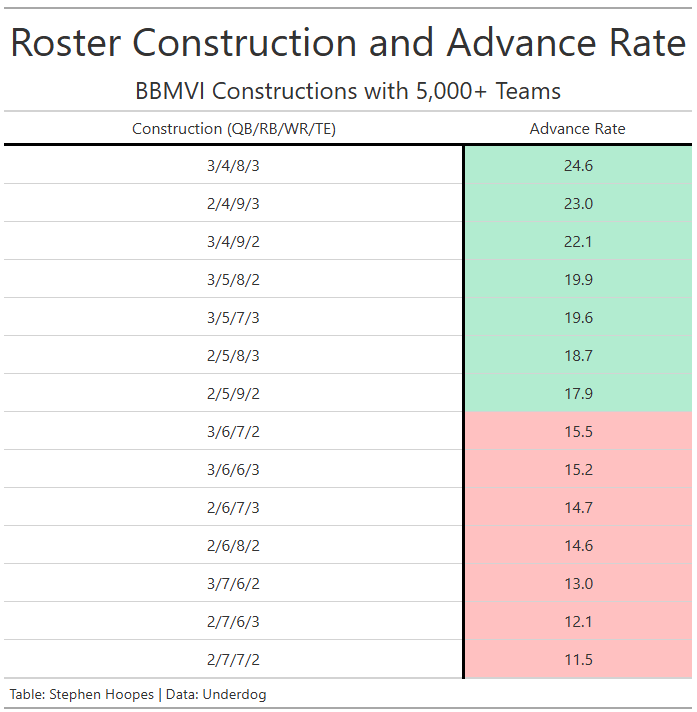
So, let’s look at what roster constructions worked last year at RB. No other year of BBM had such a clean trend. Notice as you go down the list of the constructions that it is literally sorted by the number of drafted RBs. The best options all had four RBs, then five, then six, and finally seven. And the reason is the teams that drafted RBs early tended to take fewer of them. And as we saw, those early RBs crushed last year. I’m personally still leaning toward at least 5 RBs, as that’s been more successful in other BBM iterations, but four RB builds have been optimal now in two consecutive seasons.
Is There Anything Zero-RB Drafters Can Do?
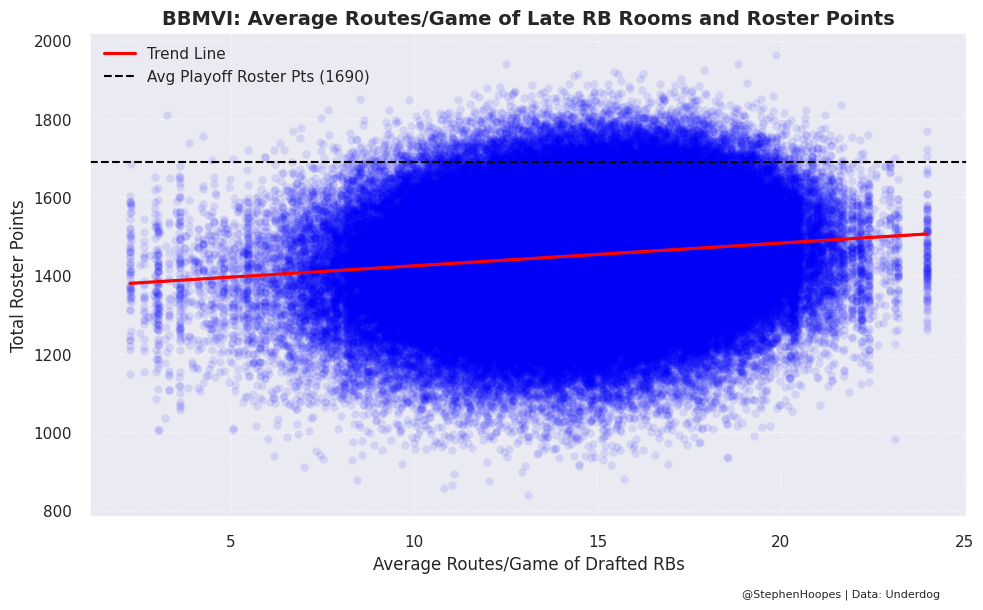
As is evident by now, it’s been a rough couple of years for zero RB drafters. If you’re going to stick with zero RB anyway, is there anything you can do to improve your odds? I did find something from last year’s data. The graph below shows the average routes per game in 2024 for the RBs drafted on a team. And the y-axis shows how many points that team scored in BBMVI. The graph is filtered only for teams that did not take an RB in Round 1 or Round 2. The relationship is intuitive and the strongest of any of the variables I tested. The more routes your RBs ran in the prior season, the better your team scored.
In terms of RB options that fit the bill this year, there are four that ran a lot of routes in 2025 and didn’t see their situation change drastically this offseason. And they’re available after the first three rounds in drafts. Those guys are Rhamondre Stevenson, D’Andre Swift, Tony Pollard, and Cam Skattebo. They might be good fits for a team that is trying to push off RB this year, but keep their RB room’s routes per game up.
How To Attack Running Back This Year?
Just like with QB, the big issue is that drafters are reacting to the trends I discussed above. It gets ugly *fast* at RB after Round 3 this year. You’re limited to just a handful of upside bets at the position, almost exclusively from second-year players with volume or offensive question marks like TreVeyon Henderson, Quinshon Judkins, RJ Harvey, and Bhayshul Tuten.
And we didn’t get bailed out by the 2026 rookie class, with only one RB drafted in rounds two or three. There is no guarantee that the biggest RB hits will always come from the top of the draft board. There is also no guarantee that this recent stretch of RB health will continue. But I’m also not seeing nearly enough high-upside bets available in the later rounds to justify a zero-RB approach. With that in mind, I’ve been leaning toward an absolute minimum of two RBs through Round 5 in early drafts this year, but ideally even more. And perhaps as the summer progresses, we will get some more late-round RB bets in our lives.
Bottom Line
- You doubled your odds of advancing to the playoffs in BBMVI if you took an RB in Round 1.
- You tripled your odds of advancing if you started your draft with two straight RBs compared to teams that passed on RB in the first two rounds.
- In addition to recent RB health, broad NFL trends like increased run rates near the goal-line are benefiting elite RBs.
- And the difference-making RBs that are separating from RB2s are both identifiable and costly in drafts.
- With all of that in mind, it’s been a rough couple of years for zero RB drafters, but one thing you can do to help your odds is focus on later-round RBs that run a lot of routes per game.
- But I don’t think zero RB is particularly viable in early drafts this year.
- There simply are not enough high-upside RB bets available outside of the first three rounds.
- And as we’ll get to in the WR article, WR2s are not separating themselves from later-round WRs.