How Winners Draft Wide Receivers in Underdog Best Ball Mania

 Make us preferred on Google
Drafting four-to-five WRs through the first seven rounds was optimal every year in Underdog’s Best Ball Mania (BBM)…until 2024. Well, that pattern returned last year when four or five WRs through seven rounds was optimal once again. That must mean Round 1 and 2 WRs crushed last year, right? Right? Wrong! Let’s dig into BBMVI data from last year to see what worked, what’s driving WR ADPs this year, and how to attack the current landscape.
What Worked in BBMVI?
The graph below shows rounds on the x-axis and playoff advance rate on the y-axis. Each line on the graph shows how many WRs a team drafted by the end of each round. At least through Round 1, this is the exact opposite of the graph we saw in the RB article. Your odds of advancing to the playoffs last year doubled if you avoided WR in Round 1 compared to taking one.
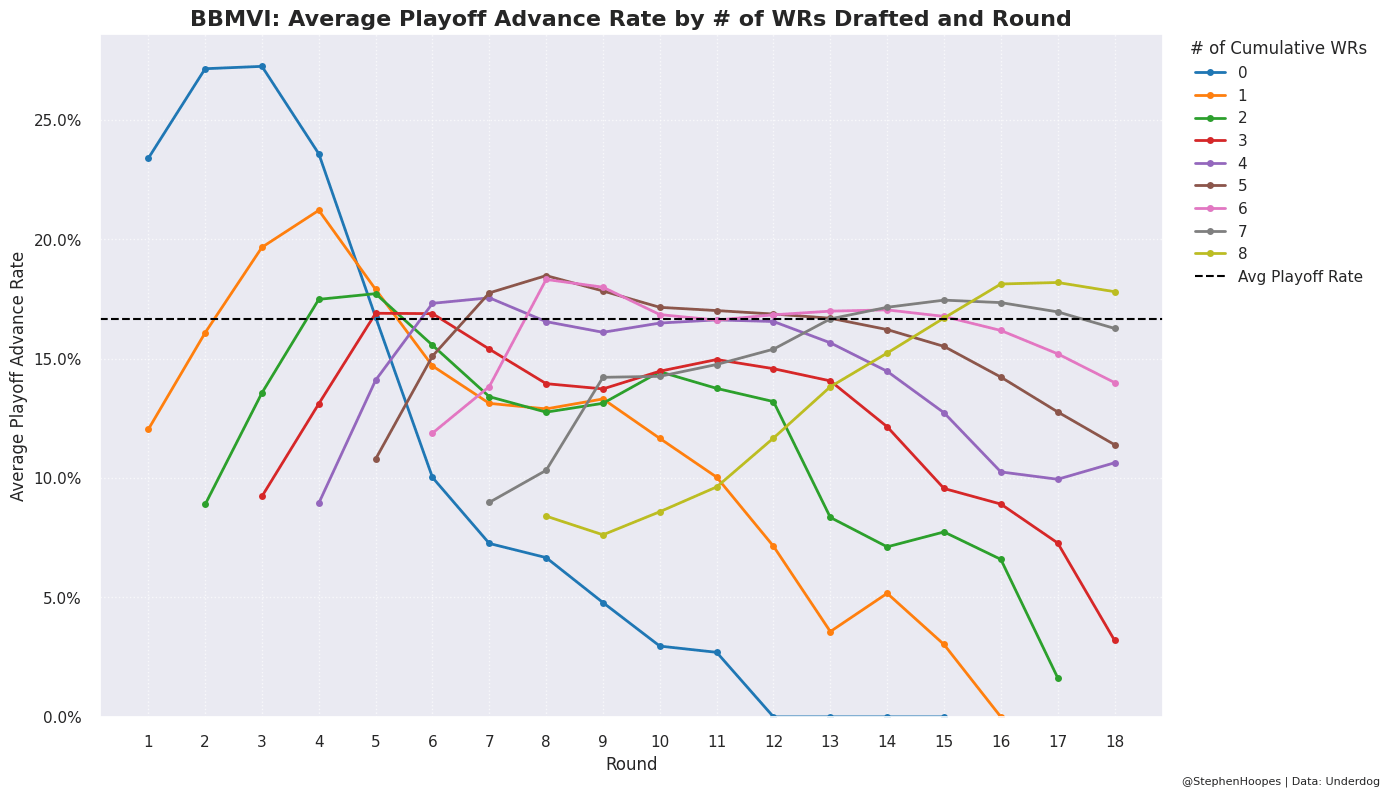
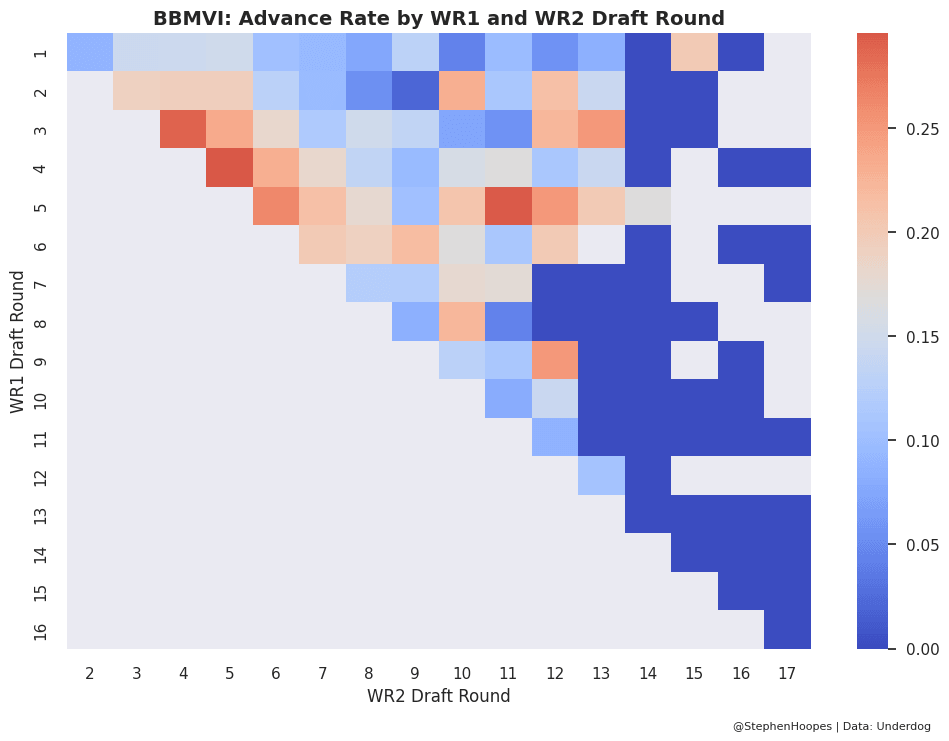
But, follow the purple and brown lines to Round 7. Those lines represent having four or five WRs. And they were the only builds with an above-average advance rate last year. So, how you actually won was by starting your draft with something like three RBs and then four consecutive WRs. To show this a different way, the graph below is a heatmap where red shows higher advance rates and blue shows lower advance rates. The y-axis shows what round you drafted your first WR in, while the x-axis shows the round of your second WR. You start seeing the best outcomes with your WR1 drafted between Rounds 3 and 5 and then immediately taking your WR2 with your next pick.
What Killed Early-Round WR Last Year?
I go more in-depth in my trends article, but here is a brief summary of what’s happening at WR. The league is passing less often with defenses keying in on explosive pass attempts. The league is playing slower. Even when a QB drops back, they’re scrambling at a higher rate than ever. And more and more WRs are being taken off the field for TEs.
With that context, the table below shows the fantasy points per game scored by WRs in each of the last five seasons. The formatting is based on the row, not the column. That just means if a cell is dark blue, it’s the highest a WR of that rank scored over the last five seasons. And white/light blue means it was the lowest.
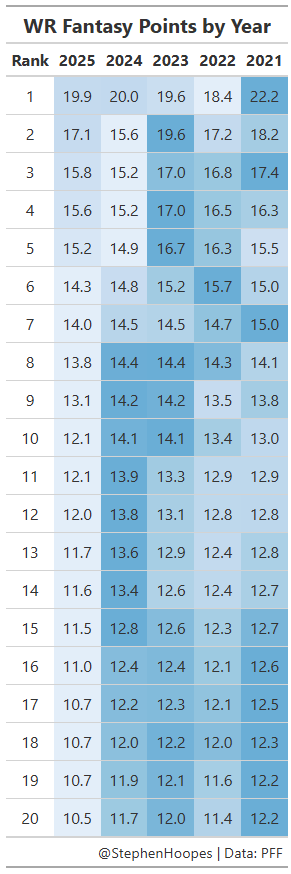
WRs one through five hung in there last year. They were down in general, but at least not the lowest in recent years. But last year was the lowest that WR6 through WR20 scored in any of the last five seasons. Ouch! And we, of course, saw this impact on playoff and finals advance rates in BBMVI. The table below shows the 16 WRs with ADPs in the first three rounds last year.
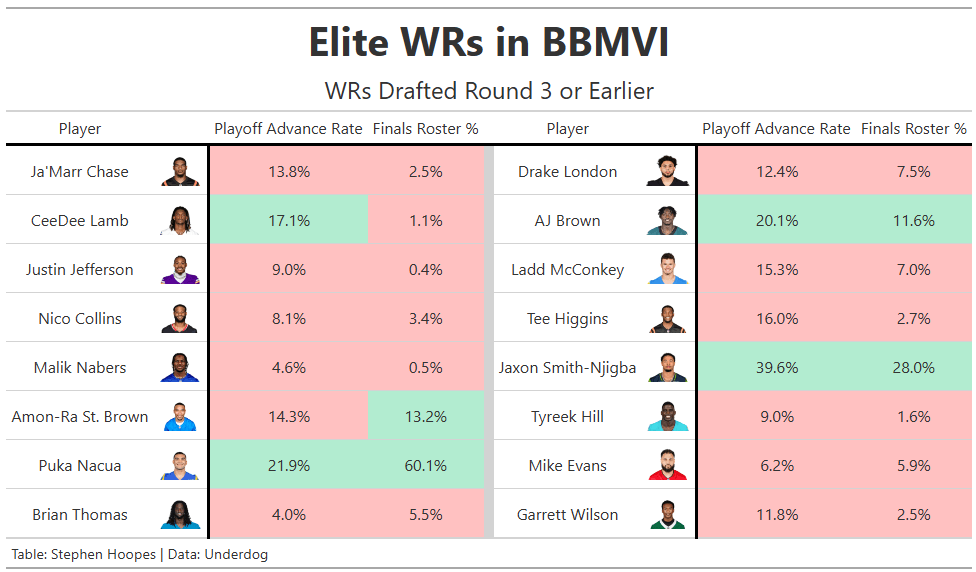
That’s a whole lotta red. Only three of the 16 WRs listed had both above-average playoff and finals rates. That hit rate was about half the mark of RBs drafted in the same range. But you still had the chance to win if you took Puka Nacua and Jaxon Smith-Njigba. Nacua was on three out of every five rosters in the finals last year. That’s absolutely insane. I suppose that can happen when you go for a 12/225/2 line in Week 16. But barring hitting the nuts on Nacua and JSN, taking these WRs over their RB counterparts was not a profitable strategy last year.
But What About This Year?
As we saw in the WR fantasy point by season table, there are still a few WRs that are separating from the field. Because of that, I’m willing to take guys like Nacua, Ja’Marr Chase, Amon-Ra St. Brown, and CeeDee Lamb in the first round of drafts. But then I’m taking my foot off the WR pedal for a bit. If last year’s trend continues, then fantasy points at the WR position quickly flatten. And that makes late WR1s and WR2s less valuable than their RB counterparts.
So, if I get one of those WRs at the tippy-top of the rankings, great. But if I don’t, then take an RB in Round 1. Regardless, try to focus more on RBs near the top of the draft before switching to back to WRs. As mentioned in the QB article, I like the QBs in Round 6 this year, but otherwise, you have to prioritize QB in Round 8 through 10, especially since the last starter we’re very confident actually plays the entire season goes off the board in Round 12.
Meanwhile, as we’ll get to in the TE article, last year was not great for elite TE. That doesn’t have to be the case again, and I could see the Brock Bowers of the world separating from the rest of the position. But the opportunity cost in Round 2 is especially high this year. Regardless, all of this keeps the window of Round 3 to 5 focused on the WR position.
ADP Value
I also just wanted to reiterate how important capturing ADP value is for your success in best ball. The blue line on the graph below shows the median number of points that each draft slot earned in BBMVI. You can see that the blue line fluctuates wildly in the first few rounds of the draft. That big spike near the beginning of the graph is thanks to Christian McCaffrey. To smooth out those fluctuations, I made the green line that does its best to approximate the trend. We'll use that to determine ADP value.
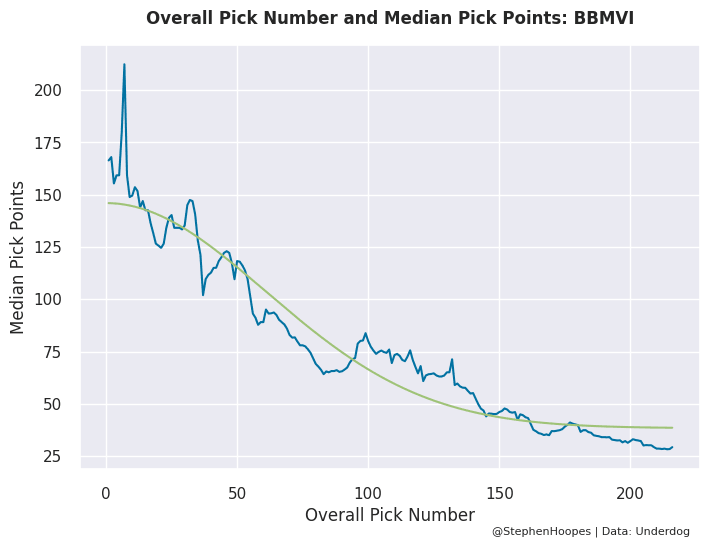
The benefit to this process is that it correctly assigns more value to getting Ja'Marr Chase two picks after ADP compared to getting Adonai Mitchell two picks after ADP. The first kind of ADP value we’ll look at is real-time value. That is comparing the pick where you drafted a player versus that player’s ADP at the time you drafted. And I split drafted teams into five buckets, where bucket 1 tended to draft players well ahead of their ADP, and bucket 5 tended to draft players that fell past their ADP. The bars below show playoff advance rate, while the green line shows the rate of making the finals.
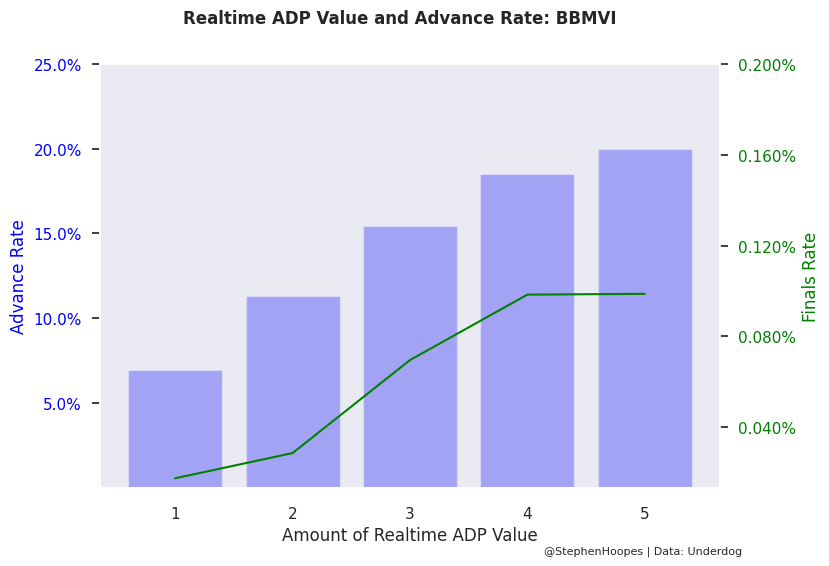
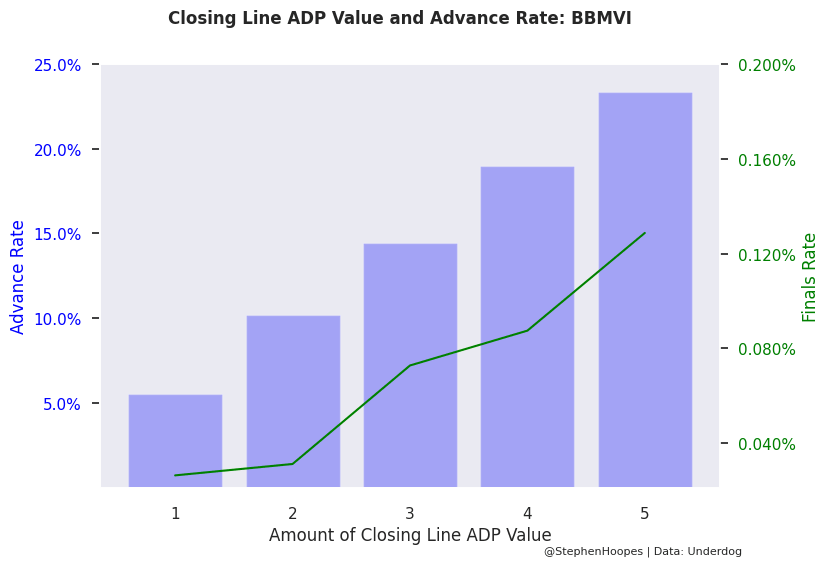
It’s about as clear a trend as you’ll see. The more real-time ADP value you scoop up throughout the draft, the higher your odds of both advancing to the playoffs and making the finals. And these trends are even more apparent when looking at the closing-line ADP value. Closing-line ADP is the average drafted position of a player at the very end of the tournament. For BBM, that is the end of August or early September, just before the season starts. Teams that were best able to anticipate what players would move up draft boards as the season approached and get value on those players advanced to the finals three times as often as their competitors, who struggled the most at this.
Bottom Line
- Your odds of advancing to the playoffs last year doubled if you avoided WR in Round 1 compared to taking one.
- But it was once again optimal to have drafted four to five WRs in the first seven rounds.
- So, how you actually won was by starting your draft with something like three RBs and then four consecutive WRs, avoiding all QBs and TEs in the process.
- While I haven’t been doing this exact strategy in every draft this year, I don’t actually mind it.
- I’m struggling with the cost of WR2s because they’re not separating from players available later.
- And while I think the elite TEs could perform better this year, their second-round opportunity cost is tough with the current RB landscape.