NFL Offensive Line Rankings Week 8: Matchups to Exploit

 Make us preferred on Google
Evaluating offensive line play through a fantasy football lens can reveal matchup advantages that traditional rankings or defensive fantasy points allowed don't always show.
Each week, we’ll rank all 32 offensive lines, track the biggest movers, and compare those units against the opposing defense’s adjusted fantasy points allowed (aFPA) to identify the quarterback, running back, and D/ST matchups most affected by trench play.
For Week 8, Dallas’ improving offensive line draws an Arizona defense allowing plenty of fantasy production through the air, while Seattle faces a Chicago defense pairing strong pressure numbers with a poor QB aFPA ranking. The Bengals and Raiders draw offenses with significant protection concerns, and the Bengals and Cardinals carry two of the slate’s better rushing setups.
Seven games give us a more useful aFPA sample, but opponent quality, game script, quarterback play, and injuries remain important alongside the defensive rankings.
Editor’s Note: Check out the complete set of Week 8 fantasy football rankings here.
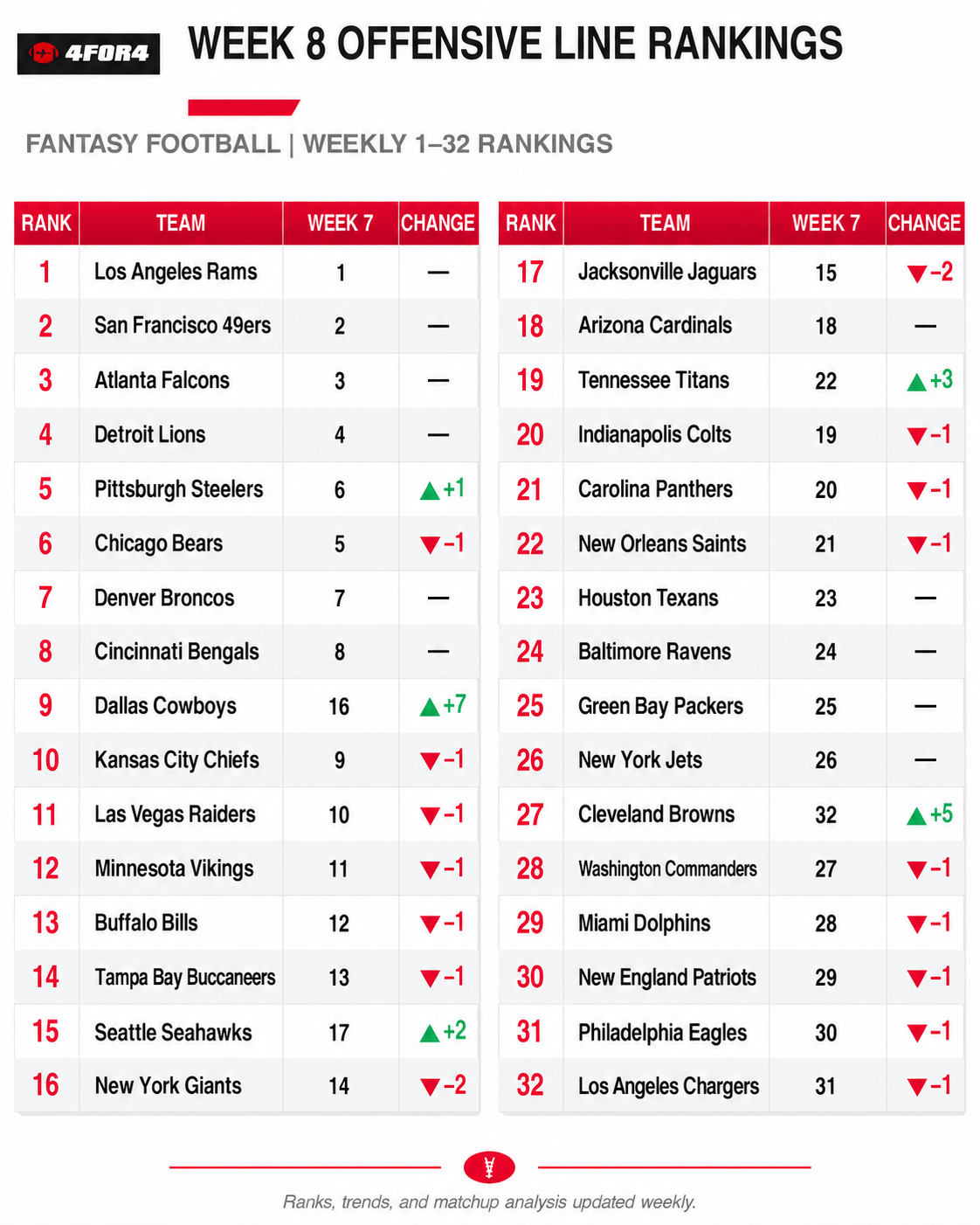 These rankings reflect overall offensive line performance, injuries, recent play, and how each unit is trending entering the week. The change column compares each team’s Week 8 ranking with its Week 7 ranking.
Biggest Offensive Line Risers and Fallers
Risers
Dallas Cowboys (+7)
Dallas makes the week’s largest jump after producing its most balanced blocking profile of the season.
The Cowboys rank first in adjusted sack rate (3.6%), ninth in adjusted line yards (4.51), and 10th in running back yards before contact (1.58). Their 34.8% pressure rate is closer to league average, but it has improved alongside the rushing results.
Dak Prescott has converted only 6.9% of his pressures into sacks, the lowest rate among qualifying quarterbacks. His pocket management deserves significant credit for the sack total, but the line is no longer relying solely on Prescott to keep the offense clean. Dallas moves from 16th to ninth with Tyler Smith back in the lineup and the broader results beginning to match the unit’s talent.
Cleveland Browns (+5)
Cleveland finally escapes the bottom spot after showing improvement in both phases.
The Browns remain last in adjusted sack rate and rank 27th in pressure rate, so this is not a declaration that the protection has become trustworthy. Deshaun Watson’s 23.8% pressure-to-sack rate has contributed to those results, but Cleveland’s +11.0% Pressure Rate Over Expectation still places substantial responsibility on the line.
The encouraging developments have come on the ground and at left tackle. Cleveland has climbed to 11th in running back yards before contact, while rookie Spencer Fano allowed only two pressures across 41 pass-blocking snaps against Tennessee. He also earned PFF’s highest run-blocking grade among all offensive linemen in Week 7.
The Browns still belong in the bottom quarter. Their recent improvement and Fano’s emergence no longer support ranking them last.
Fallers
New York Giants (-2)
New York ranks 16th in pressure rate, 13th in running back yards before contact, and fifth in blown-block rate. Its 8.4% adjusted sack rate looks worse than the disruption allowed, with Jameis Winston converting 25.0% of his pressures into sacks (J.J. McCarthy sits at 20.0%).
New York kept the Texans' pass-rushers at bay in Week 7, but this is more of a reflection of the season-long metrics and a couple of teams hopping them. They could find themselves right back where they were after the bye, with an extra week for Jermaine Eluemunor and Andrew Thomas to heal up.
Jacksonville Jaguars (-2)
Jacksonville’s fall is driven almost entirely by the season-ending loss of Anton Harrison.
The Jaguars’ results remain strong. They rank fifth in adjusted sack rate, sixth in pressure rate, seventh in Pressure Rate Over Expectation, and eighth in adjusted line yards. Walker Little also played well in Harrison’s place against Houston, giving Jacksonville a credible replacement at left tackle.
Little’s performance prevents a larger drop, but losing the starting blindside protector permanently lowers the unit’s depth and margin for error. Jacksonville moves from 15th to 17th while we evaluate the new configuration.
Week 8 Fantasy Impact Players Helped by Their Offensive Line Matchup
A strong or weak offensive line matchup shouldn’t completely override volume, talent, or game environment, but it can help break ties between similarly ranked fantasy options.
Among the biggest Week 8 beneficiaries:
- Dak Prescott and the Cowboys’ passing game: Dallas has climbed to ninth and faces an Arizona defense ranked 30th in QB aFPA. The Cardinals rank 29th in both pressure rate and defensive Pressure Rate Over Expectation, while Prescott’s pocket management and the line’s recent improvement keep him firmly in the QB1 conversation. CeeDee Lamb remains an elite option, while George Pickens carries strong WR2 appeal.
- Sam Darnold and AJ Barner, Seahawks: Seattle’s 15th-ranked line faces a Chicago defense sitting 28th in QB aFPA despite ranking third in defensive Pressure Rate Over Expectation. Darnold remains near the QB1/2 border, while Barner’s reliable route participation keeps him in the streaming conversation.
- Chase Brown, Bengals: Cincinnati ranks eighth up front and draws a Tennessee defense sitting 26th in RB aFPA. Brown belongs near the RB1/RB2 border in a game where the Bengals are favored by double digits and should have ample opportunity to lean on the run.
- Tyler Allgeier and Zonovan Knight, Cardinals: Dallas ranks 31st in RB aFPA and has produced approximately average results across the underlying run-defense metrics. Arizona’s run blocking remains inconsistent, but the matchup moves Allgeier into the FLEX conversation and gives Knight deeper-league appeal, assuming Jeremiyah Love remains sidelined.
- Jacoby Brissett and the Cardinals’ passing game: Arizona’s line has remained excellent in pass protection despite losing Paris Johnson Jr., ranking first in pressure rate allowed and fourth in Pressure Rate Over Expectation. Dallas ranks 27th in QB aFPA, although its 12th-ranked pressure rate makes this less of a free square than the matchup ranking suggests. Brissett remains in the streaming conversation, with Trey McBride and Michael Wilson carrying strong outlooks.
Best Quarterback and Passing Game Matchups
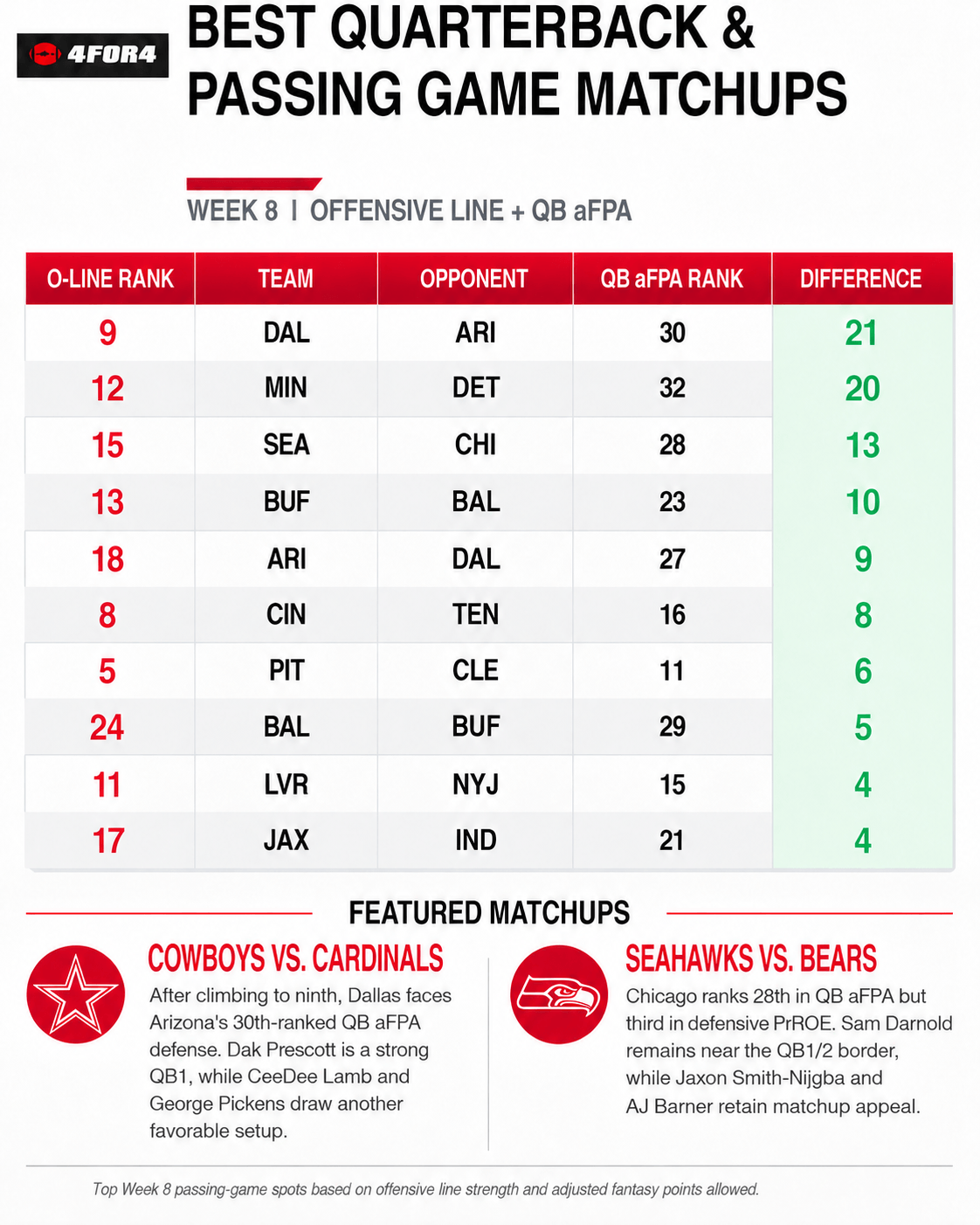
Cowboys vs. Cardinals
Dallas’ offensive line has begun performing like the unit its personnel suggested it could become. The Cowboys rank first in adjusted sack rate (3.6%), ninth in adjusted line yards (4.51), and 10th in running back yards before contact (1.58). Their 34.8% pressure rate is closer to average, but it has improved enough to provide Dak Prescott with a more stable foundation.
Arizona ranks 30th in QB aFPA while generating a 29.5% pressure rate with a -1.6% defensive Pressure Rate Over Expectation. Both marks rank 29th, giving Prescott one of the week’s cleanest combinations of opponent quality and limited disruption.
Prescott is particularly well-equipped to handle that split. He has converted only 6.9% of his pressures into sacks, the lowest rate among qualifying quarterbacks, and can be started comfortably as a QB1. CeeDee Lamb remains an elite WR1, while George Pickens carries strong WR2 appeal in one of the week’s better passing environments.
Seahawks vs. Bears
Seattle’s offensive line remains a work in progress, but the addition of Quenton Nelson raises the unit’s ceiling considerably.
Nelson arrives after allowing only eight pressures across 268 pass-blocking snaps with Indianapolis. Charles Cross’ high-ankle sprain creates immediate uncertainty at left tackle, but Nelson strengthens an interior that has contributed to Seattle ranking last in running back yards before contact.
Chicago presents a more complicated test than its aFPA ranking suggests. The Bears rank 28th in QB aFPA but have generated pressure on 37.8% of opposing dropbacks with a +8.4% defensive Pressure Rate Over Expectation, ranking ninth and third, respectively.
Sam Darnold remains near the QB1/2 border, although the pressure adds some volatility, while Jaxon Smith-Njigba remains an elite option at wide receiver.
AJ Barner also remains a viable tight end streamer. He ran a route on 83.3% of Seattle’s dropbacks in Week 7, comfortably above his 73.2% season-long rate, and caught all four of his targets for 42 yards. His 15% target-per-route rate leaves something to be desired, but the playing time is easier to trust than it is for most tight ends available in 90% of leagues.
Chicago ranks 16th in TE aFPA, making this a reasonable spot for Barner’s fantasy production to begin catching up with his route involvement.
Best D/ST Matchups
Bengals vs. Titans
Cincinnati has generated pressure on 38.4% of opposing dropbacks with a +5.8% defensive Pressure Rate Over Expectation. Those marks rank fifth and eighth, respectively, helping the Bengals produce a league-leading 3.5 sacks per game and climb to second in fantasy D/ST scoring.
Tennessee’s protection metrics are better than its 19th-place ranking suggests, but the offense continues to create favorable situations for opposing defenses. The Titans are averaging only 1.38 points per drive and a league-low 248.6 total yards per game. Cincinnati is favored by 10.5 points, the largest spread of the week, while Tennessee carries an 18-point implied team total. A pass-heavy trailing script should give the Bengals’ front plenty of opportunities to generate sacks and turnovers.
The Bengals are rostered in 27% of Yahoo leagues and belong among the strongest Week 8 streaming options.
Raiders at Jets
The Jets rank 26th in our offensive line rankings and have allowed pressure on 39.5% of their dropbacks. Their 8.9% adjusted sack rate ranks 28th, while Geno Smith has converted 22.3% of his pressures into sacks, the eighth-highest rate among qualifying quarterbacks.
Las Vegas has generated pressure on 35.6% of opposing dropbacks, the 13th-highest rate in the league. Its +2.7% defensive Pressure Rate Over Expectation is closer to average, but the matchup could end up evening that out.
The Raiders produced 10 sacks and forced nine turnovers through their first three games before facing the Chiefs, Patriots, Bills, and Rams. New York provides an opportunity for that early-season disruption to reappear.
Las Vegas is rostered in only 7% of Yahoo leagues. With the 49ers, Seahawks, and Broncos coming next, this should be treated as a one-week stream instead of a long-term hold.
Best Running Back Matchups
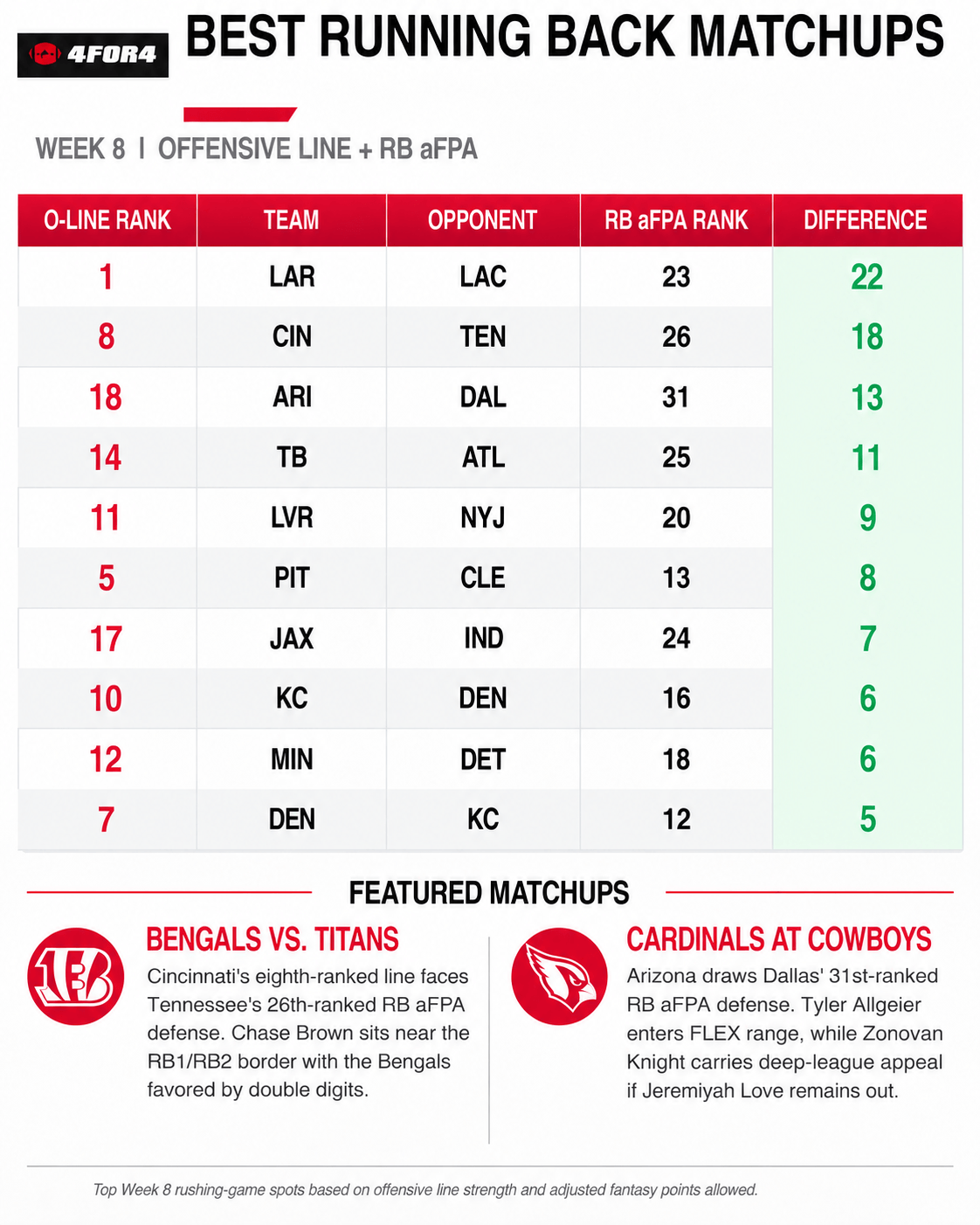
Bengals vs. Titans
Cincinnati’s eighth-ranked offensive line has been more impressive in pass protection than in the running game, but the Bengals still rank near league average in adjusted line yards and running back yards before contact.
Tennessee ranks 26th in RB aFPA while allowing a 51.4% rushing success rate and stuffing only 39.6% of opposing attempts, while allowing an explosive run on 4.1% of carries. That could encourage Cincinnati to lean more heavily on Chase Brown, particularly as a 10.5-point favorite against an offense carrying an 18-point implied team total.
Brown belongs near the RB1/RB2 border with a strong chance to benefit from positive game script. The matchup also raises his touchdown ceiling in a game Cincinnati should be able to control.
Cardinals at Cowboys
The Cardinals rank 27th in adjusted line yards and 24th in running back yards before contact, but Dallas sits 31st in RB aFPA. The Cowboys have also produced approximately average results in rushing success rate, explosive-run rate, and stuff rate.
Arizona’s excellent pass protection should help sustain drives, providing the backfield with more scoring opportunities even if the line does not consistently create clean rushing lanes.
Tyler Allgeier moves into the FLEX conversation, while Zonovan Knight remains a deeper-league option. Both recommendations depend on Jeremiyah Love remaining sidelined. If Love returns, the workload distribution would become too uncertain to treat either reserve as more than a speculative play.
Fantasy Players to Downgrade in Week 8
These players aren’t automatic sits, but their offensive line and defensive-front matchups lower their Week 8 ceilings:
- Baker Mayfield, Buccaneers: Tampa Bay’s 14th-ranked line faces an Atlanta defense ranking seventh in pressure rate and 10th in defensive Pressure Rate Over Expectation. Mayfield has converted 28.3% of his pressures into sacks, the highest rate among qualifying quarterbacks. He remains usable in Superflex formats but carries more risk than the Falcons’ middle-of-the-pack QB aFPA suggests.
- Caleb Williams, Bears: Chicago’s sixth-ranked line faces a Seattle defense ranking second in QB aFPA, third in pressure rate, and second in defensive Pressure Rate Over Expectation. Williams’ mobility keeps him usable, but the matchup pushes him toward more volatile QB2 territory.
- Jonathan Taylor, Colts: Indianapolis has fallen to 20th and will play its first game without Quenton Nelson. Jacksonville ranks eighth in RB aFPA and owns the strongest underlying run-defense profile in the league, holding opponents to a 41.8% rushing success rate while stuffing 51.9% of their attempts. Taylor remains a must-start option, but the matchup lowers his ceiling.
- D'Andre Swift, Bears: Chicago’s sixth-ranked offensive line remains a major positive, but Seattle ranks sixth in RB aFPA and has limited opponents to a 41.7% rushing success rate. The Seahawks lead the league with a 52.0% stuff rate and have allowed the second-lowest missed-tackle rate. Swift settles closer to the RB2 range in one of the week’s most difficult rushing matchups.

How These Offensive Line Rankings Work
These rankings are designed specifically for fantasy football and are not intended to function as a pure evaluation of NFL offensive line talent.
The weekly process incorporates injuries, projected starters, recent performance, individual line play, and opponent context. Metrics such as pressure rate, blown-block rate, adjusted sack rate, adjusted line yards, and running back yards before contact help identify how each unit is performing in pass protection and the running game.
Pressure Rate Over Expectation provides additional context by comparing a team’s actual pressure rate with the rate expected based on its quarterback’s time to throw. That helps identify whether a quarterback is creating additional pressure by holding the ball or whether the offensive line is allowing disruption more quickly than expected.
Pressure rate and blown-block rate receive particular consideration because they more directly reflect offensive line performance. Sack rate remains useful for fantasy purposes, but quarterback decision-making, mobility, and pocket management can significantly affect the final result. Pressure-to-sack rate helps separate those quarterback effects from the protection itself.
Penalties receive very little weight and are generally referenced only when they become an extreme or repeated part of a unit’s performance.
The offensive line rankings are then compared with 4for4’s adjusted fantasy points allowed to quarterbacks and running backs. aFPA improves upon raw fantasy points allowed by accounting for the quality of each defense’s opponents and updates weekly throughout the season.