NFL Offensive Line Rankings Week 2: Matchups to Exploit

 Make us preferred on Google
Evaluating offensive line play through a fantasy football lens can uncover matchup advantages that aren’t always obvious from traditional rankings or defensive fantasy points allowed.
Each week, we’ll rank all 32 offensive lines, track the biggest movers, and compare those units against the opposing defense’s adjusted fantasy points allowed (aFPA) to identify the quarterback, running back, and D/ST matchups most affected by play in the trenches.
For Week 2, the Rams, Cowboys, and Panthers stand out among the strongest offensive line and matchup combinations on the slate. The Saints, Titans, and Raiders face much more difficult paths, while teams such as Green Bay and Philadelphia present an interesting clash between offensive line concerns and otherwise favorable fantasy matchups.
With only one week of regular-season action available, these early aFPA rankings should be treated as an additional piece of matchup context rather than a settled evaluation of each defense.
Editor’s Note: Check out the complete set of Week 2 fantasy football rankings here.
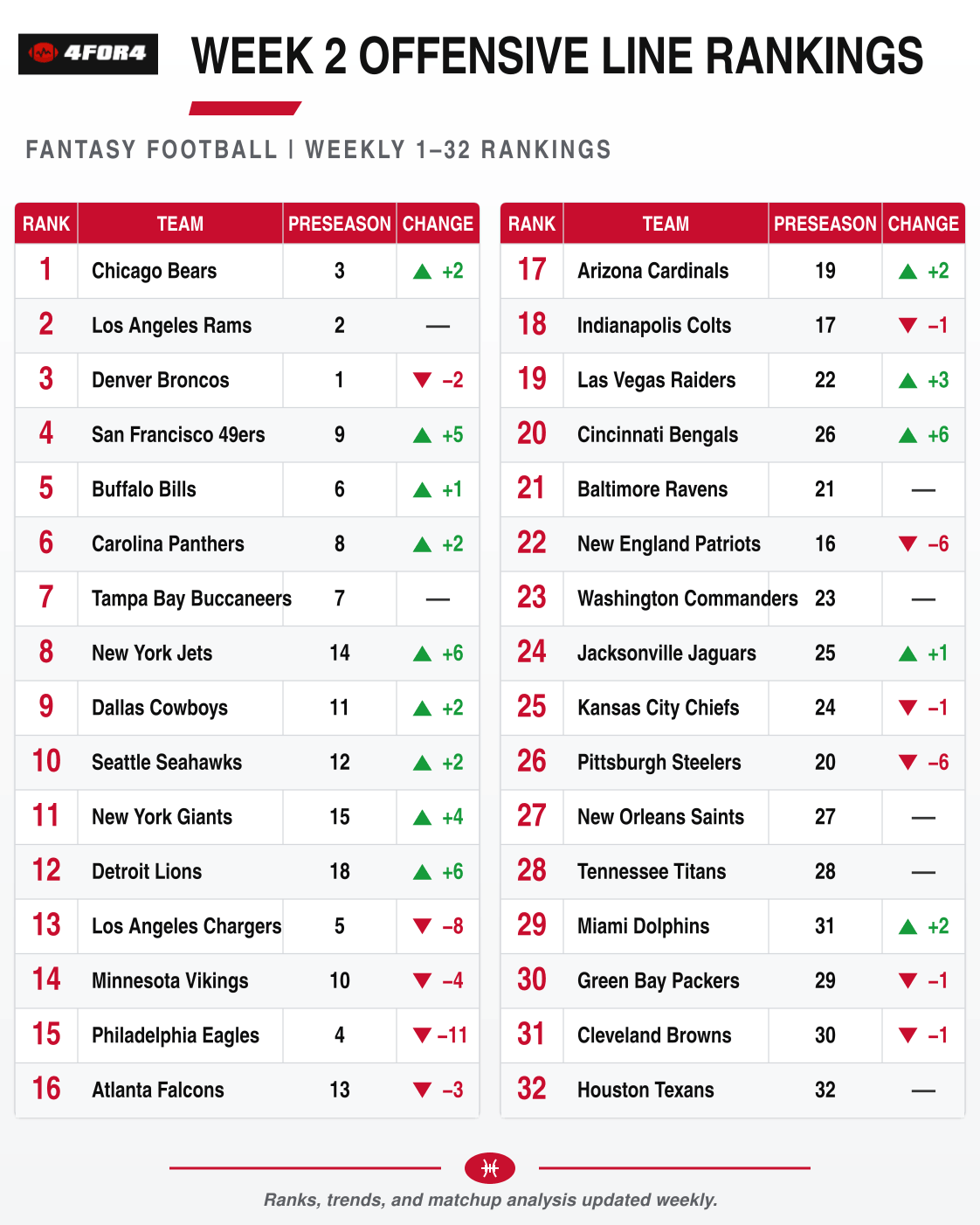
These rankings reflect overall offensive line performance, injuries, recent play, and how each unit is trending entering the week. For this opening update, the change column compares each team’s Week 2 ranking with its preseason ranking.
Biggest Offensive Line Risers and Fallers
Risers
Cincinnati Bengals (+6)
Cincinnati’s offensive line delivered one of the most encouraging Week 1 performances relative to preseason expectations, keeping Joe Burrow consistently clean against Tampa Bay’s pass rush.
He was pressured on only 24.3% of his dropbacks, while right tackle Amarius Mims allowed zero pressures in an intriguing individual matchup against first-rounder Rueben Bain Jr. The Bengals finished with a 3.2% adjusted sack rate and a 0.56% blown-block rate, providing an encouraging first look at a unit that entered the season ranked 26th.
The rushing efficiency was less impressive, and Houston presents a difficult Week 2 matchup, but Cincinnati showed enough in pass protection to climb six spots to No. 20.
Detroit Lions (+6)
Detroit’s reconstructed offensive line produced one of Week 1’s most complete performances, creating explosive rushing opportunities for Jahmyr Gibbs while keeping Jared Goff relatively clean.
The Lions finished with 5.25 adjusted line yards, 2.90 RB yards before contact, a 22.0% pressure rate, and a 0.69% blown-block rate. Detroit also led the league with seven runs of at least 10 yards, an encouraging start for a young unit that entered the season with several new pieces.
There are some immediate health concerns, though. Left guard Christian Mahogany exited Week 1, while rookie right tackle Blake Miller is dealing with a knee injury ahead of Thursday night’s matchup with Buffalo. Provided the line avoids multiple absences, its Week 1 performance warrants a six-spot jump to No. 12.
Fallers
Philadelphia Eagles (-11)
Philadelphia’s fall is driven by both its Week 1 performance and the loss of left guard Landon Dickerson, who has been placed on injured reserve with a lingering knee injury.
The Eagles finished Week 1 with only 3.24 adjusted line yards and 1.06 RB yards before contact. Jalen Hurts was protected reasonably well on the edges, but the interior struggled throughout the game. Dickerson was repeatedly beaten while attempting to play through the injury, Cam Jurgens committed two holding penalties, and Tyler Steen had difficulty consistently reaching his assignments in space.
Drew Kendall appears to be the leading candidate to replace Dickerson, although Philadelphia could consider a larger interior reshuffle. The Eagles still have two high-level tackles and draw a favorable Week 2 passing matchup against Tennessee, but the uncertainty inside pushes them from No. 4 to No. 15.
New England Patriots (-6)
New England’s inability to create movement in the running game was one of the clearest negative offensive line performances of Week 1.
The Patriots finished last in adjusted line yards at 2.71, while their running backs averaged only 0.33 yards before contact. Rookie left tackle Will Campbell held up reasonably well, but the line struggled to consistently open rushing lanes or handle Seattle’s pressure packages. The frequent use of cut blocks by Campbell and veteran right tackle Morgan Moses is another tendency worth monitoring.
Seattle can create protection problems for plenty of teams, so one performance does not completely erase New England’s preseason outlook. However, the Patriots now face a Pittsburgh defense ranked second in RB aFPA, creating another difficult environment for Rhamondre Stevenson and TreVeyon Henderson, should the sophomore suit up. New England falls six spots to No. 22.
Week 2 Fantasy Impact Players Helped by Their Offensive Line Matchup
A strong or weak offensive line matchup shouldn’t completely override volume, talent, or game environment, but it can help break ties between similarly ranked fantasy options.
Among the biggest Week 2 beneficiaries:
- Kyren Williams, Rams: The Rams’ second-ranked offensive line draws a Giants defense ranked 29th in RB aFPA. Los Angeles produced 4.87 adjusted line yards and 2.38 running back yards before contact in Week 1, giving Williams one of the strongest combinations of blocking and opponent quality on the slate.
- Dak Prescott, Cowboys: Dallas moved into the top 10 after finishing Week 1 with a 0.5% adjusted sack rate and zero blown blocks. Prescott now faces a Washington defense ranked 30th in QB aFPA.
- Javonte Williams, Cowboys: Williams benefits from the same favorable environment against a Washington defense ranked 30th in RB aFPA. His 16.2-point projection is one of the highest at the position, and Dallas’ offensive line should give him opportunities to remain efficient.
- Tetairoa McMillan, Panthers: Carolina’s sixth-ranked offensive line allowed pressure at one of the league’s lowest rates in Week 1 despite playing without both starting tackles. McMillan now faces an Atlanta defense ranked 30th in WR aFPA, raising the ceiling of the entire Panthers passing game.
- Jadarian Price, Seahawks: Seattle created encouraging rushing lanes for Price and George Holani in Week 1 and now faces an Arizona defense ranked 31st in RB aFPA. Price is not an automatic RB1 due to questions about goal-line and passing-game usage, but this matchup still gives him a very solid floor.
Best Quarterback and Passing Game Matchups
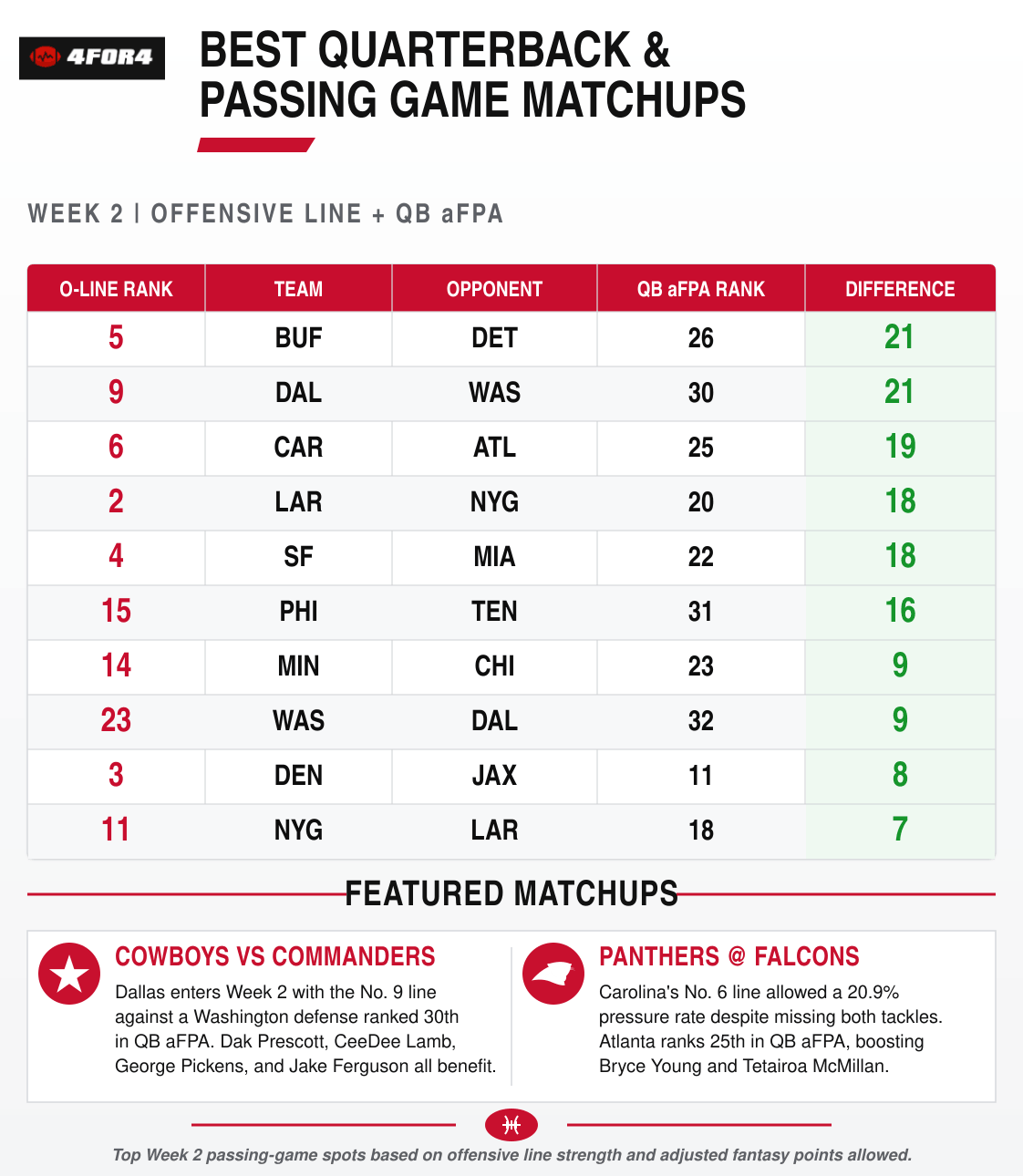
Cowboys vs Commanders
Dallas enters Week 2 with one of the slate’s strongest combinations of offensive line play and opponent quality. Even without Tyler Smith, the Cowboys finished Week 1 with a 0.5% adjusted sack rate and did not record a single blown block. The pressure rate was less dominant at 33.3%, but the overall performance was encouraging enough to move Dallas into the top 10 of these rankings.
Dak Prescott now faces a Washington defense ranked 30th in QB aFPA. The Commanders also rank 24th against wide receivers and 32nd against tight ends, creating favorable matchups throughout the Dallas passing attack.
Prescott projects for 19.6 fantasy points and belongs firmly in the QB1 conversation. CeeDee Lamb and George Pickens should both benefit, while Jake Ferguson can gobble up enough leftovers to be considered a fringe TE1/2.
Panthers at Falcons
Carolina’s offensive line entered the season with high expectations and immediately demonstrated why, even while playing without both starting tackles. The Panthers finished Week 1 with 5.43 adjusted line yards, 2.74 RB yards before contact, and a 20.9% pressure rate.
Bryce Young now faces an Atlanta defense ranked 25th in QB aFPA and 30th against wide receivers. Young projects for 16.2 fantasy points, putting him in the streaming and Superflex conversation in a matchup that should give him opportunities to push the ball downfield.
Tetairoa McMillan is the primary beneficiary and should be in a place to build on his 5-75-0 Week 1, while Jalen Coker has plenty of upside to consider as a WR3/FLEX.
Fantasy Football D/ST Matchups to Target
49ers D/ST vs Dolphins
Miami’s offensive line enters Week 2 as one of the league’s most obvious units to target. The Dolphins allowed a 15.7% adjusted sack rate in their opener while finishing with a 37.8% pressure rate, 4.0% blown-block rate, and only 3.11 adjusted line yards. Those problems affected both phases of the offense and contributed to Miami falling to No. 29 in this week’s offensive line rankings.
San Francisco generated pressure on approximately 41% of the Rams’ dropbacks in Week 1 despite failing to turn much of that disruption into sacks. The 49ers should have more opportunities to finish those plays against Malik Willis and a Miami line that struggled to prevent immediate penetration.
Buccaneers D/ST vs Browns
Cleveland produced the league’s worst adjusted sack rate in Week 1 and now takes another unstable offensive line into Tampa Bay. Deshaun Watson was sacked five times as the Browns finished with an 18.9% adjusted sack rate and a 46.7% pressure rate. Cleveland also generated only 3.23 adjusted line yards, leaving the offense without much support from its rushing game.
The Browns played without Teven Jenkins in the opener, and Jenkins and center Parker Brailsford remain worth monitoring. Even with improved health, this is a line that ranks 31st entering Week 2. Watson’s tendency to hold the ball can add to the offensive line’s sack totals, but the extremely high pressure rate shows that the problems extended beyond the quarterback. Tampa Bay carries substantial sack and turnover upside in this matchup.
Best Running Back Matchups
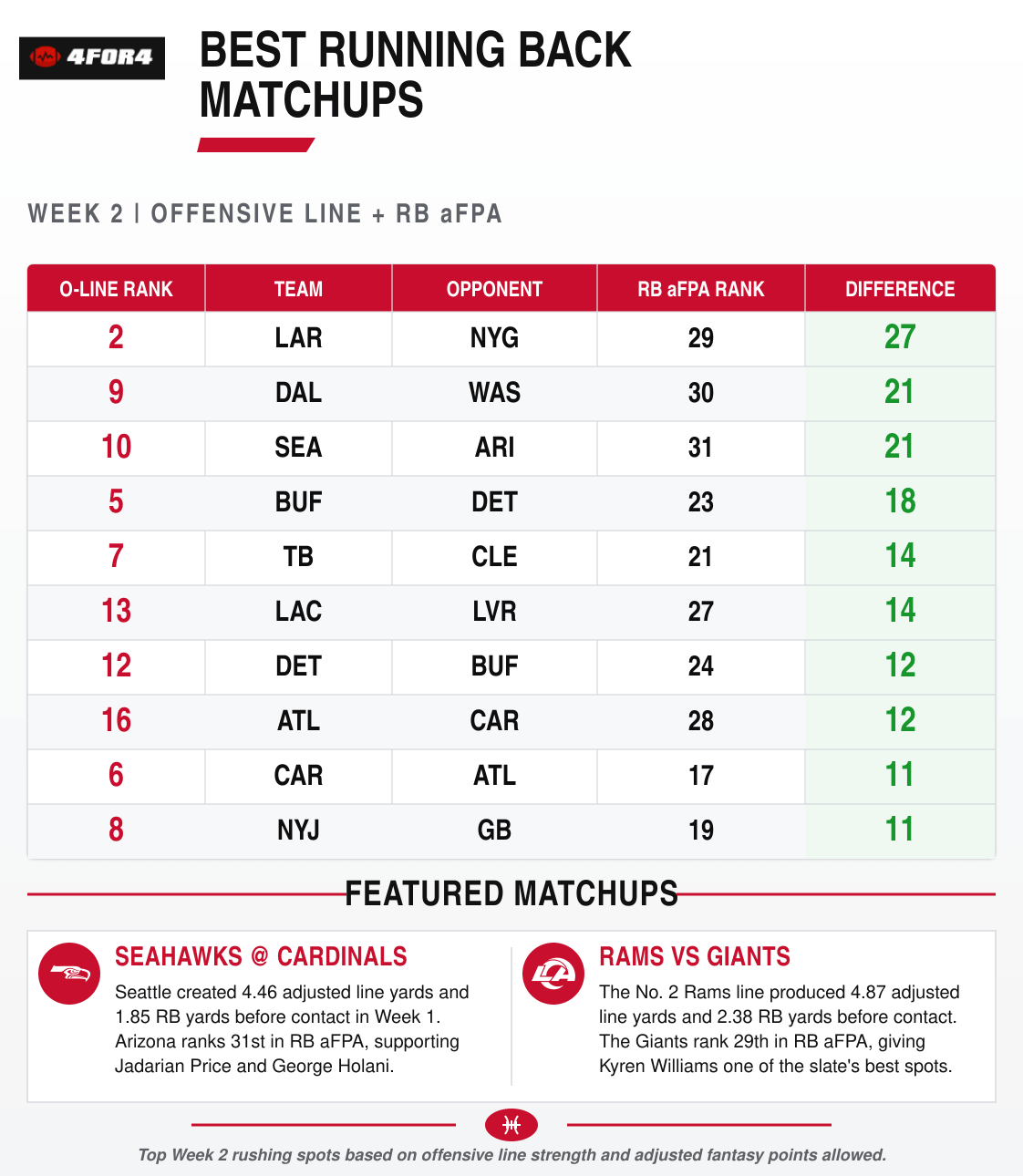
Seahawks at Cardinals
The Seahawks finished Week 1 with 4.46 adjusted line yards and 1.85 running back yards before contact. The pass-protection numbers were less impressive, but Seattle consistently created usable rushing lanes for Jadarian Price and George Holani.
Arizona enters Week 2 ranked 31st in RB aFPA. That matchup should give Seattle an opportunity to lean on the running game and keep Drew Lock out of obvious passing situations.
Price projects as a fringe RB2/3 and is the preferred option in the backfield, although his exact workload remains somewhat uncertain. Holani is more of a desperation play that will need to find his way into the end zone for fantasy usability.
Rams vs Giants
The Rams’ pass protection deserves monitoring after allowing a 44.8% pressure rate in Week 1, but the offensive line was considerably more effective in the running game; Los Angeles finished its opener with 4.87 adjusted line yards and 2.38 running back yards before contact.
Kyren Williams has consistently shown that splitting time with Blake Corum has next to no impact on his fantasy RB2 projections, but Corum can also pop for some FLEX-worthy weeks; those just might be more realistic for your starting lineup when we encounter bye weeks.
Running Backs to Downgrade in Week 2
These players aren’t automatic sits, but their offensive line and defensive-front matchups lower their Week 2 ceilings:
- Rhamondre Stevenson, Patriots: New England ranks 22nd after producing the league’s lowest adjusted line yards and only 0.33 running back yards before contact. Pittsburgh ranks second in RB aFPA. His workload should keep him in RB2-land regardless.
- Travis Etienne, Saints: New Orleans enters the week ranked 27th and travels to face a Baltimore defense ranked first in RB aFPA.
- Ashton Jeanty, Raiders: Las Vegas delivered an excellent Week 1 blocking performance, but the line remains 19th while the Chargers rank fifth in RB aFPA. Jeanty’s workload keeps him in lineups, although the matchup lowers his efficiency ceiling.
- Jeremiyah Love, Cardinals: Arizona ranks 17th and faces a Seattle defense ranked third in RB aFPA. His modest 9.2-point projection leaves little room for an inefficient rushing performance.

How These Offensive Line Rankings Work
These rankings are designed specifically for fantasy football rather than as a pure evaluation of NFL offensive line talent.
The weekly process incorporates injuries, projected starters, recent performance, and individual line play. Metrics such as pressure rate, blown-block rate, adjusted sack rate, adjusted line yards, and running back yards before contact help identify how each unit is performing in pass protection and the running game.
Pressure rate and blown-block rate receive particular consideration because they more directly reflect offensive line performance. Sack rate remains useful, but the quarterback’s decision-making, mobility, and time to throw can significantly affect the final result.
The rankings are then compared with 4for4’s adjusted fantasy points allowed to quarterbacks and running backs. aFPA improves upon raw fantasy points allowed by accounting for the quality of each defense’s opponents. That adjustment becomes increasingly useful as the season progresses.
With only one regular-season game available, Week 2 aFPA rankings remain a small-sample matchup indicator rather than a complete evaluation of each defense. Combining those early results with offensive line strength, injury information, and expected player usage provides another way to identify fantasy situations where play in the trenches could create an additional advantage.