Who Should I Draft with the 9th Pick in Fantasy Football

 Make us preferred on Google
The ninth pick in fantasy drafts puts us right on the other side of what has become a fairly defined opening tier. According to our Multi-Site ADP Tool, the first eight selections are pretty stable across the market, leaving James Cook, CeeDee Lamb, Ashton Jeanty, and Justin Jefferson as the four most likely options sitting in front of us. There’s enough disagreement between individual platforms to make this an interesting decision, particularly with two very different running back profiles and two superstar receivers coming off seasons that left fantasy managers wanting more.
Below, we are going to take a look at those four options and whittle them down to decide on our optimal pick in each scoring format.
RB James Cook, Bills
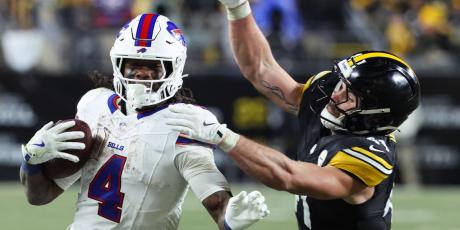
James Cook might be the least exciting answer of the four, but sometimes “just take the good running back on the great offense” is perfectly reasonable advice.
Cook followed his 16-touchdown 2024 season with 1,621 rushing yards and 12 rushing scores on a career-high 309 attempts last year. More importantly for projecting his 2026 fantasy role, those touchdowns haven't simply materialized from long-distance runs. Cook has handled 31 rush attempts from inside the opponents’ five-yard-line over the last two seasons, and though that’s nothing to scoff at, that ranks a decent eighth among the league’s running backs.
That’s due in large part to none other than Josh Allen, who has 28 attempts (and 18 touchdowns) in that exact same situation.
There is also very little chance Cook suddenly turns into one of fantasy's highest-volume receiving backs, which places more pressure on his rushing and touchdown production than some of the other top-15 options.
Still, Cook has now produced consecutive seasons with 14+ total touchdowns, and Buffalo has given us no indication that it suddenly wants him to stop handling the bulk of the traditional rushing work. Prior to his two-snap Week 18, Cook was second behind only Jonathan Taylor (309) with 307 rush attempts while ranking 8th in team rushing share (60.9%). This was with Ray Davis and Ty Johnson each handling 37 attempts apiece, so the early-down rotation was practically non-existent.
The addition of D.J. Moore should improve the passing attack, but a better overall offense can just as easily create more scoring opportunities for Cook as it can take carries away. At the 1.09, we're paying for a strong floor rather than trying to project an entirely new role.
WR CeeDee Lamb, Cowboys
If we're looking for the player in this group whose 2025 fantasy output has the easiest path to bounce back, CeeDee Lamb has a very good argument.
Lamb's 2023 mega-breakout produced 135 catches, 1,749 yards, and 14 total touchdowns, but things have been a little shakier since then. We saw a WR10 season in 2024, but last season he missed 3.5 games and found the end zone only three times, finishing as the WR14 (11.7 half-PPR points per game).
The good news is that a lot of the scoring decline looks unsustainable. Lamb scored on only two of his 17 red-zone targets last season, an 11.8% conversion rate that was less than half the league average and the worst mark of his career. Despite all of that, his 9.2 yards per target remained slightly above his 8.9 career average, thanks in part to Dak Prescott attempting 73 passes 20 or more yards down the field, his highest mark since the 2019 season.
George Pickens unquestionably changes the potential ceiling. Lamb is unlikely to get back to the ridiculous 30% target-share neighborhood of 2023 while playing alongside another legitimate WR1, and Pickens gave Prescott another highly efficient option last season. But that's also part of why we're talking about Lamb at the ninth pick instead of the first three. A healthy 17-game season alone should add a meaningful chunk of raw opportunity, and even moderate positive touchdown regression could get him right back into the overall WR1 conversation.
RB Ashton Jeanty, Raiders
Ashton Jeanty's rookie season reminded us that volume alone can't fully overcome a terrible offensive environment.
Jeanty finished as the RB17 in half-PPR scoring, which certainly wasn't as much of a disaster as people want to remember it as, but it was underwhelming relative to a back-end Round 1 price. The underlying numbers tell a pretty encouraging story about why things didn't go better. The Raiders finished 31st in RB yards before contact (0.72) while Vegas backs had a league-leading 52.1% hit-at-line rate (contacted at or before the line of scrimmage). With those numbers in mind, it’s almost unfathomable that Jeanty finished behind only Bijan Robinson (28.9%) and Jahmyr Gibbs (25.1%) in broken-plus-missed-tackles forced and eighth in PFF’s elusive rating (80.2).
In other words, the rookie was still creating plenty on his own. The Raiders simply weren't creating much for him.
Las Vegas apparently got the message. The Raiders led the league with +$28.3 million in net offensive line spending this offseason, with former Ravens center Tyler Linderbaum —a 92nd-percentile run blocker— headlining the additions. If that unit can simply get Jeanty to the line of scrimmage without a defender already hanging off him, the Year 2 efficiency jump could be massive.
The only thing that could complicate the sophomore breakout case is Jeanty’s health. He went down during Sunday’s practice while diving for a pass and initially couldn’t put weight on his right leg, but Adam Schefter later reported that the injury is believed to be a sprained ankle and is not considered a long-term issue.
That’s about as good of an update as fantasy managers could have hoped for given how concerning the scene looked initially, but there is still some uncertainty. A moderate sprain could put Week 1 in jeopardy, while a high-ankle sprain could linger longer and potentially cost him multiple games.
Nobody wants to spend a first-round pick on an injured player, but this doesn’t sound serious enough to completely fade Jeanty at the 1.09. I’d still be comfortable drafting him in this range while keeping a very close eye on practice reports and any updated recovery timeline over the next couple of weeks.
WR Justin Jefferson, Vikings
It feels strange to frame Justin Jefferson as something of a post-hype selection, but that's where we've landed after the worst statistical season of his career.
Jefferson still saw 141 targets last year, but he turned them into only two touchdowns while posting a career-low 59.6% catch rate. Prior to 2025, Jefferson had scored on 5.5% of his career targets — once every 18.3 looks. Last season, he scored once every 70.5 targets.
Based on historical touchdown rates and where his targets came from, Jefferson was expected to score 6.8 touchdowns last season rather than two. You don’t have to look too hard to find the culprit. J.J. McCarthy’s 63.0% on-target rate was quite literally the worst mark in Sports Info Solutions’ database (min. 150 pass attempts), which dates back to the 2015 season. It got even worse in the red zone, where he completed only 16 of his 35 attempts (45.7%) with an on-target rate of 53.1%.
While Kyler Murray isn’t a stand-in-the-pocket gunslinger, he still offers a legit path to league-average quarterback play, and we’ve seen Jefferson thrive with that kind of archetype over and over again throughout his career.
Kevin O’Connell has coaxed some great football out of middle-of-the-road QBs over the years, and that’s enough for me to remain interested in the wide receiver. Jefferson isn't suddenly an ordinary receiver because of one miserable touchdown season, and 140+ targets with positive scoring regression could quickly make an end-of-Round 1 price look silly.
The difference between him and Lamb is simply that I trust the Cowboys' quarterback environment more.
Who Should You Draft?
James Cook, CeeDee Lamb, Ashton Jeanty, and Justin Jefferson all belong in the conversation at 1.09, but the scoring format makes the decision a little easier for me.
In PPR, my choice is CeeDee Lamb. A healthy season should immediately restore a chunk of the volume he lost in 2025, and his absurdly poor touchdown conversion gives him an easy avenue toward fantasy regression even with George Pickens commanding a large piece of the Dallas passing game.
In half-PPR and standard, I'm taking James Cook. He has already demonstrated that Buffalo is willing to feed him 300 carries and valuable red-zone work, and two consecutive seasons with 14+ touchdowns give us a much stronger scoring foundation than we're getting from most backs near the end of Round 1.
Jeanty would be my second choice in the non-PPR formats, but his ankle sprain does have some bearing here. His Year 2 ceiling might ultimately exceed Cook's if Las Vegas' offensive line investments pay off, but Cook requires considerably less projection. Jefferson would be my second receiver in PPR; the talent and target volume remain elite, but the Cowboys are currently projected for the sixth-highest team total in the league while the Vikings are resting near No. 20.
My pick at the 1.09 in each format:
- PPR: CeeDee Lamb
- Half-PPR: James Cook
- Standard: James Cook
Lamb's reception ceiling and likely positive touchdown regression make him my preferred wide receiver when catches are fully rewarded, while Cook's combination of rushing volume, red-zone usage, and scoring environment makes him the safer bet as receptions become less important.