Trends from 2025 That Matter

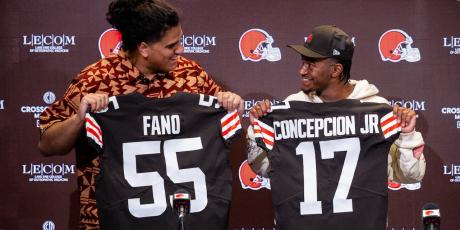
It’s fitting to do this trend article right after the NFL Draft because it’s one of the few times that teams show us what they’re truly thinking. They actually have to make decisions that reveal their thoughts on the state of the league. And an obvious trend from the 2026 draft is that teams are prioritizing TEs. From 2016-2022, teams drafted an average of 2.4 TEs in the first two rounds of the draft. They’ve drafted at least five early-round TEs in three of the last four drafts. Today, let’s dig into the broad trends that are causing this shift before looking at each fantasy-relevant position.
It’s All About Explosives
We’ve seen big changes on the defensive side of the ball over the last five years. Defenses have been less reactive to what opposing offenses are doing and more premeditated in their schemes. They’re more dynamic and have gotten both lighter and faster. And that’s because they’re almost singularly focused on limiting explosive passing plays and are willing to trade a higher rushing success rate to meet their goal. And yes, they’re using two-high safeties to limit explosive passes, but that’s been around forever. A key element of recent defensive play is their post-snap rotations. They show the QB one thing pre-snap and then change the coverage completely after the snap. That’s made a QB’s ability to quickly process defenses more important than ever.
Offenses have responded to these defensive changes by getting bigger. If the defense keeps an extra defensive back on the field against heavy personnel, then the offense wants to punish them on the ground. And if the defense switches back into their base defense against a heavier set, then the offense should be able to attack them through the air. It’s harder for a defense in their base set to use post-snap rotations because they have fewer defensive backs on the field to execute the shift. TEs are a critical element of the current offensive response. They need to be able to run block to punish a defense in nickel on the ground and be an excellent receiver to punish a defense in base through the air.
A TE will never be as good as an offensive lineman in run blocking. And they are not as good as a slot WR in running routes (with few exceptions). They have to be able to do both at a level high enough to pose a real threat to the defense, regardless of the play call. So, it’s not enough to just draft any TE. You have to draft a TE that can do everything well enough. Some teams clearly get that, like the Rams. And some teams clearly don’t, like the Jaguars. Here are Nate Boerkircher’s receptions by season in his first four years of college: two, six, five, and six. The Jaguars just took this player in the second round!
Plays, Pace, and PROE
But enough about the Jaguars. What are these offensive and defensive trends actually changing? Let’s look at the number of plays per game. The graph below shows the last five years of data. The blue line shows the average number of offensive plays per game. And the green line shows starting field position. A part of the big drops in plays we’re seeing is an increase in run rate, which we’ll get to next. But it’s also directly correlated with the implementation of the new kickoff rule in 2024. Offenses started almost two full yards closer to their opponent’s endzone last season compared to 2023, and that naturally reduces play volume.
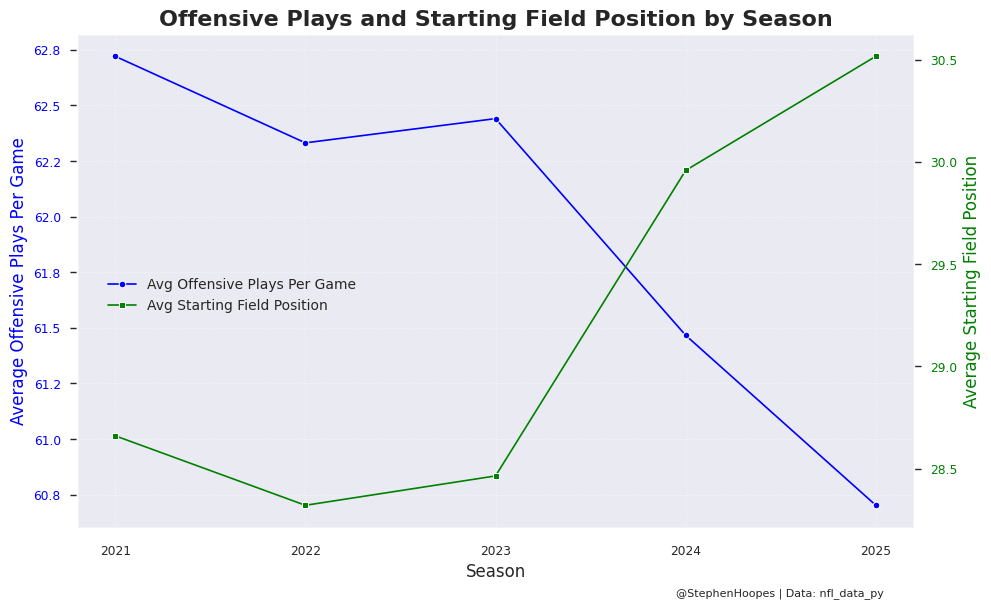
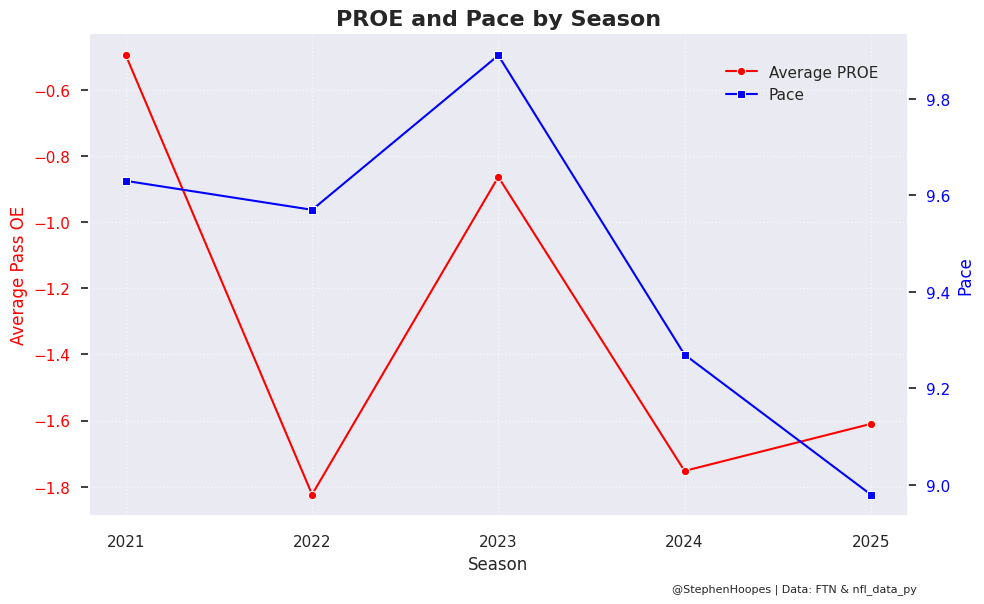
Simultaneously, offenses are running more often in response to the defensive focus on eliminating explosive passes. The average pass rate over expected (PROE) in 2025 was over a full percentage point lower than in 2021. And those run plays keep the play clock running compared to an incomplete pass. In turn, they limit the number of plays an offense can execute in a game. Similarly, teams have operated at a slower pace in neutral situations. They took almost a full additional second off the clock per play in 2025 compared to 2023, according to FTN.
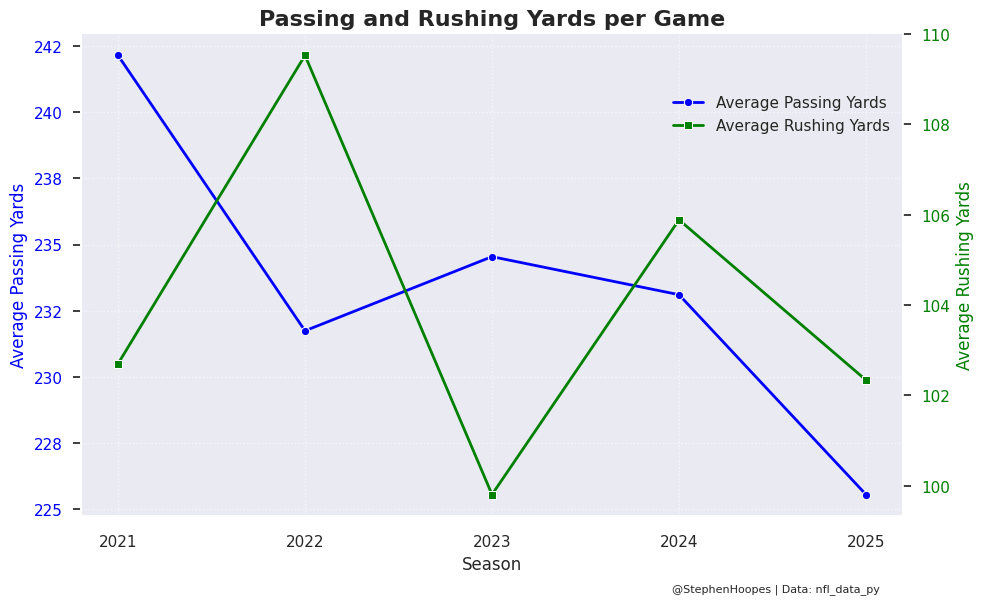
And we’re seeing the reduction in play volume, the shift toward the run, and the slower pace hit passing yards the most. The graph below shows passing yards per game in blue and rushing yards per game in green. It’s not like rushing yards are up over the last five years. They’re more stagnant despite the increased focus on running the ball. But passing yards have plummeted. They’re down about 17 yards per game compared to 2021. And it’s important to remember this context as we see more TEs and fewer WRs on the field during passing plays.
The graph below shows the share of dropbacks with two or three TEs on the field in purple. And then the orange line is the number of WRs with at least a 50% slot rate. Multi-TE sets have increased by about five percentage points since 2022. A fun team to look at here is the Rams. Here are the Rams’ number of dropbacks with three TEs on the field over the last five years: two, zero, one, one…and then 132 last year.
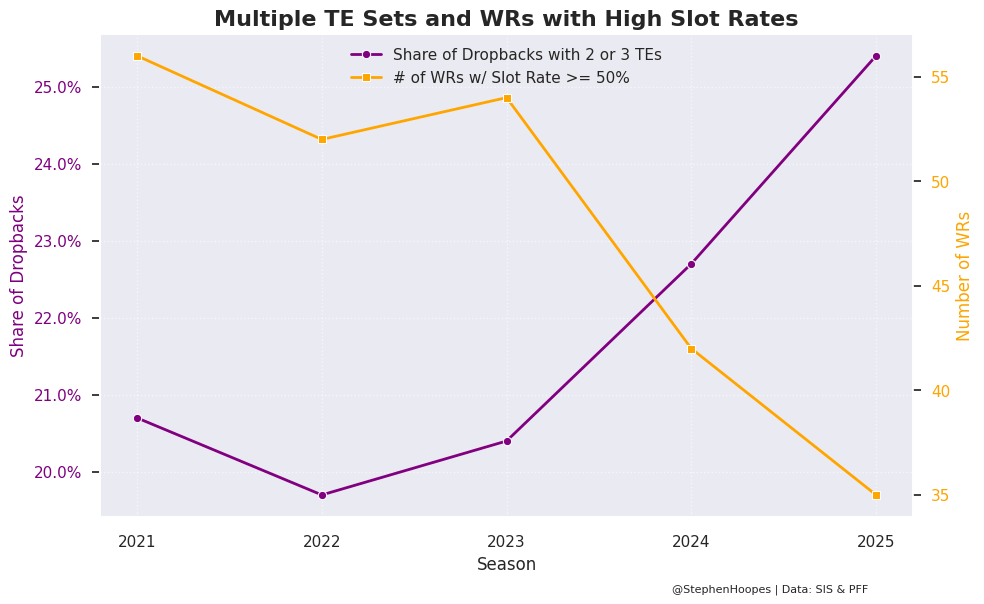
Looking at the league’s decision-making in the draft, I assume this accelerates even further in 2026. And what we’ll see below is that it has harmed secondary WRs, especially slot WRs, the most. By average fantasy points per game, the cohort of slot WRs is not wildly off compared to previous seasons. But the biggest change is the total number of them that get on the field in that role anymore. We’ve lost 20 WRs with high slot rates across the league in only two seasons. Let’s turn to look at how these trends impact each position now.
Quarterback Scoring Has Flattened
The table below shows the fantasy points per game scored by QBs in each of the last five seasons. The formatting is based on the row, not the column. That just means if a cell is dark blue, it’s the highest a QB of that rank scored over the last five seasons. And white/light blue means it was the lowest. For example, the 24.9 fantasy points per game scored by the QB1 in 2025 was the lowest a QB1 scored over the last five seasons (minimum of eight games played). And that’s true for QB2, QB3, and QB4.
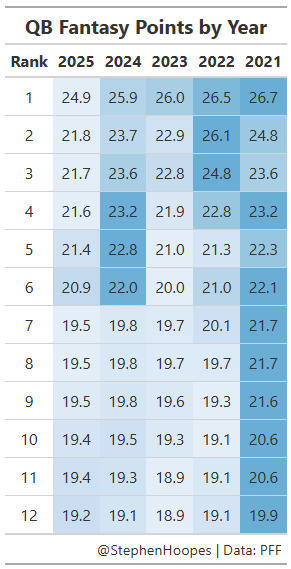
At the same time, QBs seven through 12 have been stable over the last four seasons. That reduces the advantage you get by drafting an elite TE if they’re separating less from a QB you can take later in the draft. Why is this happening? Well, we’ve already seen that passing yards are declining with the new defensive meta. That’s obviously not great for QBs. But QB rushing is also part of the story.
The graph below shows average QB scramble rate in blue. It’s a very clear trend with QB scrambles increasing almost linearly year-over-year. The green line is a bit harder to explain. It’s the highest number of scramble yards that any team reached each season. So, the scramble rate continues to climb every year, but no individual team or QB is lapping the field (at least last season). I stole this stat from Ben Gretch, but Josh Allen’s league-leading 579 rushing yards last season was the lowest number for a QB league leader since 2009.
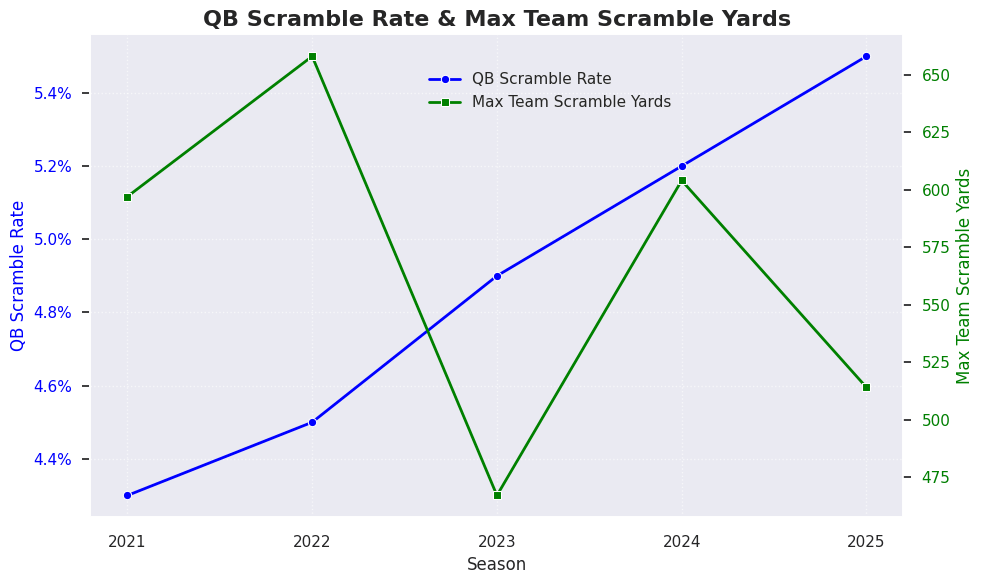
The reduced rushing of the early-round QBs, along with the increased rushing of later-round QBs, makes the opportunity cost of those earlier guys more difficult to take. We’re already seeing the market adjust to this in best-ball drafts. It’s basically Josh Allen in a tier of his own, and then it’s the cheapest we’ve seen the next tier of guys go in recent memory. And the mid-tier QBs are more expensive than ever, especially in 20-round drafts where drafting three QBs is optimal.
Top-End RB Scoring is Back
The table below is the same idea as the one for QBs. This is half-PPR scoring with a minimum of eight games played. Here’s what we’ve seen in recent seasons from RBs. They’ve stayed healthier than ever, especially those we’ve drafted early. They’ve seen the share of carries increase relative to expectation. And the run rate within an opponent’s 5-yard line has increased from 48.8% in 2021 to 51.5% in 2025. That’s great news for elite RBs.
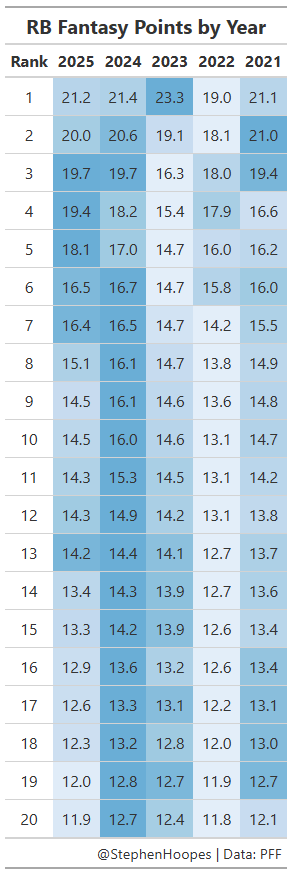
RBs three through seven either set or nearly set new highs in 2025 relative to the previous four seasons. And it’s not just that top RBs are scoring more. It’s crucial to take into account where in drafts you got those players. Every single one of these players was drafted in the first three rounds last year. The difference-making RBs that are separating from RB2s are both identifiable and costly in drafts. The market is again already adjusting for this in early drafts.
It gets ugly *fast* at RB after round three this year. You’re limited to just a handful of upside bets at the position, almost exclusively from second-year players with volume or offensive question marks like TreVeyon Henderson, Quinshon Judkins, RJ Harvey, and Bhayshul Tuten. And we didn’t get bailed out by the 2026 rookie class, with only one RB drafted in rounds two or three. There is no guarantee that the biggest RB hits will always come from the top of the draft board. But I’m also not seeing nearly enough high-upside bets available in the later rounds to justify a zero-RB approach.
The Hollowing-Out of WR2s
The table below is dark for WRs. Here’s a recap of what we said above. The league is passing less often with defenses keying in on explosive pass attempts. The league is playing slower. Even when a QB drops back, they’re scrambling at a higher rate than ever. And more and more WRs are being taken off the field for TEs. I guess it shouldn’t be a surprise that the table is rough.
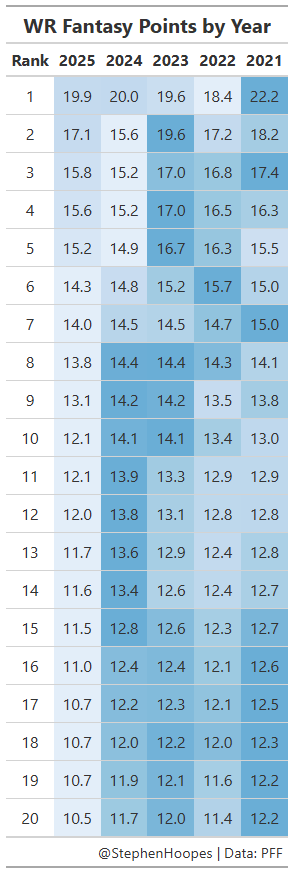
WRs one through five hung in there last year. They were down in general, but at least not the lowest in recent years. But last year was the lowest that WR6 through WR20 scored in any of the last five seasons. Woof. If this were to continue, it would increase the relative value of the very elite WR1s. If they’re separating more from the next tier of WRs, then they’re more important to our championship-winning roster. The issue again is that these guys are known. So, the biggest takeaway is to prioritize other positions after the very elite WRs because the next batch isn’t separating from WRs that you can take later in the draft.
TE is *Gulp* Deep This Year?
We seem to say that TE is deep every year, only to hit Week 14 of the season, and there are essentially three TEs you care about at all, and the rest are awful. But the scoring flattened last year, similar to that for QBs. I don’t think this has to be the case moving forward. Brock Bowers was stuck on a Raiders offense that was incapable of protecting Geno Smith for more than a second. And then Colston Loveland started to truly ascend at the very end of last year. I think the top end of the position is capable of putting up stronger numbers in 2026 compared to 2025.
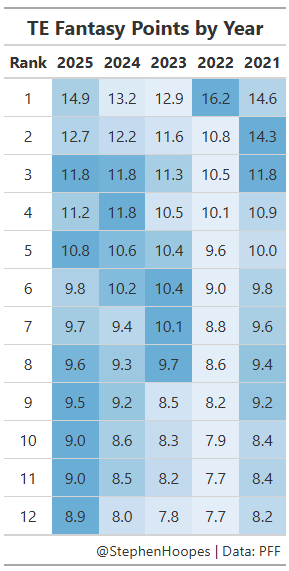
But we are seeing later-round TEs deliver more points than ever. They’re simply on the field more often in passing situations, largely at the expense of slot WRs. And the opportunity cost of a Trey McBride or a Brock Bowers is especially high this year, in my opinion. What I said above is that the very elite WRs are separating more from the WRs you can select later in the draft. Meanwhile, there are very few high-upside RB options after the third round, especially with a weak rookie RB class. Having to take one of the top TE options comes with an extremely high opportunity cost in early drafts. And so, I’m finding myself waiting on TE at least until Loveland in most cases.

Bottom Line
- Defenses are almost singularly focused on stopping explosive pass attempts, using more defensive backs, two-high shells, and post-snap rotations to make life harder on QBs.
- Offenses have responded by putting heavier sets on the field, using more TEs to run block against nickel defenses, and exploiting pass advantages against base defenses.
- But the net result is that offenses are running more often.
- When you combine the increased run rate and fewer explosive passes with a slower pace and shorter fields, passing play volume and yards are down sharply.
- And that directly hurts QB scoring. But we’re also seeing a trend where QB rushing is increasing, especially among later-round QBs, lowering the advantage you get from selecting an elite option at the position.
- RBs are benefitting a lot from recent NFL trends, especially as the run rate within an opponent’s 5-yard line has increased from 48.8% in 2021 to 51.5% in 2025.
- The issue in drafts is difference-making RBs that are separating from RB2s are identifiable and costly, with high-upside bets hard to find after the third round.
- WRs, particularly WR2s and slot WRs, are harmed the most by recent trends, with pass play volume concerns made even more extreme by TEs replacing WRs on the field.
- TEs are obviously big beneficiaries of recent changes, but with later-round TE scoring up and the opportunity cost of early-round TEs higher than ever, I’m personally finding it difficult to take McBride or Bowers in early drafts.