John Paulsen's 2026 March Madness Bracket Picks and Tips

 Make us preferred on Google
March Madness is once again upon us, and since I have a bit of free time during the lull in NFL free agency, I thought I’d write an article for 4for4 subscribers outlining the process I use to fill out my bracket. I tend to do quite well in my pools, and it’s rare that my bracket isn’t in the hunt heading into the Final Four.
Two years ago, I correctly picked the overall winner (UConn) and the runner-up (Purdue). Last year, I correctly picked Florida to make the final, but incorrectly picked Duke to win.
Not surprisingly, my process is statistics-driven, utilizing the following tools:
-
Pomeroy ratings (overall, offensive efficiency, defensive efficiency)
-
Bracket Breakers (The Athletic)
-
The Power Rank (TPR)
Note: While I have plenty of data to use, I’ll admit that I’m not the most informed when it comes to key injuries to specific teams, so feel free to hit me up on Twitter (or email support) to let me know if I’ve overlooked something.
Hosting your own pool? Here’s a tip.
I’m in a long-running pool that has standard scoring with one caveat: For the first two rounds only, if someone correctly picks a (seed) upset, they are awarded the appropriate points for the win PLUS the difference in the seeds. For example, if a 10-seed beats a 7-seed in the first round, they would receive one point for the win plus three points (10 minus 7) for the upset, for a total of four points. It makes the first weekend even more fun when people are encouraged to pick upsets. (It’s also the smart thing to do in most matchups.)
Pool Genius
If you don't like my analysis, our friends over at Team Rankings have a feature called Pool Genius that can help you fill out your bracket.
- Build a fully optimized March Madness bracket in under a minute. No research required.
- $2.5M+ in reported subscriber winnings since 2017, with 52% of users winning a pool each year.
- Uses real public pick data and advanced simulations to uncover smart contrarian edges.
Pomeroy Ratings
Ken Pomeroy’s site has been a predictive tool for years.
In the last 17 years…
-
Sixty of the 68 Final Four (88.2%) teams went into March Madness ranked inside the Top 20 in KenPom overall rankings.
-
Nine of the past 17 NCAA champions (52.9%) were rated No. 1 at KenPom heading into the tournament. Florida was the No. 2 team last year.
In the last 23 years…
-
Twenty-one of the last 23 national champions (91.3%), including UConn’s back-to-back championship-winning teams and Florida last season, have entered the tournament Top 21 in offensive efficiency and Top 37 in defensive efficiency. I’ll call this the 21/37 Rule moving forward.
-
The last eight national champions entered the tournament in the Top 6 in offensive efficiency.
CBB Analytics
All 20 teams that made the Final Four in the last five years have been in the top right quadrant of this graph, so I'll factor this in as well when I'm advancing teams to the Final Four. I'm going to call this the Top Right Rule.
Bracket Breakers
Created by Peter Keating and Jordan Brenner, the Giant Killers blog has been under the ESPN umbrella for years, and I enjoy reading their quantitative take on the potential upsets in the first round. However, as of 2018, the duo left ESPN. They are now at The Athletic and are deploying their model under the “Bracket Breakers” moniker. Over the past four seasons, the duo’s Top 10 upsets have gone 5-5, 2-8, 4-6, and 3-6 or 14-25 total. That’s a 36% hit rate, which is quite good considering they are only picking upsets.
After identifying the teams with the best chance for the Final Four/Elite Eight/Sweet Sixteen, I’ll refer to Bracket Breakers to help fill out the first round. This resource is especially useful for brackets that reward extra points for picking upsets in the first round or two.
Bart Torvik, The Power Rank & Evan Miya
Torvik’s site is similar to Pomeroy’s, so it’s another data point to consider in tight matchups. I discovered The Power Rank last year, so I’ll refer to it in tight matchups as well. Evan Miya is sharp, so I’m going to include his data as well.
Be sure to check back on Thursday morning to see any updates, which I'll indicate in red.
Note: Use code JOHN25 to get 25% off our already discounted 2026 subscriptions.
Top-Down Method
National Championship Game
If possible, I like to get my Final Four locked in and work backward from there.
Based on Pomeroy trends, the last eight champions had an offensive efficiency in the Top 6, so that includes Purdue (1), Illinois (2), Alabama (3), Duke (4), Arizona (5), and Arkansas (6), though Alabama (67) and Arkansas (48) do not have a defense in the Top 37. Purdue (36) barely makes the 21/37 Rule cut.
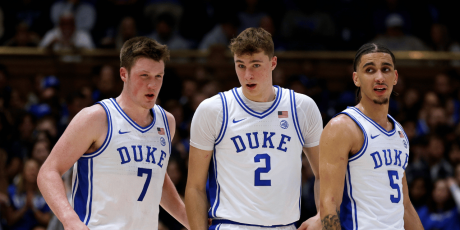
Since more than half of the last 17 champions were ranked No. 1 at KenPom heading into the tournament, I would normally take Duke to win it all, but given they are unlikely to have their point guard, Caleb Foster, for the first four games, at least, and he may not even be able to return in the Final Four if the Blue Devils even make it that far. Duke still won the ACC tournament, but barely beat Florida St. and beat a good Virginia team by four points in the tourney final. I think they will make the Final Four, but they aren't the overall favorite.
I'm going with Arizona (over Duke) to win it all, as they are healthy, and have the No. 5 offense and the No. 3 defense.
Final Four
In the South Region, Illinois has a Top 6 offense and satisfies the 21/37 Rule, but they have lost their last five games against tournament teams. Florida is a rock-solid pick, but they don't have a Top 6 offense, and the final two games in this region will be in Houston, so I'm going to go with the Cougars to advance to the Final Four since they satisfy the 21/37 Rule and have home court advantage.
In the Midwest Region, the only team with a Top 6 offense is Alabama, but they don't satisfy the 21/37 Rule. Michigan (8/1) and Iowa State (21/4) do, and Michigan is better than Iowa State both offensively and defensively. However, per Bracketfacts, only 10 of the last 68 Final Four teams have had a negative turnover margin, and Michigan does, so I'm advancing Iowa State to round out the Final Four. They are also playing excellent basketball in March. All four teams are in the top right quadrant of this chart.
Elite Eight
Duke, Arizona, Purdue, Michigan, Iowa State, Florida, and Illinois are all penciled into the Elite Eight since they fit the profile of a Final Four team via the 21/37 Rule. Picking the final Elite Eight team in the East Region is tricky since there are three pretty good candidates: 6-seed Louisville satisfies the 21/37 Rule (19/25), while 3-seed Michigan St. (24/13) is ranked 10 spots higher at KenPom. Then there's 2-seed UConn (30/11), who just lost by 20 to St. John's, and lost to two non-tourney teams (Marquette and Creighton) in their last eight games.
If we go strictly by the 21/37 Rule, then Louisville is the choice, though according to Bracket Breakers, their first round opponent--11-seed South Florida--has a 28% chance to spring the upset, so picking Louisville makes me nervous. I'm going with Michigan St. since they are the highest-ranked team of the three, seem to be playing the best basketball right now, and nearly satisfy the 21/37 Rule. All three teams satisfy the Top Right Rule, for what it's worth.
Sweet Sixteen
Duke, Michigan St., UConn, Arizona, Purdue, Michigan, Iowa State, Florida, Illinois, and Houston are penciled into the Sweet Sixteen at this point. Vanderbilt satisfies both the 21/37 Rule and the Top-Right, so that makes 11. (McNeese over Vanderbilt is the most likely first-round upset, per Bracket Breakers, by the way.)
Texas Tech satisfies the 21/37 Rule, so that's 12, though they could easily lose to Alabama and the Tide's Top 6 offense. Virginia (No. 13 overall, Top-Right), Gonzaga (No. 10 overall, Top-Right), and Arkansas (Top-6 offense, No. 15 overall, borderline Top-Right) have some appealing qualities, so let's advance them as well. Finally, I'm going with St. John's over Kansas in the East Region since they are higher overall than Kansas (No. 17 vs. No. 21) and satisfy the Top Right Rule.
Round of 32
Here we'll use Bracket Breakers, game lines, and our usual metrics to try to gain an edge on the field.
The team in bold is ranked higher in three of the four sites. If a team is bold and underlined, it means they are ranked higher at all four sites. If there is no formatting, then the teams are each favored at two of the four sites.
#8 Ohio State (-2.5) vs. #9 TCU
#7 UCLA (-5.5) vs. #10 UCF
#8 Clemson (-2) vs. #9 Iowa
#4 Nebraska (-12.5) vs. #13 Troy*
#6 North Carolina (-2.5) vs. #11 VCU***
#7 Saint Mary's (-3) vs. #10 Texas A&M
#8 Villanova vs. #9 Utah State (-2)
#5 Wisconsin (-9.5) vs. #12 High Point**
#6 BYU vs. #11 Texas**
#7 Miami FL (-2) vs. #10 Missouri
#8 Georgia (-2.5) vs. #9 Saint Louis
#6 Tennessee vs. #11 Miami OH
#7 Kentucky (-3.5) vs. #10 Santa Clara
*** greater than 40% chance of upset, per Bracket Breakers
** 30%-40% chance of upset, per Bracket Breakers
* less than 30% chance of upset, per Bracket Breakers, but still on the Top 10 upset list
Note: UCF, High Point, McNeese, Santa Clara, Texas, Utah State, BYU, Iowa, Miami FL, Saint Mary's, and SMU are all in the Top Right of this chart.
TL;DR
Second Round: Duke, Ohio State, St. John's, Kansas, Louisville, Michigan St., UCLA, UConn, Florida, Iowa, Vanderbilt, Nebraska, VCU, Illinois, Saint Mary's, Houston, Arizona, Utah State, Wisconsin, Arkansas, Texas, Gonzaga, Miami FL, Purdue, Michigan, Georgia, Texas Tech, Alabama, Tennessee, Virginia, Santa Clara, Iowa State
Sweet Sixteen: Duke, St. John's, Michigan St., UConn, Florida, Vanderbilt, Illinois, Houston, Arizona, Arkansas, Gonzaga, Purdue, Michigan, Texas Tech, Virginia, Iowa State
Elite Eight: Duke, Michigan St, Florida, Houston, Arizona, Purdue, Michigan, Iowa State
Final Four: Duke, Houston, Arizona, Iowa State
National Championship: Arizona over Duke